
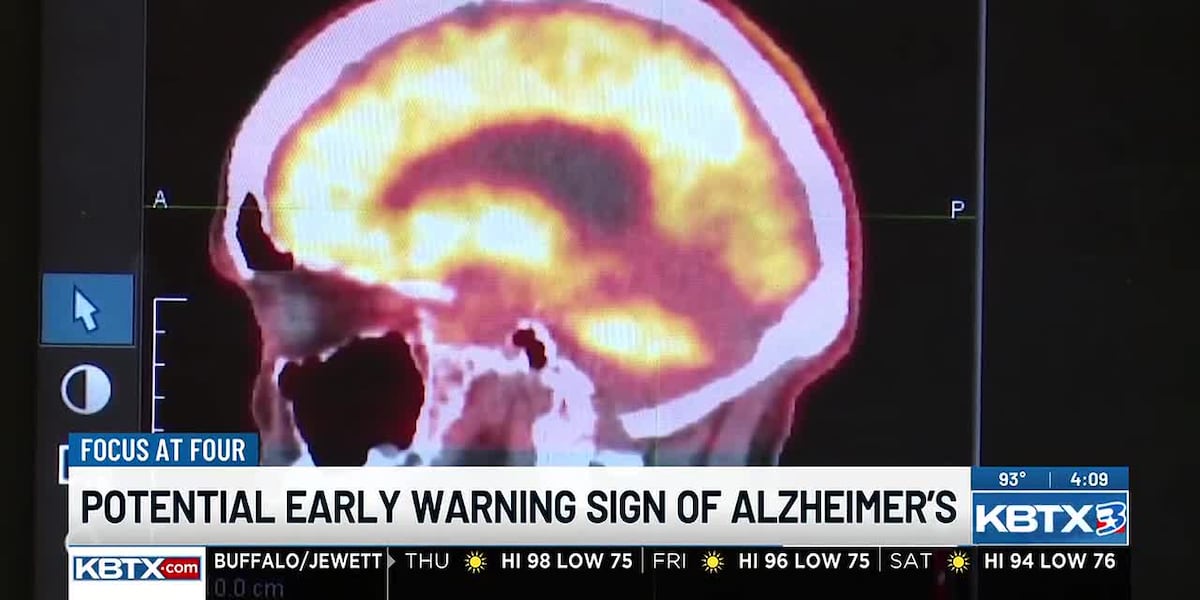
BRYAN, Texas (KBTX) – New research from Texas A&M Health suggests the brain may signal Alzheimer’s disease years before memory loss begins—and the warning sign has nothing to do with forgetting.
Researchers say trouble adapting to change, called cognitive inflexibility, could be an earlier red flag than the memory slips most people recognize. Cognitive flexibility is the brain’s ability to adjust behavior when circumstances change. When a person becomes unusually rigid or resistant to change, it could indicate something is happening in the brain long before a formal diagnosis.
The research focuses on cholinergic neurons — brain cells already central to Alzheimer’s research and targeted by FDA-approved drugs. Dr. Jun Wang’s team at Texas A&M Health found that changes to these neurons may also affect cognitive flexibility, potentially making cognitive inflexibility one of the earliest detectable signs of the disease.
“Once a patient experiences the later stage, it will be very challenging to prevent or treat,” Dr. Wang said. Early detection opens a window for intervention while treatment options are still available.
If a loved one shows unusual rigidity or struggles to adapt to new situations, Dr. Wang recommends seeing a doctor. “They may be able to run at least a behavior test — it should be easy and does not cost much,” he said. From there, doctors can order more advanced screenings for Alzheimers related biomarkers if needed.
The sooner a diagnosis is made, the more options patients and families have. For more information on Texas A&M’s research on this topic, you can click here.
Copyright 2026 KBTX. All rights reserved.