
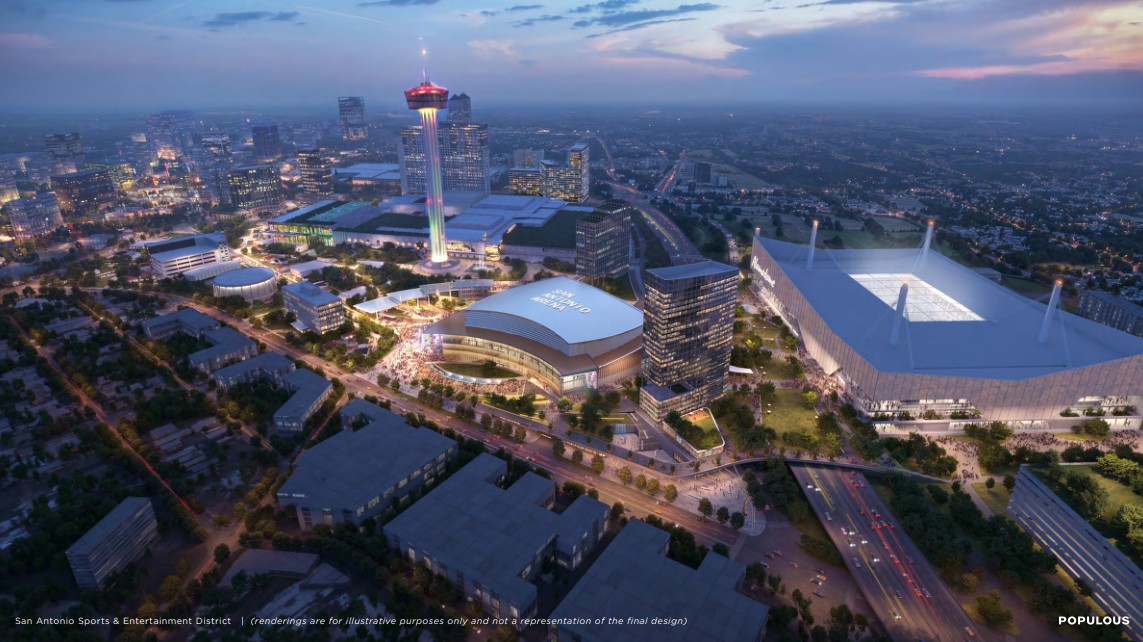
A rendering shows what a sports and entertainment district downtown could look like. As the city and county move forward with the district, they should establish an oversight committee to improve public confidence.
City of San Antonio and Populous
The Museum Reach redefined San Antonio’s urban core. Oversight of this project could serve as a template for San Antonio’s burgeoning downtown sports and entertainment district.
BILLY CALZADA/SAN ANTONIO EXPRESS-NEWS
San Antonio is about to undertake the largest public-private redevelopment effort in its modern history.

The proposed downtown arena for the Spurs may be the catalyst, but the larger story is the redevelopment district around it: billions of dollars in housing, offices, hotels, retail, parks and infrastructure that will reshape downtown for generations.
Article continues below this ad
The decisions involve housing affordability, transportation, parks and open space, environmental sustainability, workforce opportunities, historic preservation, neighborhood stability, and billions of dollars of future public and private investment.
Those decisions should not rest solely with elected officials, consultants, developers or the Spurs. It requires a stakeholder committee for oversight.
San Antonio already has a proven model for doing this right.
When the San Antonio River Improvements Project launched in 1998, the city of San Antonio, Bexar County and the San Antonio River Authority created the San Antonio River Oversight Committee.
Article continues below this ad
This 22-member stakeholder body guided planning and design, prioritized funding and oversaw phased implementation for more than 15 years and through many changes in elected officials.
Respected civic leaders, former Mayor Lila Cockrell, and architect and urban designer Irby Hightower chaired the committee. As the River Authority’s initial staff coordinator for the SAROC, and later as general manager, I observed the committee’s effectiveness.
The resulting Mission and Museum Reach projects were transformative and achieved unrivaled public support. The Museum Reach sparked billions in private investment, including the Pearl development, and the Mission Reach helped secure World Heritage designation for the San Antonio Missions National Historical Park while catalyzing renewed investment on the South Side.
The oversight committee worked because governmental partners agreed on member organizations and stakeholder groups, and those groups appointed their own representatives.
Article continues below this ad
Neighborhood associations, business organizations, environmental groups, cultural institutions and others served through posted monthly meetings and subcommittees, working toward consensus and demanding high-quality projects.
Members heard from project managers and design teams, advised and challenged the river authority, city, county and the U.S. Army Corps of Engineers. The result was better because of their input.
San Antonio is using a similar model for the Westside Creeks restoration, including the recently completed San Pedro Creek Project.
The River Improvements Project transformed San Antonio not simply because it produced beautiful parks and trails, but because it created a governance structure that earned public confidence.
Article continues below this ad
The development of the new sports and entertainment district downtown deserves nothing less.
The city and county should establish a similar oversight committee to guide the planning and implementation of the sports and entertainment district. Membership should include representatives from neighborhood associations, environmental organizations, labor, businesses, historic preservation groups, cultural institutions, transportation interests and educational institutions, and housing advocates, sports fans and other affected stakeholders.
The committee should have real responsibilities.
It should engage in the site master planning and development of design guidelines that promote public use opportunities, evaluate major public investments, receive regular financial and performance reports, issue public recommendations, monitor compliance with community benefit commitments and provide an independent forum for resolving concerns.
Article continues below this ad
Like the San Antonio River committee, it should remain in place throughout the development of the district’s improvements, allowing expertise and institutional memory to grow.
Recent discussions have focused on public engagement to determine how to use the Spurs’ approximately $2.5 million per year community benefits payment. Why not have a stakeholder committee to guide the entire project?
Today, cities around the world study the San Antonio River as a model for urban redevelopment. We should, too. As San Antonio begins its next great civic project, we should remember one of the greatest lessons from our last one.
Article continues below this ad
Suzanne Scott is former general manager of San Antonio River Authority.
Have a response? Send us a letter to the editor.