
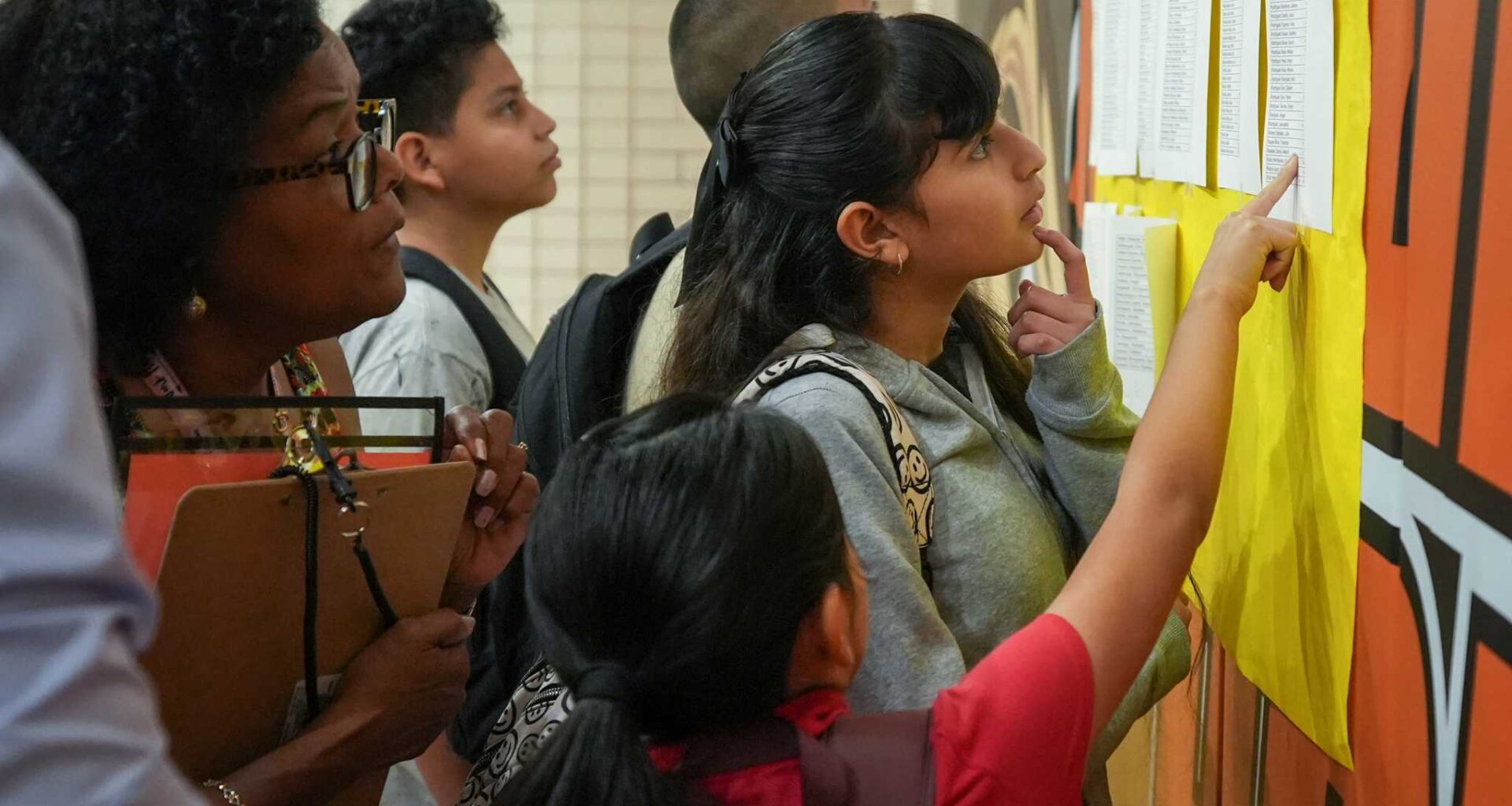
Dobie Middle School students look for their schedules on the first day of classes last year. With Dobie, Burnet and Webb middle schools on the brink of a fifth consecutive failing rating, why hasn’t the state accountability system produced meaningful change?
Jay Janner/Austin American-Statesman
For more than 25 years, Texas leaders have built one of the nation’s most aggressive school accountability systems, relying on tests, A-F ratings and state interventions to drive improvement. Yet student outcomes remain uneven, teacher shortages have worsened, special education failures persist, and the evidence increasingly suggests the system is better at measuring problems than solving them.

Recent STAAR scores underscore the challenge. Nearly half of Texas students still fail to meet grade-level expectations in core subjects while ever-shifting accountability ratings, years of litigation and STAAR scoring errors have undermined public confidence in the state’s approach.
Article continues below this ad
The state’s priorities suggest accountability may be more political theater than an improvement strategy. While state leaders have spent enormous time and energy enacting private school vouchers, culture-war issues and Bible-infused curricula, they have failed to adequately address persistent teacher shortages, a growing number of uncertified teachers and an outdated school finance system.
The state’s record on special education is equally troubling. For years, the Texas Education Agency operated an unofficial cap that illegally restricted access to special education, demonstrating that compliance with state accountability requirements does not necessarily translate into meaningful student experiences and outcomes.
RELATED: Texas is entering a public school bust of its own making
The Austin Independent School District offers a powerful example of the limits of Texas’ accountability system. Stark differences in campus performance remain divided along geographic lines, with many schools east of Interstate 35 continuing to struggle while campuses west of the highway thrive. The persistence of this pattern through multiple superintendents and accountability cycles raises questions about whether improvement efforts have produced meaningful change.
Article continues below this ad
Burnet, Dobie and Webb middle schools are now on the brink of a fifth consecutive failing rating, putting the district at risk of state intervention, which likely could have been avoided if improving these schools had been a true districtwide priority years ago. Similarly, Austin ISD delayed major rezoning and consolidation decisions for years, revisiting the same challenges as enrollment declined and financial pressures grew.
To make matters worse, several campuses slated to close had recently received bond-funded upgrades. Even after the announced closures, Austin ISD postponed most boundary revisions while signaling that additional schools may still close.
Austin ISD’s record in special education tells a similar story, with years of compliance failures, delayed evaluations, staffing shortages, leadership turnover and eroded parent trust before some corrective action occurred.
Some of those challenges stem from state policy failures like enrollment declines from rapid charter growth, teacher shortages and a broken school finance system. Others reflect local decisions. Together, they raise a troubling question: what value does a state accountability system provide if serious problems can persist in a district for years without meaningful correction?
Article continues below this ad
ALSO READ: Texas loves being No. 1. For kids, it ranks near the bottom
Effective accountability systems identify problems early and prompt action before they become crises. Instead, state leaders have become far better at labeling failure than addressing its causes. In the absence of effective state accountability, Austin ISD has repeatedly delayed difficult decisions and allowed too many schools to languish.
As a former public school teacher and administrator who has spent years studying how policy and leadership shape student experiences and outcomes, I take no pleasure in criticizing a district operating within a state policy environment that has repeatedly fallen short of its responsibilities. Yet overlooking Austin ISD’s shortcomings would be no more defensible than overlooking the state’s many failures in supporting public education.
State budget surpluses could strengthen the teacher workforce, modernize school finance, improve special education, and support high-quality public schools for every district. The state could also redesign accountability systems to proactively support struggling districts like Austin ISD rather than waiting years for problems to worsen before taking over.
Article continues below this ad
Accountability has clearly failed too many Austin ISD students and others across Texas. When large numbers of students remain below grade level despite decades of testing, ratings, sanctions and state oversight, serious questions must be asked about a system that scrutinizes schools, educators and students far more than the state leaders responsible for shaping education policy.
Without a different approach to leadership and accountability, Texas will continue measuring, publicizing and punishing failure while doing too little to prevent it.
David DeMatthews is a professor of education in the Department of Educational Leadership and Policy at the University of Texas. He is expressing his views as a private citizen.