
The case is a snapshot into an ongoing debate in Austin about when violent offenders should be sent to prison instead of being sent to rehabilitation programs.
TRAVIS COUNTY, Texas — Travis County Sheriff’s Office Sgt. Laura Mabry has spent most of her career balancing motherhood of 15- and 11-year-old sons with daytime patrols in West Austin. On May 9, 2025, two days from Mother’s Day, she was thinking about the upcoming family holiday.
“What I thought was just a normal Friday at nine o’clock in Steiner Ranch wasn’t,” she said.

This story continues below.
She pulled into the parking lot of a Randall’s on RM 620 and spotted a stolen GMC Denali.
She approached the truck – a teen and another man standing by it – when the teen jumped into the driver’s seat.
“I give him commands. ‘Don’t do it. Come over here and talk to me,’” Mabry recalled.
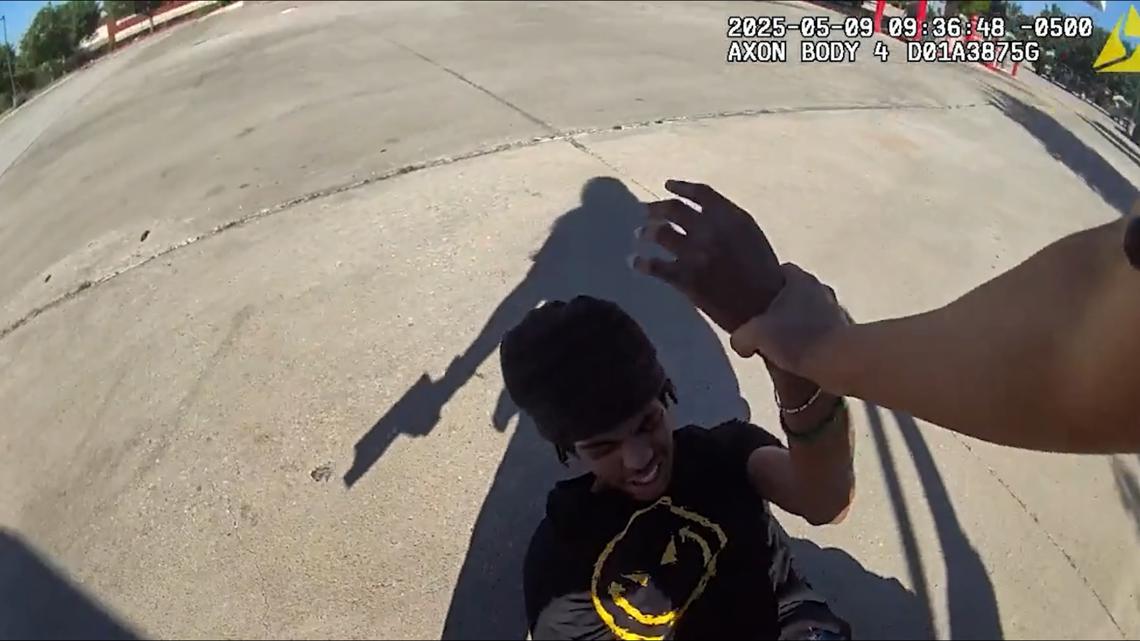
Mabry leapt onto the running board of the truck and the two get into a struggle as he presses the gas – all seen on her body camera footage.
“OK, dude, stop!” she yelled.
The encounter lasts several seconds before the truck crashes.
Court documents say – and video shows – the driver, Graham Freeman, who was 17 at the time, then grabbed a Glock 19 handgun wedged between the driver’s seat and center console, and the gun fired, the bullet hitting him in the leg but sparing Mabry.
“He wanted to get away, and it didn’t matter that my life was going to be collateral damage to that. And that was very obvious to me,” Mabry said.
Authorities charged Freeman with four felonies, including aggravated assault on a public servant – crimes for which he faced up to life behind bars.
Freeman remained in jail for 49 days before he was released on bond.
Less than two weeks later, authorities say he carried out another violent crime that led to an aggravated robbery charge when a man traveled to Pflugerville to see a woman he met online – and Freeman robbed him at gunpoint when he arrived.
“Obviously, I didn’t know he had gotten out of jail, much less gotten out of jail and had already committed another crime. And also, I was just worried for whoever that victim was,” she said.
This case is a snapshot into an ongoing debate in Austin into a larger criminal justice question: When should violent offenders be sent to prison – or when should prosecutors place them in rehabilitation programs that more quickly get them back into the community?
Garza: Not light on crime
Mabry said she heard nothing about her own case for months – until a prosecutor informed her in February that the Travis County District Attorney’s Office was looking to resolve it.
She said she argued for at least a prison sentence of a year, but prosecutors said they were considering probation.
“My fear, and I told this to the ADA [Assistant District Attorney], was my concern about there being an unnecessary victim if he is allowed to just go back out into the public,” she said.
Mabry said she didn’t hear back again until a victim counselor informed her last month that the deal would be finalized the following week and that Freeman would receive five years probation – a sentence that did include a 90-day in-custody treatment program in a state prison.
“I just felt based on his actions after being released on bond, and then committing another crime, were indicative that consequences didn’t affect him,” she said.
Travis County District Attorney José Garza said he believes that the sentence was appropriate – and rejected the idea that the outcome demonstrates a light-on-crime approach by his office. He said that Freeman spent about 16 months behind bars awaiting the outcome of his case, will be a convicted felon, and will be closely supervised during his probation.
“I feel like it was an appropriate outcome for the safety of our community,” he said.
Travis County Sheriff Sally Hernandez would not specifically say whether she thinks the outcome in these cases was appropriate, but said in a statement that her department does its best to protect victims of all crimes and help them attain justice.
Freeman’s attorney said he also believes the sentence was appropriate given his client’s age – he is about to turn 19 – and probation conditions.
However, Garza said he was disappointed that Mabry did not appear to have been fully informed of how prosecutors planned to resolve the case.
“Any time we have a victim who is not happy with an outcome, the first thing we examine is what was our communication with that victim. And in this instance, it is pretty clear to me that we had room for improvement,” he said.
Mabry is now back on the street, thankful that she wasn’t seriously injured or killed that day 13 months ago. This is what she told Freeman on the day he was sentenced.
“I survived,” she said. “That does not diminish the seriousness of what happened. My life mattered then, and it matters now.”