
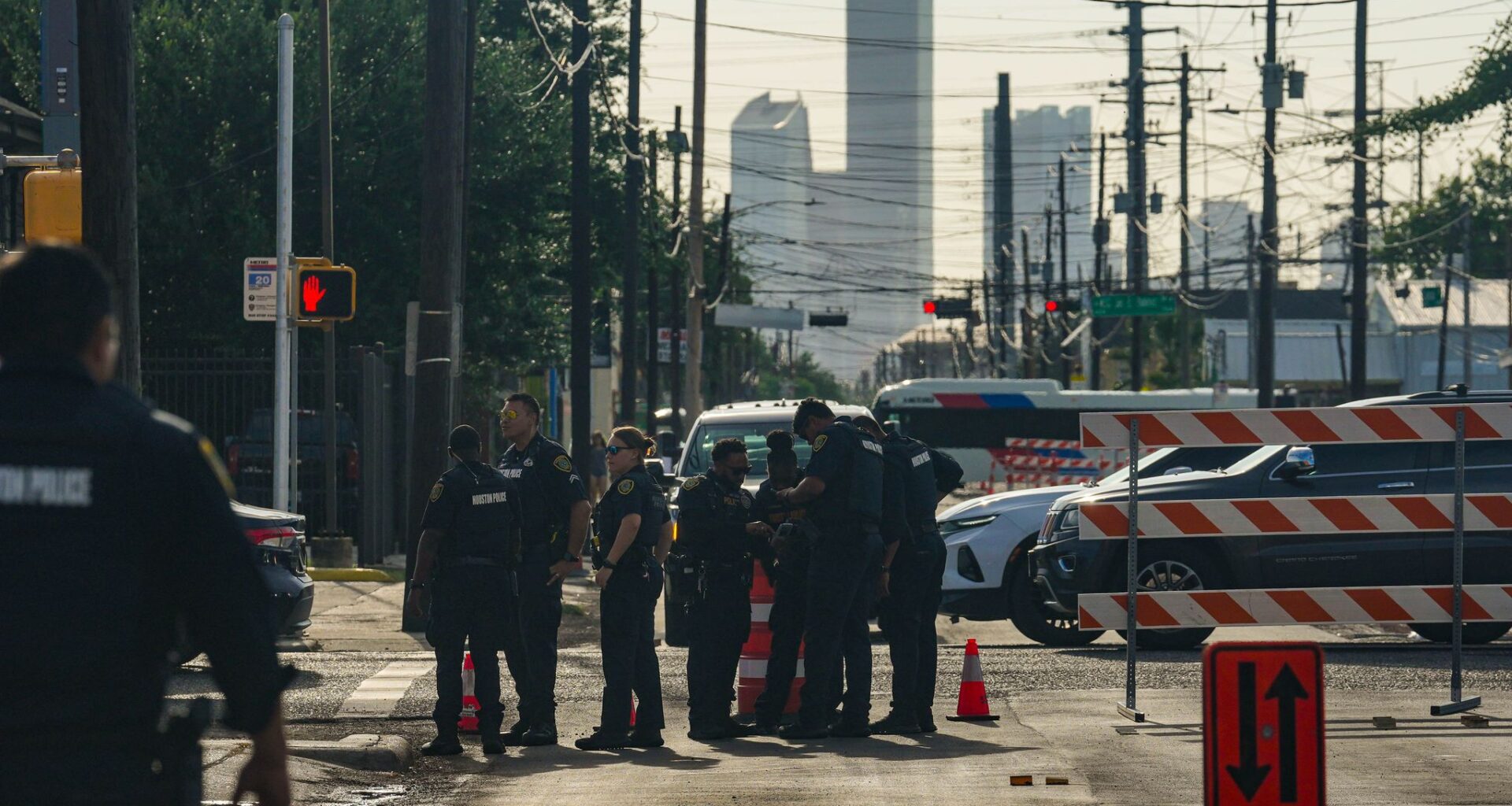
Police close a section of Canal Street on Wednesday as demonstrators gather for a protest, march and candlelight vigil in honor of Lorenzo Salgado Araujo, who was shot and killed by Immigration and Customs Enforcement agents in Houston on July 7.
Raquel Natalicchio/Houston Chronicle
In the days since a U.S. Immigration and Customs Enforcement agent shot and killed Lorenzo Salgado Araujo in east Houston, community leaders, residents and officials from nearly every corner of the city have called for an independent investigation into the shooting.
They pointed out that ICE narratives in three separate Minnesota shootings in January were refuted by video footage. The ICE description of this case — that Salgado evaded arrest and tried to weaponize his car against the agents — mirrors the initial descriptions of the killing of Renée Good, but no video evidence has emerged to support or refute the agency’s claims.
Local elected officials have joined calls for a thorough review but have been reluctant to publicly order investigations themselves. Mayor John Whitmire backed a “thorough, transparent and credible investigation … that should be coordinated with our local and federal partners.”
Article continues below this ad
Harris County District Attorney Sean Teare said Araujo’s family deserves the truth, but “federal authorities continue exclusively handling all aspects in this case.”
CALLS FOR PROBE: LULAC demands Houston police investigation into ICE shooting death
The result is that Houston police are not investigating Araujo’s death at this time. Teare has instructed his office to quietly return to the scene of the shooting and collect evidence for its own probe. He told Salgado’s son in a closed-door meeting Tuesday a local investigation would be difficult but impartial.
The calls for action and murky responses from local officials raised the question: Do local governments have the authority to investigate a federal official on their own? And if they do, what happens?
Article continues below this ad
Legal experts, former police chiefs and former prosecutors all agree that Houston police and the Harris County District Attorney’s Office unquestionably have the authority to conduct their own investigation into Salgado’s death. In past fatal shootings caused by federal officials, like one involving an FBI agent in 2018, Houston police conducted a parallel investigation and Harris County prosecutors made their own charging decisions.
These experts also said that it is exceedingly difficult to gather any productive information if federal authorities do not cooperate. That’s because local officials have no ability to compel federal officials to appear in court, and they have no right to force them to hand over evidence collected at the scene.
“The state court doesn’t have the power to drag those people in the court — make them do anything — because they’re acting in their capacity as the federal government,” said Jules Johnson, a former Harris County civil rights prosecutor who worked on the case involving the FBI official. “You can issue a subpoena, and they never even have to respond to it — they just ball it up and throw it away.”
FAMILY ACCOUNT: Stepdaughter of man arrested by ICE alleges racial profiling before fatal Houston shooting
Officials in Minnesota, where high-profile ICE killings earlier this year led to nationwide protests, are encountering that obstacle right now. The state of Minnesota and Hennepin County are conducting their own investigations into the shootings of Good, Alex Pretti and Julio Sosa-Celis, but federal authorities for months have refused to turn over evidence. The state and Hennepin County Attorney Mary Moriarty have filed a lawsuit to force them to comply, and that suit is still being heard in court.
Article continues below this ad
Still, the uphill battles have not dissuaded Houston police investigations in the past. Former Chief Charles McLelland, who led the department from 2010 to 2016 and spent his entire career with the Houston Police Department, said it was standard protocol during his time for local officials to conduct their own investigations.
“This shooting and death occurred in Houston proper, in Harris County,” said McLelland. “Whenever the medical examiner classifies this shooting, it’s going on HPD’s books. It has to be accounted for in the crime stats. How are you not going to have anything to do with the investigation?”
MAGNOLIA PARK PROTEST: Hundreds of protesters turn out to denounce ICE at scene of deadly Houston shooting
At least one other retired police chief agreed with McLelland’s stance, saying it was important for local authorities to look into every shooting death that occurs in their boundaries.
“When you’re the chief of a city, Houston in this example, your bosses are the residents of Houston,” said Jorge Colina, a retired Miami police chief who now consults for law enforcement agencies nationwide. “You can say, ‘OK, we want to embed an investigator, because the people of Houston have a right to know what happened.’”
Article continues below this ad
City Council Member Joaquin Martinez, whose district includes the neighborhood where the shooting happened, called for HPD to join the DA’s investigation, saying “we have an obligation to exhaust every available local recourse.”
U.S. Rep. Al Green, a Houston Democrat, told reporters yesterday there is no law preventing a local probe, and he hopes investigators pursue one.
“The Houston Police Department ought to see this as its responsibility, its obligation to get involved in this,” Green said. “This is no time for us to decide that we’re just going to wait and see what happens.”
Hundreds of demonstrators gather in Houston’s Magnolia Park neighborhood for a protest, march and candlelight vigil following the shooting of Lorenzo Salgado Araujo by a federal agent during a federal immigration enforcement operation in Houston, Wednesday, July 8, 2026.
Raquel Natalicchio/Houston Chronicle
A fissure under the Trump administration
Bryna Godar, a staff attorney with the State Democracy Research Initiative at the University of Wisconsin Law School, said federal and state officials have historically collaborated on these investigations. But the Trump administration’s immigration crackdown this year has led to a fissure.
Article continues below this ad
“In recent months, what we’ve seen is that process has broken down across three shootings in Minnesota,” Godar said. “DHS and the DOJ have refused to share even basic information with state investigators and prosecutors, and the state has sued to obtain that information, and that litigation is now pending. So we’re seeing far less collaboration between the federal government and state investigators, and we’re also seeing a change in how federal officials are conducting their own investigations.”
But there is no question federal officials can be charged with local crimes. Godar mentioned the infamous Ruby Ridge standoff in Idaho in the 1990s, when an FBI sniper accidentally shot and killed Vicki Weaver, the wife of anti-government separatist Randall Weaver. Federal prosecutors declined to bring charges, and local Idaho prosecutors charged him with involuntary manslaughter.
The case lingered for years until a federal court concluded it could continue in state court because it was unclear whether the shooter “acted in an objectively reasonable manner in carrying out his duties.” Soon after, a newly elected local prosecutor dropped the case.
ELECTED RESPONSE: How Houston and Texas officials are responding to fatal ICE shooting of Lorenzo Salgado Araujo
In Houston, an FBI agent shot and killed Ulises Valladares at a home in 2018. Valladares had been kidnapped from his Conroe home and taken to Trinity Gardens by a pair of armed men who posed as cartel members.
The duo demanded money from Valladares, saying his brother owed them.
When federal agents came to the rescue, one of them fatally shot Valladares, thinking he was a kidnapper, according to authorities.
The agent responsible for killing him was not charged following an 11-month investigation by the U.S. Attorney’s Office for the Western District of Texas. Following that investigation, the Harris County District Attorney’s Office brought the case before its own grand jury. It did not result in any charges.
Johnson, the former Harris County prosecutor, said he had no way of knowing if federal authorities were handing over all their evidence in that case.
“(The public’s) expecting us to say this was a complete investigation, but I can’t say that — because I don’t know if it was a complete investigation,” he said.
Hundreds of demonstrators gather in Houston’s Magnolia Park neighborhood for a protest, march and candlelight vigil following the shooting of Lorenzo Salgado Araujo by a federal agent during a federal immigration enforcement operation in Houston, Wednesday, July 8, 2026.
Raquel Natalicchio/Houston Chronicle
The ICE factor
Ken Magidson, a former U.S. Attorney for the Southern District of Texas and Harris County district attorney, said ICE is playing a very different role now than it has in the past.
During his four-decade-long prosecutorial career, Magidson said ICE focused on immigrants who had lengthy criminal records and posed a threat to the community. As the agency increasingly focuses on longtime residents without a criminal past, federal agents are collaborating with local law enforcement less and encountering more people who are not expecting to be targeted.
He estimated that in 90% of the use-of-force cases during his career, federal and local authorities collaborated on the investigation. When they don’t, he said, the feds have the upper hand.
“The question is, can you prove it in court beyond a reasonable doubt? And that’s where the rubber meets the road,” Magidson said.
City Council Member Julian Ramirez, a former prosecutor, described the challenges at City Hall on Wednesday.
“Federal agencies will control the scene. They’ll control the evidence. They’ll take witness statements. They’ll collect the evidence and will share what they want to share with local authorities,” Ramirez said. “And so, it becomes quite difficult for local authorities to conduct a decent investigation. This has been the case over several decades. It didn’t just start yesterday.”
Whitmire later said Ramirez articulated why “there cannot be two ongoing investigations.”
U.S. Rep. Sylvia Garcia, whose congressional district includes the neighborhood where the shooting occurred, said she would push for a different kind of federal probe, possibly through the U.S. Commission on Civil Rights. Appearing on Houston Public Media’s “Hello Houston” program, she said it needs to be truly independent.
“You cannot allow just (the feds) to check themselves,” Garcia said. “Because if you ask yourself what happened with the Good investigation, I can sit here today and tell you there’s never been a release of anything. We still don’t know if there was a serious investigation.”