
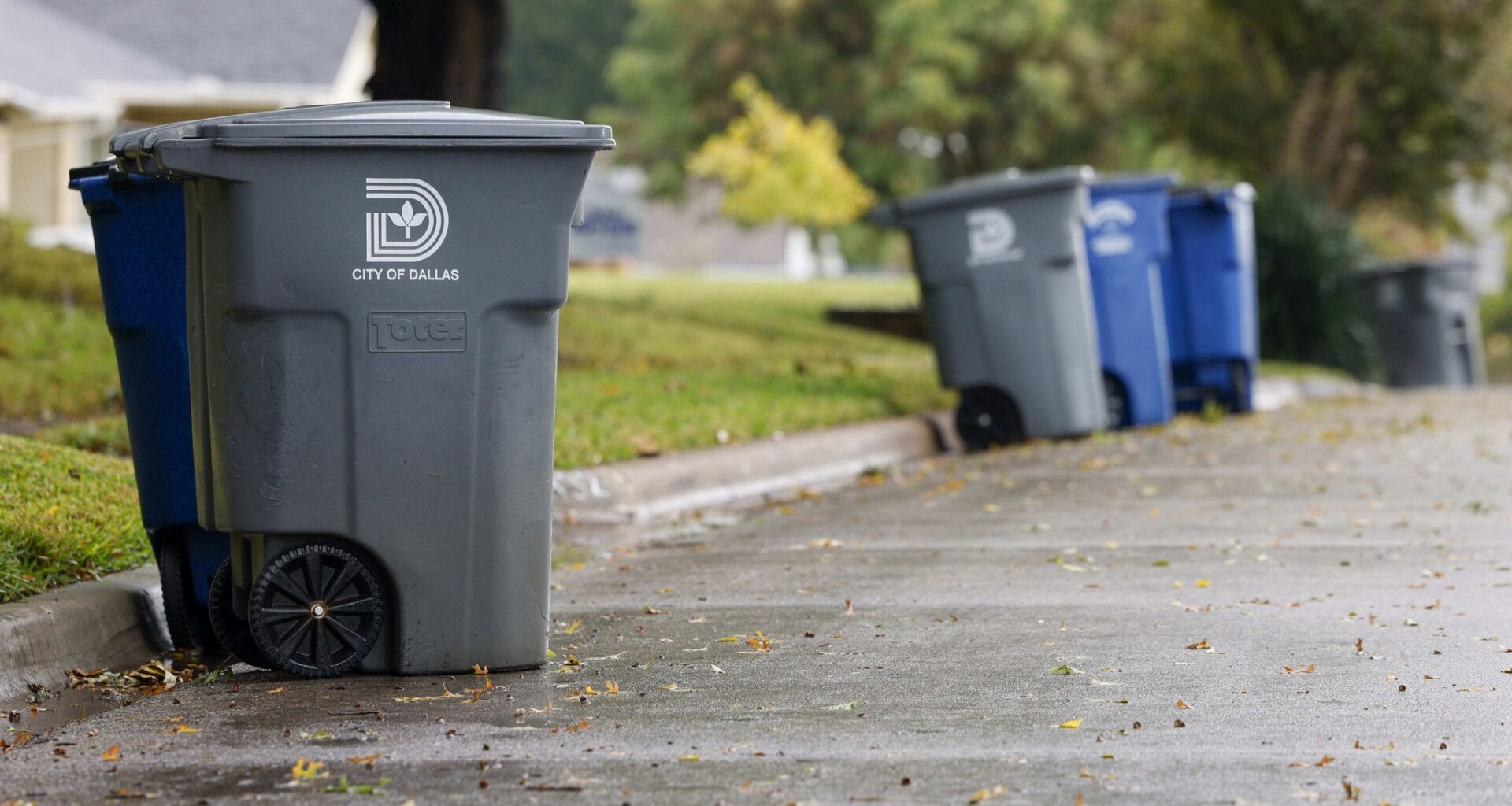
The city’s sanitation department launched a website and map, and residents can check whether their pickup location will change. Affected homes are scattered across Dallas, with the map showing clusters in northern and northeastern parts of the city.
The plan affects about 200 alley blocks, or 2% of Dallas’ roughly 260,000 sanitation customers. Most homes that now receive alley collection will keep it.
The city said the affected alleys are too narrow, damaged, unpaved or blocked for trucks to use safely. Dead ends can also force drivers to reverse for long distances, raising the risk of injuries, damage, delays and missed pickups.
Affected residents will be notified by mail. Their pickup day will stay the same, but they must move their garbage and recycling carts to the curb starting Feb. 1, 2027.
Rates may change for alley pickup. City officials say alley service is more expensive. City Manager Kimberly Bizor Tolbert is expected to propose updated rates during budget discussions in August.
Paying an alley rate wouldn’t guarantee permanent alley service. The city says pickup locations depend on whether trucks and crews can reach them safely and reliably.
Under city rules, the sanitation director has the authority to determine whether an alley can be served, so the transition doesn’t require separate City Council approval.
Libby Collet, a Preston Hollow resident and member of the Keep Alley Trash Neighborhood Coalition, said the group appreciates city leaders for scaling back the alley-to-curb trash transition plan after hearing residents’ concerns.
She said the coalition hopes the city will work with impacted homeowners to keep alley collection for those who want it where possible.
“We also hope that as future decisions are made regarding sanitation rates, the city recognizes that alley collection isn’t a premium feature, but a key aspect of the design of many Dallas neighborhoods,” said Collet, who started an online petition last year against the city’s alley phaseout plans that received more than 13,000 signatures. “Any pricing model should not inadvertently become punitive for residents whose homes rely on alley access.”
Dallas first considered ending all alley collection in 2024 but backed away after public opposition. Last year, as many as 26,000 households faced moving to curbside service before Tolbert directed staff in October to consider other options.
In May, sanitation officials said they had narrowed the review to about 7,500 customer locations. The current plan affects about 1,500 fewer homes.
Customers with disabilities who have no one at home to help can apply for free assistance moving carts to the curb and back.