
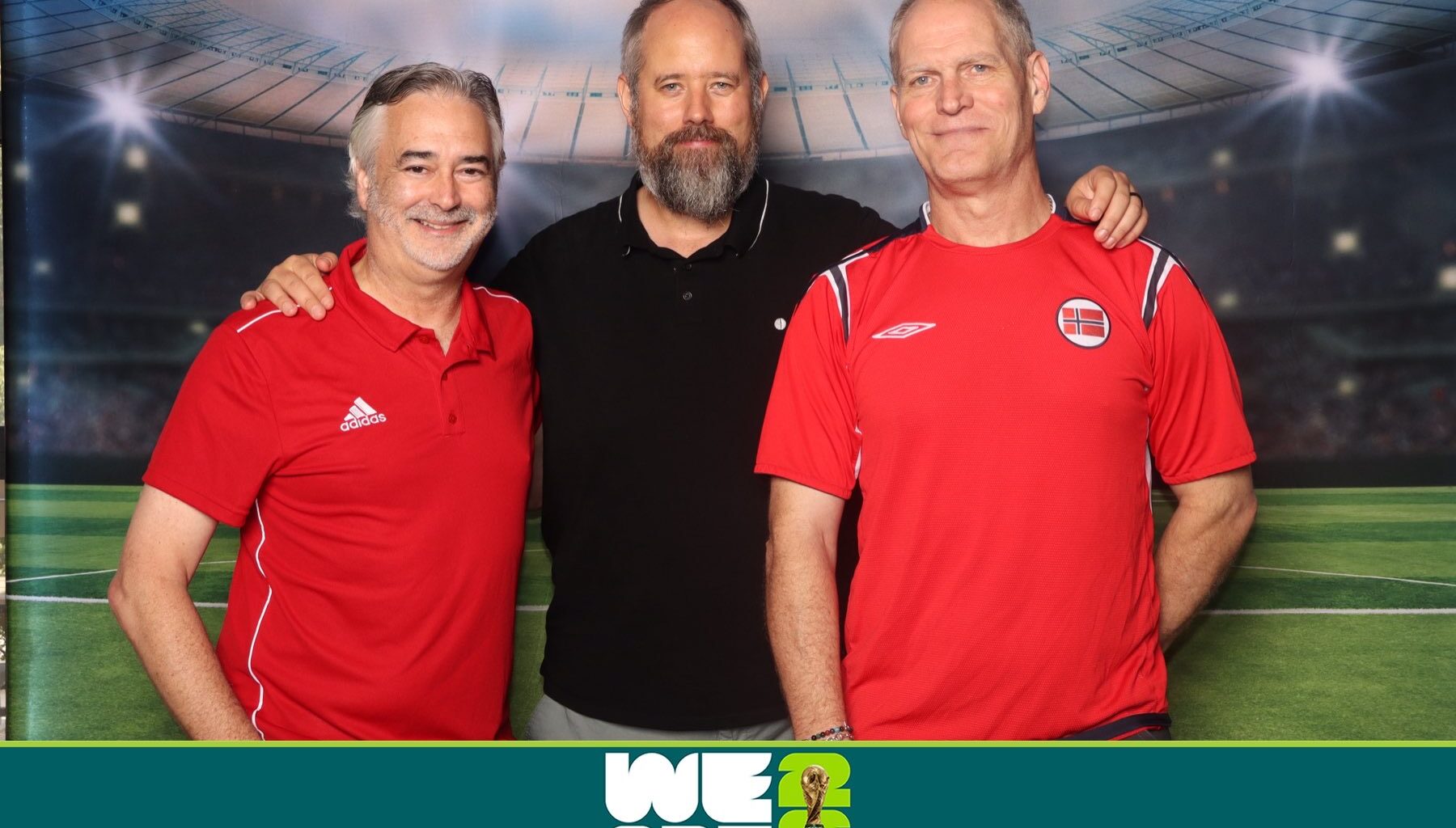
The Kickaround’s Andy Swift (left), Lars Sivertsen (center) and Peter Welpton have been running The Ticket’s World Cup coverage all summer.
The Kickaround
The Ticket’s Peter Welpton has had a busy summer.

He’s been co-hosting an hourlong nightly show on the sports talk station, mixing in time with the local news on Fox 4 and also writing on a semi-daily basis about a subject he knows and loves: World Cup soccer.
Welpton and co-host Andy Swift run The Ticket’s soccer show, “The Kickaround,” with longtime Norwegian contributor Lars Sivertsen, who traveled across the Atlantic to pitch in with Peter and Andy for the tournament.
Article continues below this ad
The show, which began in 2014, typically airs Saturdays. In honor of the World Cup coming to town, they added nightly Monday-Friday shows as well as the occasional Sunday, too. That’s upwards of 44 hours of World Cup talk for the station’s beloved “P1s.”
For Welpton, it’s the culmination of four years of buildup. With the World Cup nearing its pinnacle as teams square off in the quarterfinals, Welpton visited with The Dallas Morning News to discuss, among other things, his busy month-plus, the unceremonious ousting of the United States, the future of soccer in the U.S. and how Dallas and all of North Texas has handled the grand event that is the World Cup.
You’ve been on “The Kickaround” for over 10 years. How did you get your start at The Ticket, and how did the show come about?
“I was actually an employee at The Dallas Morning News. I was a director of digital at the time, and the project owner/project manager of the original version of the SportsDay Talk app. … When that was going on I was working hand-in-hand with Jeff Catlin, the operations manager for Cumulus in Dallas and the program director of the station. Before I started at the paper, I was in the radio business for 20-something years. I’ve been doing it part-time ever since, so I know how it works.
Article continues below this ad
“One day, when we were talking about the app, I jokingly said to Jeff, ‘Will you ever let me come on The Ticket and talk soccer?’ And he said, ‘Why in the world would I ever spend any airtime talking about soccer?’ And I said, ‘Because the World Cup’s about to come, and you can make money on it.’ And he said, ‘Oh, put a pitch together and we’ll look at it.’
“So I ran home and spent the next two hours putting a pitch together, and within a week we’d all sat down and come up with an agreement to do a nightly show on the station. In fact, my pitch had been a weekend wrap-up show. It was Jeff’s idea to turn it into a regular nightly thing. We did that for Brazil in 2014, and it was a huge success. Such a success that it led to us turning it into a weekly Saturday show later that year. We’ve been doing it ever since, and this is our fourth World Cup where we’ve pivoted into a daily-nightly wrap-up show.”
It kind of seems like you guys have found a secret weapon in Lars. Can you talk about how you connected?
“One day I was listening to a soccer podcast out of England, this was maybe pre-pandemic, I don’t remember. But there was this guy on this podcast, I just loved his voice and his delivery and insight, and one day he completely caught me off guard when he referenced a guy who, at the time, was an FC Dallas player. He’d previously played for a Norwegian club, it might have even been Lars’ hometown club… I just thought that was so funny that he mentioned [an FC Dallas player] that I, as they say, I slid into his DMs on Twitter. I said, ‘Hey, you don’t know me, but I heard you say this today, and man, he’s really caught on with the fans here, you’d think it’s interesting. ‘ … That just kind of began an online back and forth, and then finally one day I said, ‘Hey man, would you like to come on this radio show I do here?’ He gladly accepted and it just kind of spun into this thing.
“I’d say for the last year we’ve been working really hard to figure out how we can get him here to Dallas for the entire tournament. A ton of credit goes to [Catlin] and the people at the Cumulus office in Dallas in sales and management for coming up with the budget to afford to have someone like Lars come over for the entirety of the tournament. And I can’t tell you how pleased I am, Andy and I both, that Lars has been able to fill it out for us this time.”
Article continues below this ad
Now to the bummer part: Does the U.S. loss to Belgium erase the momentum the team had built through the first few weeks of the tournament? Is that going to be all U.S. fans remember?
“Well, I hope not. I do think [the Belgium game] was such an antithesis to everything we’d seen out of this team in the tournament. What really struck me after the game was that I finally had the explanation for this weird nagging feeling I’d had about this team in the prior four games. … I’d never seen the U.S. national team play like this before, it’s really weird that they’re this good. And unfortunately, [the Belgium game] was a far more familiar feeling for those of us that have been watching this team dating all the way back even to the 1990 World Cup.
“I’m sure as more time goes on I’ll ponder about it more, but the reality is: The Paraguay win, the Australia win, before the red card in the Bosnia game, those performances are unfortunately kind of the outliers for the U.S. men’s team. Those are not the normal things. What we saw against Belgium is far more common, and here we are again at the Round of 16 and they just kind of ran into the wall again. And really the disappointment is more how they went out than the fact that they went out at all.”
Article continues below this ad
What can a disappointed U.S. fan who’s already looking for silver linings to take into the 2030 World Cup look forward to?
“Well, before the tournament, people asked me what I thought would constitute success, and for me, it was finally beating a reasonably impressive European side in a Round of 16 game. The fact that they didn’t do that, to me, makes this particular performance — I’m gonna use a strong word here — a failure.
“I don’t necessarily mean it, because they also achieved a lot of things in this tournament: They won games, they won their group, they won a knockout game, even if in this tournament the context of that is a little wonky. Those are all successes.
“I think we also started to feel better about our pool of players, in terms of looking at our starting lineups. We see guys playing for the biggest clubs in the world, several Champions League players on the team. That really is a significant progression for a guy like myself who remembers when the national team was made up of some pros, maybe one played overseas, a bunch of semi-pros and even college students. The fact that we’ve come that far in my lifetime is significant to me, but I’m also several generations older than a lot of people who are very impatient and just expect and assume that the U.S. can suddenly spit up an international power in the sport. It just doesn’t work that way.”
You hear about a lot of factors holding the U.S. back from reaching the world-class level of international soccer — that all our athletes go play football or basketball, that the cost of youth soccer has exploded — do you think there’s a primary reason the U.S. has never reached the top tier?
Article continues below this ad
“There are little bits of truth in all of those theories. I think less when it comes to the type of athletes we attract to the game — I think there’s a misunderstanding of the game if you think 7-foot, 285-pound linebackers are gonna be good at soccer, but that’s a different conversation. I think there’s a conversation to be had about the structure of our youth system — but I’m not sure there’s a realistic fix for it based on what we do in the United States.
“I would say the predominant driving factor is simply the fact that our soccer culture is, I don’t know, 50, 100 years behind the rest of the world? It’s just generations of kids growing up with the game, with parents that are familiar and understand and introduce them to the game, and kids making it their primary thing. In the U.S., the reality is, unlike almost every other country, we have a wide selection of sports for kids to choose, I think that’s just an element to what complicates this. Along with the fact that we’re an incredibly large land mass, and trying to unify a system of how we do this is incredibly difficult to achieve.”
How many games have you attended during this World Cup?
Three — I went to Japan-Netherlands, England-Croatia and then I was at the Norway-Ivory Coast game with Lars.
How do you rank the U.S. as a host country?
Article continues below this ad
“The success isn’t necessarily ‘U.S., the team.’ The success is ‘U.S., the host.’ The tournament for the U.S. and Mexico and Canada has been such an incredibly overwhelming success. As we went into the tournament, I’m sure you’re familiar with the reports of doom and gloom and the empty stadiums and empty seats or whatever political-cultural things were gonna get in the way — by and large none of those things have happened, and the tournament itself has been wildly entertaining. For the U.S. in general, that’s really the victory that comes out of this. Because those are the things that people remember much longer than how the U.S. performed.”
Welpton can be heard on “The Kickaround” with co-host Andy Swift nightly from 7-8 p.m. on “The Ticket” through the duration of the tournament, as well as on Saturdays from 2-4 p.m.