
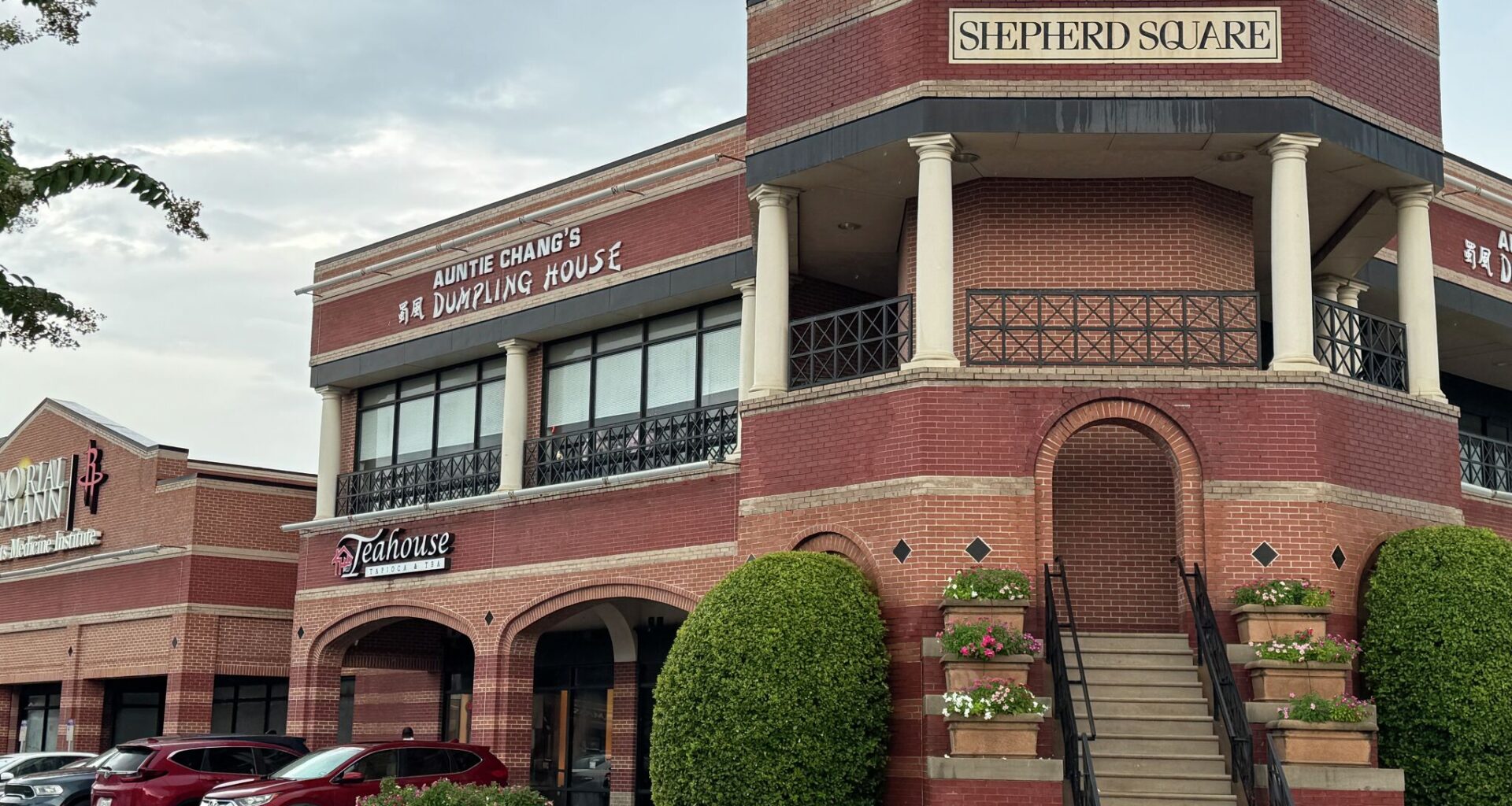
Shepherd Square in River Oaks is a two-story strip mall with restaurants, a boba tea shop, a dentist and more.
Gwen Howerton
Growing up in Texas, I found strip malls as natural to me as any other part of the landscape. I sort of assumed that the sprawling centers full of Best Buys and Burlingtons, stretching endlessly towards the horizon, were like any other of God’s creations: They were here before me, and they will be here long after me.

But when I moved into my first apartment in Houston, just off South Voss and Westheimer, I realized that the strip malls back home in College Station were puny compared to what Houston could build. In particular, I was fascinated by the massive two-story strip malls found throughout much of the city, even in some of the denser parts of the Inner Loop.
Article continues below this ad
Take Rich-Hill Plaza on Richmond in West Houston, near the Mahatma Gandhi District. It is a little bit overstimulating, this sort of chimera of businesses cobbled together, cellphone stores and massage places, a driving school, a place to buy quinceañera dresses, an empanada restaurant. This is not a pleasant place to hang out. But there is something charming about them. In these stacked strip malls, life almost thrives the same way that volcanic vents on the ocean floor teem with bacteria.
Strip malls, like much of our modern city design, were born out of the advent of mass car adoption. Caroline Cheong, associate director of the Center for Housing & Neighborhoods at the Kinder Institute for Urban Research, said that while they began popping up as early as the 1920s, strip malls really proliferated in the 1950s, ’60s, and ’70s as America underwent suburbanization.
That was particularly true of Houston. The city, which has no zoning laws and was booming thanks to oil and gas, saw an influx of residents motivated by cheap, new developments popping up as far as the eye could see.
“The development of strip malls was allowed to kind of expand unfettered,” Cheong explained. “As we had these other kinds of outlying suburbs and more horizontal development happening, you also saw this boom of strip malls as well.”
Article continues below this ad
Those suburbanites wanted everything in one place, so a strip mall would often become a one-stop shop: grocery stores, dry cleaners, restaurants, and big-box stores. Houston’s mega, two-story strip malls often follow this same pattern. Take the dreaded River Oaks Kroger on West Gray Street. The black-and-white, art deco-style, tiled strip features Kroger on one side and a two-story retail strip next door, home to a liquor store, a print shop, and salons—everything you would ever need.
And in true Houstonian fashion, these developments have been embraced by our city’s incredibly diverse population. My girlfriend and I sometimes get dinner from Auntie Chang’s Dumpling House at the Shepherd Square strip. After shopping at Target, I can get boba tea on the first floor and a succulent Chinese meal on the second. If I’m feeling feisty, I can go get my teeth cleaned and my lashes done nearby.
Shepherd Square in River Oaks is a two-story strip mall with restaurants, a boba tea shop, a dentist and more.
Gwen Howerton
Cheong said that to her, these two-story strip centers almost resemble indoor shopping malls mashed with their strip siblings. While traditional shopping malls are struggling, these double-decked retail outlets are thriving. Cheong likened them to shophouses, a type of development popular in Southeast Asia but found throughout the world, where a person might live on the top floor of the house and run their business from the bottom.
Article continues below this ad
“They’re almost like shophouses, not with residential at the bottom, but you have restaurants or businesses on the bottom, and then on the top floor you have more service-oriented functions like a dentist or a hair salon,” Cheong said.
That’s taken to the max at developments like Dun Huang Plaza in Houston’s Chinatown, where Asian barbecue spots, supermarkets, spas and arcades mingle. While most of the developments seen throughout Houston don’t have residential spaces, they serve similar functions and create a unique sense of place. Some also offer a strange simulacrum, but not the full experience of walkable access.
“They provide a sort of drop in the bucket of walkability versus what you might find in other denser urban cores, where walkability based on access to stores and storefronts is a much more central focus,” Cheong explained.
Article continues below this ad
True, our strip malls aren’t Parisian cafes or Italian patios. But still, in a place like Houston, they are a bizzaro analog. You can see a world where, in the future, instead of tearing down these gargantuan shopping centers, we integrate them into a more walkable city. Walking around one of these developments, I get a sense that I am part of a community, even if the architecture of many of our city’s strip malls screams at me that I shouldn’t be walking at all. No matter what, they certainly remind me of home.
“Given our familiarity and our visual comfort with these kinds of strip malls, I don’t think they’re going anywhere,” Cheong said. “But I do think that we need to be sort of thinking creatively about how to keep them fresh and sexy, if you will.”