
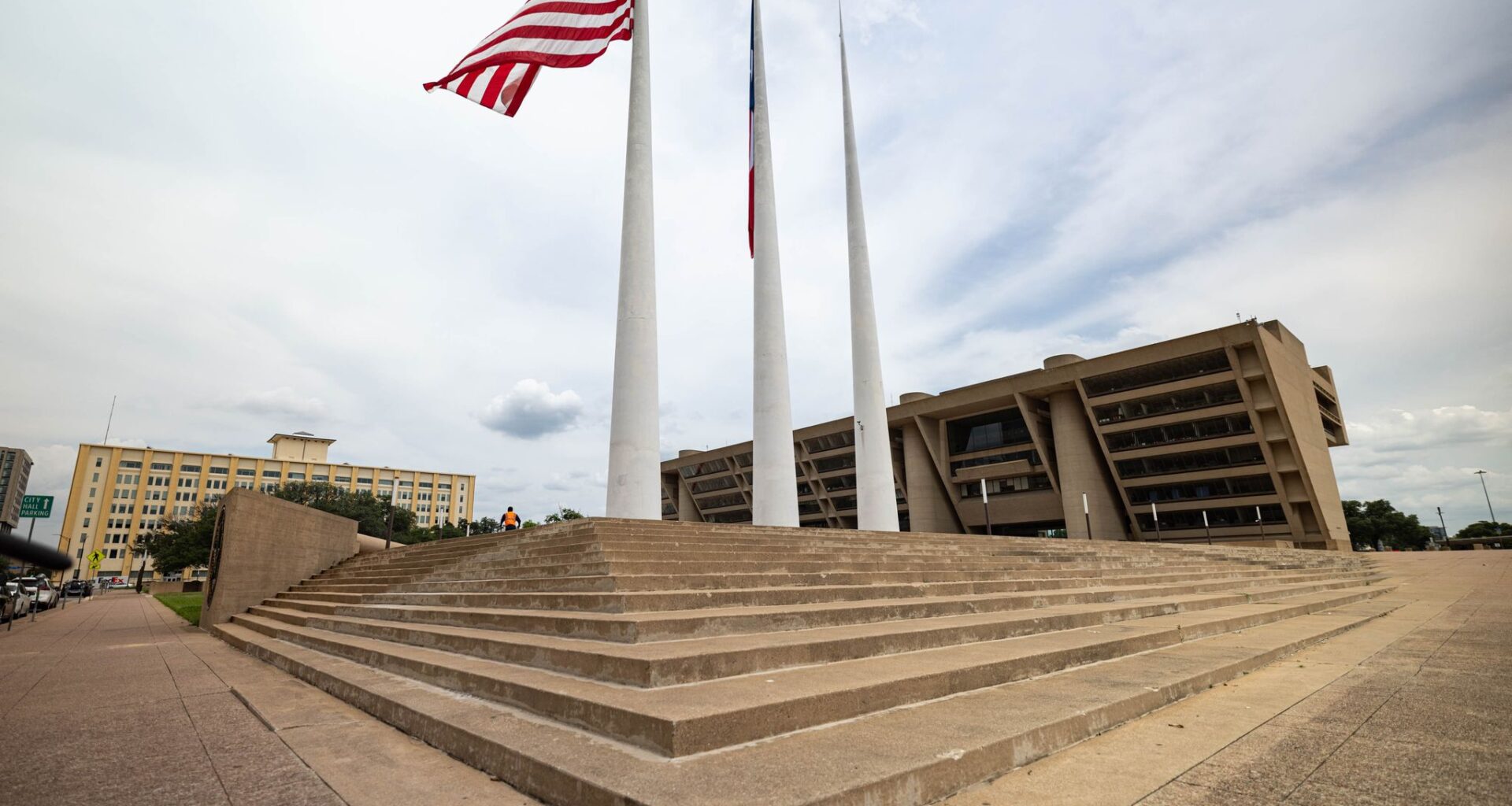
An American flag waves in front of Dallas City Hall in May. A city that isn’t growing much can’t expand the size and cost of local government the way Dallas has.
Angela Piazza/The Dallas Morning News
Dallas hasn’t grown much as a city in the last 10 years, but the spending at City Hall has exploded. And now the bill is coming due.
The city recently announced that thousands of employees will be furloughed for three days to help deal with a $30 million budget shortfall. These mandatory, unpaid days off are expected to save Dallas about $5 million.
This measure is a necessary part of addressing an immediate financial crisis. But furloughs are not a sign of a healthy organization, and should be treated as a desperate measure.
Article continues below this ad
The bigger problem is the way the city has been managing its budget over years. While residents have made it clear they want a bigger police force, City Hall has been growing just about everywhere, adding hundreds of new civilian employees and firefighters and paramedics.
A review of the city’s annual financial reports show that spending and staffing grew significantly faster than the population did between the 2016 and 2025 fiscal years.
Dallas’ grew to about 1.3 million people in 2025, a bit over 2% higher than in 2016, according to the Census Bureau.
Even excluding uniformed and civilian staff in the police and fire departments, City Hall’s headcount grew by about 750 between the 2016 and 2025 fiscal years, reaching about 7,600. That’s a roughly 11% increase. The city’s total employee base is about 14,000.
Article continues below this ad
The general fund budget, the pot of money the city uses for daily operating expenses, has grown immensely during that time. In the 2025 fiscal year, it reached about $1.9 billion, up from about $1.1 billion in 2016. That’s about a 66% increase.
This rise in spending and staffing weighed against population growth should set the stage for discussions about the coming budget that’s expected to bring its own, $51 million deficit.
While the City Council has lowered the tax rate, rising property values have left most residents paying more. Instead of looking for new revenue, council members should turn their attention to cutting an organization that has grown without providing meaningfully improved service.
A review of city records suggests that, in 2025, the median annual pay for a non-police, non-fire employee was in the ballpark of $55,000, not including pension and medical benefits. Just for the sake of illustrating the scale of cost, that would be roughly $41 million at 750 employees. Most of that additional headcount is not in the park and library departments that often face cuts first.
Now it’s time to broach the topic of public safety spending. This Editorial Board has consistently supported investments in policing. But it’s still worth a look at the details.
Article continues below this ad
The Dallas Police Department’s headcount fluctuated between the 2016 and 2025 fiscal years, growing only marginally in that time. Nonetheless, the department’s budget increased during that period from about $450 million to nearly $720 million.
Because of the requirements set down by Prop U — the measure voters approved forcing Dallas to grow its police force and increase officer salaries — it’s unlikely any trimming here would be doable, even if it were desirable.
Dallas Fire-Rescue’s growth between the 2016 and 2025 fiscal years was substantial.
The department’s headcount stood at roughly 1,900 uniformed employees in the 2016 fiscal year. That figure rose by more than 400 by the 2025 fiscal year. Fire Chief Justin Ball noted that the department was understaffed in 2016 and relied heavily on overtime, with many vacancies following pension changes that sparked a wave of departures.
The department explained that it has mainly been filling empty spots that had already been budgeted for, so the number of positions hasn’t grown so much even if the headcount has.
Article continues below this ad
Even so, the fire department’s budget rose by nearly 80% between the 2016 and 2025 fiscal years, reaching nearly $430 million. Ball noted that this is largely a matter of increasing pay, which he said has probably doubled since 2016. But it’s worth asking questions here. If the department grew to address overtime, and positions were budgeted, why are overall costs so high? And what are residents getting in return? We can’t be sure of the answer.
It’s hard to reconcile such massive budget growth and a uniformed force employing around 22% more people against such small population growth in the city.
A serious council, and serious management, needs to see that a city that isn’t growing much can’t expand the size and cost of local government the way Dallas has.
Residents are reckoning with high prices all around, from the grocery store to the tax bill.
Article continues below this ad
Average Dallasites are having to make sacrifices in their own budgets, and it’s their money the city is spending. It’s time for the council and city management to start acting like it.
Have thoughts about this? Send a letter to the editor using our letters form or email letters@dallasnews.com. Letters should be no more than 200 words and include the first and last name of the writer and city of residence.