
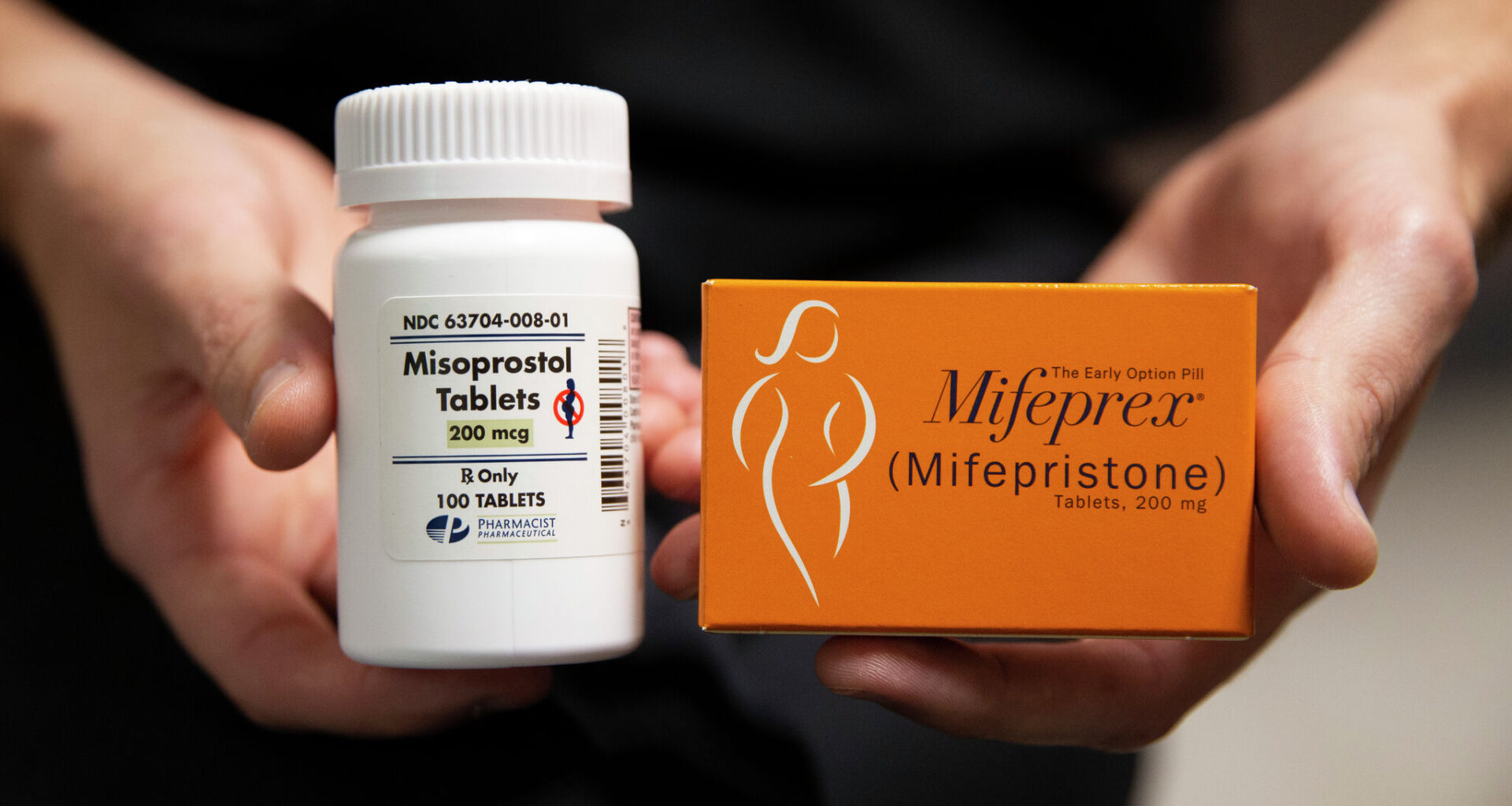
A doctor holds a bottle of Misoprostol and a box of Mifeprex (Mifespristone) medications at the Whole Women’s Health clinic in Fort Worth, Texas, on Thursday, November 21, 2019. These medications can terminate a pregnancy if taken together within 10 weeks of a person’s last menstrual period.
Lynda M. Gonzalez/Dallas Morning News
As abortion medication has become the sole way women are able to access the procedure in Texas, a fringe medical intervention is gaining traction – reversing the effects of the pills.
So-called abortion reversals were developed to try and combat the effects of the first half of a two-pill regimen that induces a medication abortion. And in Texas, their use appears to be on the rise.
READ MORE: The Texas GOP wants to stop all abortions. It’s willing to punish women to do it.
Article continues below this ad
But physicians say the method is ineffective, and others say it could be dangerous. One doctor who started a study of abortion pill reversals in 2019 abandoned the effort after a third of patients showed up to the emergency room with severe bleeding.
“We have zero evidence it works, because the one report that the anti-choice groups rely on is completely unreliable,” said Dr. Mitchell Creinin, an OB-GYN at the University of California – Davis who carried out the study.
No one is tracking how many abortion reversals are being done across Texas. While the state requires data collection on abortions, there is no standard to report anything about reversals, including any negative side effects.
Several crisis pregnancy centers, which are run by anti-abortion groups, told the Houston Chronicle they’ve had a growing number of requests, and are working to expand access to abortion reversals with help from the Republican-controlled Legislature. This year, lawmakers have poured nearly $100 million into the Thriving Texas Families program, which gives grants to crisis pregnancy centers with little oversight.
Article continues below this ad
Sylvia Johnson, executive director of the Houston Pregnancy Health Center, told the Houston Chronicle that the center didn’t do very many abortion reversals when they started providing the option around 2018. Now, the center does about three a month.
“They’re in kind of like a twilight zone,” Johnson said of the women who call them about reversal. “They call us because they changed their mind, and we respect the woman’s decision to change her mind.”
Abortion reversals in Texas
Texas effectively outlawed abortion in 2022. But women have continued to access the procedure by ordering abortion pills from out of state and having them shipped.
Evidence shows few are interested in an abortion reversal. A 2015 research paper found that less than 0.004% of women taking mifepristone in the U.S. – the drug that triggers the abortion – later chose to continue the pregnancy.
Article continues below this ad
But many are being directed to reversals through a hotline set up by Heartbeat International, an anti-abortion group that works with crisis pregnancy centers across the country, including in Texas.
The organization has trained more than 1,500 doctors to do reversals, according to last year’s impact report. Their numbers show about 1,700 abortion reversals were attempted in 2021, a number that jumped up to about 2,400 in 2025. Heartbeat International didn’t say how many were performed in Texas.
READ MORE: Fact check: Anti-abortion groups claim 1 in 5 patients using mifepristone suffer complications
Johnson said her center gets most referrals for abortion reversal from the Heartbeat International hotline.
Jana Pinson, executive director of Pregnancy Center of the Coastal Bend, said her team will drive to meet a woman immediately upon getting a call.
Article continues below this ad
The reversal has to be initiated within 72 hours after a woman has taken the first abortion medication, mifepristone. Instead of continuing with the second pill, the patient takes progesterone in an attempt to reverse the effects of the mifepristone, which blocks the hormone.
“We drive there and do an ultrasound to see if her baby is still alive, and then if there’s a heartbeat, then we help her get the progesterone that she needs,” Pinson said, describing the process. “Then keep giving her ultrasounds to make sure that the baby is still doing well.”
The organization is planning to open new locations in South Texas with funds from the state’s Thriving Texas Families program.
Both Pinson and Johnson said the reversals work about 60 to 65% of the time, but even in anti-abortion circles, the data varies.
‘Zero evidence it works’
Many doctors raise concerns about the intervention, saying it’s never been effectively studied, so it’s not clear whether the regimen works or could cause harm.
Article continues below this ad
“From everything we’ve gathered about the research that does exist,” on abortion reversal, it doesn’t work, and “from some studies that are high quality, that it might actually be dangerous for patients,” said Dr. Colleen Denny, an OB-GYN in New York and the chair of the ethics committee at the American College of Obstetricians and Gynecologists.
Creinin, the OBGYN at the University of California – Davis, started recruiting women who wanted to have abortions to participate in a study in 2019. After about 12 participants, the study had to be stopped because three women had to go to the emergency room with severe bleeding. Two women had a placebo intervention, and one had progesterone.
He said women in both groups may have experienced complications as a result of taking only one abortion pill, and not the second, the effects of which haven’t been extensively studied.
“We don’t have all the information that people need,” Creinin said. “We have zero evidence it works.”
He only chose low-risk women for his study, but because the impact of progesterone and the first abortion pill taken toegether are so unstudied, there could have been risk factors he didn’t know to screen for. But to him, that’s part of the point. Anti-abortion groups are recommending reversal with no idea what factors may put a woman at risk, he said.
“That’s false advertising, or misleading people,” he said. “What conclusions can I make?… I couldn’t, in low-risk people, do a study, and these things happened.”
He and other doctors have criticized some studies from anti-abortion doctors that say abortion reversal is safe and effective because they are too small to be useful and cherry-pick data that does not rise to a rigorous scientific standard. Some studies that examined the effects of taking only the first abortion pill and nothing else found that pregnancy continued in about half of cases, casting doubt on the efficacy of prescribing progesterone, Denny said.
Following up
In the past, crisis pregnancy centers have been accused of presenting misleading and untrue information to sway women away from abortions. It’s unclear whether every center is presenting patients with the potential risks of abortion reversal or whether they’re following up with women afterward to see if it worked or if patients experienced any side effects.
Dr. Ingrid Skop, an anti-abortion OBGYN based in San Antonio, is one doctor in Texas working with crisis pregnancy centers to expand abortion reversals. She said she’s done at least a dozen reversals, with a success rate of roughly 60%.
Skop said it’s “very hard to do what would be considered a gold standard study on anything related to abortion.” Skop also acknowledged that there are sometimes complications with reversal, as there are with any medical procedure.
“Mifepristone itself is associated with hemorrhage, so that is a well-known fact,” she said. “So we give them precautions about what to do if you experience bleeding.”
Skop said she schedules follow-up appointments with patients. Pinson said she does too. She insisted their center hasn’t had a patient with complications from the reversal, though she also said that some who have ultimately gone on to lose their pregnancy have had to go to the emergency room for bleeding.
Johnson said they don’t necessarily see women they’ve guided to abortion reversals afterwards, since they aren’t a medical center.
While Texas has yet to officially weigh in on abortion reversal, about 14 states as of 2021 have passed laws that require doctors to give some kind of information about the procedure, according to one report.
Democratically-led states are on the opposite side of the issue, and California is suing Heartbeat International over billboards that advertise abortion pill reversal.
Anti-abortion advocates are hoping they can get the word out in Texas.
“It’s crazy to think that if a woman changes her mind and wants to have her baby, that you wouldn’t give her that chance,” Pinson said. “I’d love for the nation to do a whole advertising campaign that, if you regret it, that you have the opportunity to reverse it, because the girl has to look really hard or be one of our clients to know that this even exists.”