
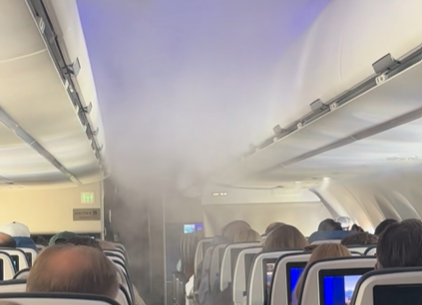
The video, posted Monday by Extreme Weather and Disaster Scientist “Hurricane Hal,” shows dense fog pouring from overhead air vents as passengers prepared to land on a United flight from Houston to Denver.
“Check out the ‘fog machine’ on my United flight from Houston to Denver today!” the post read. “It was so humid on the plane that the cool air from the AC immediately condensed and dropped.”
The unusual sight is not the first time travelers took to social media, where some viewers questioned whether smoke had entered the cabin. In one video, a flight attendant can be heard reassuring passengers it was not an emergency.
United Airlines told Chron there was a simple scientific explanation behind the strange-looking scene.
“As we descend into warm, humid destinations like Houston, passengers may occasionally notice a visible mist or fog-like vapor emitting from the cabin air vents,” a United spokesperson told Chron in a statement. “Please know that there are no ‘fog machines’ on any United Airlines aircraft.”
In other words, the airline said the effect is caused by simple physics: As the plane descends into humid air, the cold air conditioning mixes with the warm, moisture-filled air outside. That sudden temperature change causes the moisture to condense into tiny water droplets, briefly creating what looks like a cloud inside the cabin.
“Every passenger remains entirely safe during descent,” the airline said. “This phenomenon is purely visual, does not impact cabin air quality, and clears quickly as the air circulates.”
Despite how dramatic it looks, aviation experts note the phenomenon isn’t unusual. CNN previously reported in 2024 that cabin fog can occur whenever warm, humid air rapidly mixes with cold conditioned air inside an aircraft, particularly in tropical and subtropical climates.
So while it may look like someone accidentally turned on a fog machine at 35,000 feet, passengers are actually seeing a tiny cloud forming inside the cabin—one that’s expected to disappear almost as quickly as it appears.