
Shortly before the machines arrived to begin devouring the Kay Bailey Hutchison Convention Center at the end of March, city staff dispatched an email to department heads alerting them of surplus property for the taking down in the building’s bowels. Stuff that would otherwise get auctioned off, thrown out, bulldozed over. Saul Castaneda, a firefighter, made a few runs to collect some things for Fire Station 3 in Deep Ellum, like spray paint for the hydrants and a kegerator for the kitchen.
Then, one one trip, he saw some things – someones – that looked familiar.
“That’s them,” he remembers thinking when confronted by the two figures lurking in a corner, awaiting their inevitable demise. “It was like discovering a hidden treasure. It was exciting. It put a smile on my face.”
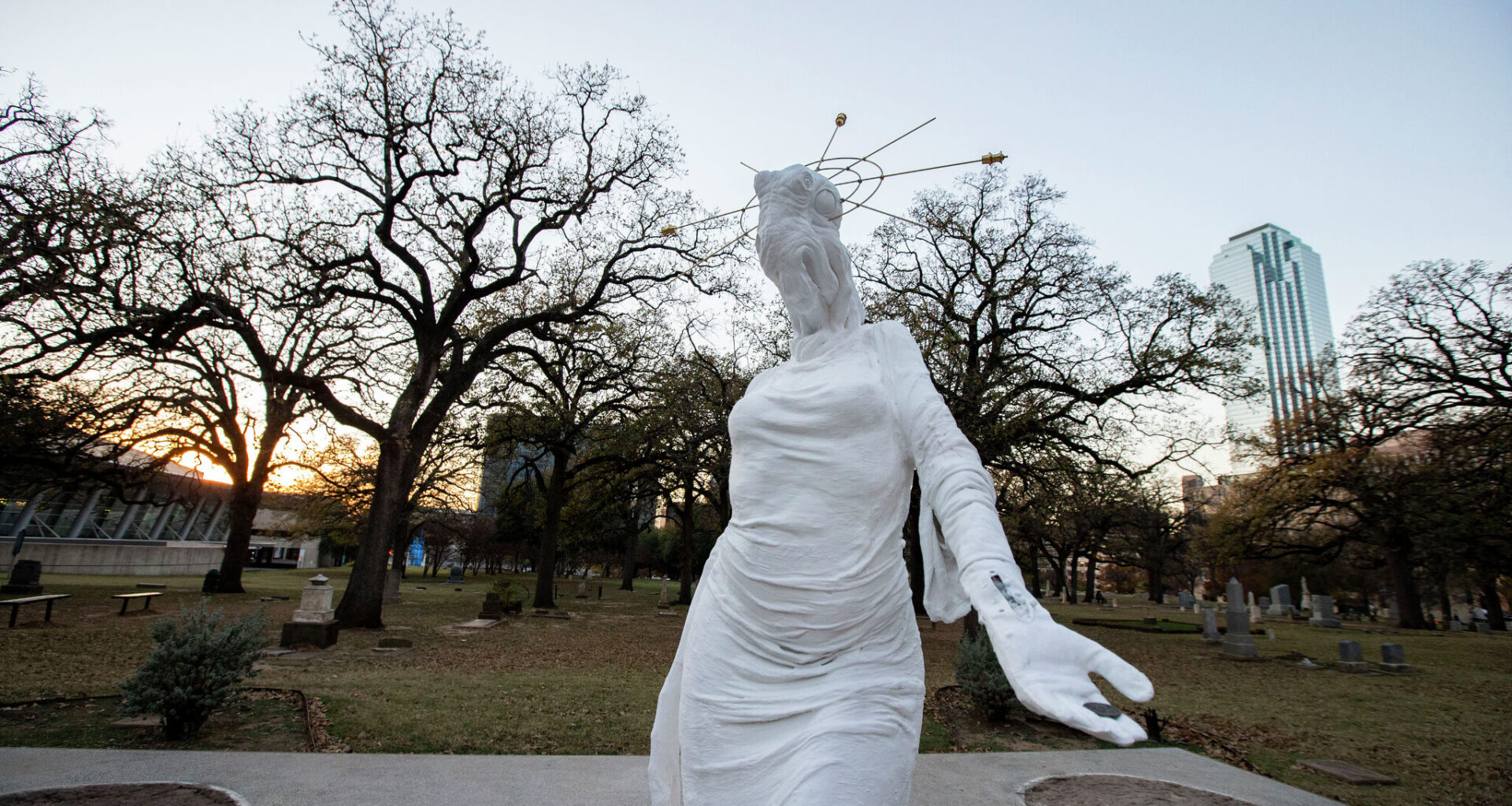
Castaneda had stumbled across the two sculptures planted downtown by the artist known only as Solomon, who, in 2019 and 2021, rendered two of this city’s forebearers as cephalopod-human hybrids and then gifted them to an ungrateful city.
Article continues below this ad
Those tasked with overseeing Dallas’ public art wanted absolutely nothing to do with Solomon’s squid-like statues of John Neely Bryan, Dallas’ founder, and Sarah Horton Cockrell, who turned Bryan’s settlement into a city. Officials expeditiously removed the pair when they popped up near the convention center and hid them — then nearly destroyed them, until they were rescued by a fireman who’d read all the stories about Solomon and his plaster pioneers.
“I tried to hide my excitement, so no one would think anything more of it since they were about to be thrown out,” Castaneda, a 39-year-old Woodrow Wilson High School graduate, told me Monday. “I tried to be super-nonchalant. I said, ‘I’ll take these off your hands.’ Meanwhile, inside I’m like, ‘Holy cow, these are the statues.’”
Solomon’s statues featuring the artist’s cephalopod interpretations of Sarah Horton Cockrell, left, and John Neely Bryan have been saved after the city removed and hid them beginning in 2019.
Robert Wilonsky/Staff writer
They city never would say where they went or why they were hidden from the public’s view, only that they weren’t commissioned works of public art and therefore did “not belong in the public space.”
They still remain out of sight but have been spared execution, thanks to Castaneda, now thrilled and proud to be part of a story that inches toward myth with every turn of the screw. Using his father’s SUV, he ferried the couple to his grandparents’ circa-1920s house on Glasgow Drive, where they remained until a long-planned renovation forced Castaneda to find them yet another home last weekend.
Article continues below this ad
So Monday evening, I went to visit Bryan and Cockrell at their latest digs: the northwest Dallas garage of my old friend and former Dallas Observer colleague Pete Freedman, who’d covered Solomon and his statues while at Central Track and WFAA-TV (Channel 8) with the fervor of a true believer. Castaneda knew Freedman would give them a good home.
“This story just pops up every couple of years, and it’s so crazy, everything about it,” said Freedman, now managing corporate communications at Public Storage, how appropriate. “But it’s also so fun. Nothing surprises me anymore. I am completely and utterly charmed by the whole thing. You have a guy doing this for no real reason other than to have fun with some bizarre Dallas history and proliferate the Dallas origin story. This is crack for people like you and me.”
Self-Portrait of John Neely Bryan (hypothetical), 1877 first surfaced near the convention center’s Lamar Street DART station at October’s end in 2019. It was accompanied by a plaque, made to look like an official public work, whose text began with the story of Bryan’s end, when he was “confined in his last days to an insane asylum in Austin” — the State Lunatic Asylum, to be precise, where he died in 1877 after a seven-month stay.
Dallas firefighter Saul Castaneda kept the statues in his East Dallas home until a planned renovation required him to find a new home for the pair over the weekend.
Saul Castaneda/Courtesy
I’d wager that most people who read that first Central Track story knew little to nothing of the Tennessee-born Bryan, except, perhaps, that there’s a log cabin planted downtown meant to replicate his long-drowned home along the Trinity River. The Pioneer Cemetery headstone honoring the “First Citizen of Dallas” is also phony, as it’s likely Bryan is buried in an unmarked grave in Austin.
Article continues below this ad
Solomon’s statue and its accompanying plaque remind me of something historian A.C. Greene wrote in Texas Monthly in 1973 when lamenting that Dallas had done little to honor the man who willed this city into existence.
“It is a shame that the city he made can’t know more of him,” Greene wrote. “He was one of the frontier strange ones; gifted in vision, but touched with a kind of driven, vengeful fate that finally enveloped him (he suspected the terrible experience of cholera had damaged his mind and body).”
The statue is as much a fever dream as Bryan and the city he forged. And the plaque accompanying it ended with a question many of us dug-in lifers ask regularly: “Is the city he began a city in fact or only in shared delusion?” Octopus-headed John Neely Bryan just put it more elegantly.
Portrait of Sarah Horton Cockrell, 2024 – taller and heavier and sturdier and more detailed than Bryan, her head adorned with a halo, her upward-turned right palm holding a John Kennedy half dollar, her feet surrounded by real animal bones – showed up in mid-December 2021 on the spot formerly occupied by the 1897 Confederate War Memorial.
Its accompanying plaque bore Cistercian numerals forming a phone number, which, when dialed, played a distorted message; then, later, classical music. The plaque also spoke obliquely of Cockrell’s construction of the first bridge to span the river — “her Trinity Toll Bridge still calling in Sarah’s debts on another plane, a taller, more enduring memorial than any our city’s other daughters have built.”
Article continues below this ad
Pete Freedman cradles the head of John Neely Bryan (or close enough), who now shares a home with Sarah Horton Cockrell in the Central Track founder’s garage. Freedman is thrilled to have them. His wife is occasionally startled by the cephalopods now residing in her garage.
Robert Wilonsky/Staff writer
Again, the city quickly snatched the statue and buried it in the bowels of the convention center.
Downtown Dallas Inc.’s president and CEO, Jennifer Scripps, at the time director of the city’s Office of Arts and Culture, said Monday that the works were “shockingly good.” But leaving Bryan and Cockrell in place would have “opened the doors to anyone putting anything on city property,” she said, “and what you think is art, someone else doesn’t, and then you have issues.”
The statues stopped appearing, the stories stopped running, but Solomon was far from finished.
In April 2022, Freedman and a few others smitten with the mystery received a text that read, “Absence was noticed/Ambassador of ashes/The keys are in the safe,” accompanied by a photo of five plaster birds lying in a circle in a parking lot in downtown’s shadow — on the spot of the burned-down Ambassador Hotel in the Cedars. More clues led to more birds around Cockrell’s grave at Uptown’s Greenwood Cemetery — then, eventually, a box in a small lake near the Santa Fe Trestle Trail containing a bronze bird and more clues and carvings.
Article continues below this ad
A 47-minute YouTube video titled The Dallas Cephalopod Mystery chronicled the story also unfolding on the group-chat app Discord. Reddit, too, became obsessed. Then in 2024, Freedman said, he and the other Solomon followers received another photo of a plaque in the Trinity floodway containing five lines representing Dallas’ possible namesakes. Determined diggers discovered Solomon had also buried a sarcophagus, a foot below ground, containing what Freedman described as an unnamed “cephalopod humanoid.”
Bird statues placed around Sarah Horton Cockrell’s headstone at Greenwood Cemetery weeks after the statue was discovered in downtown’s Pioneer Cemetery.
Staff photo/Dallas Morning News
Freedman thinks he knows who Solomon is. But in truth, that’s the least interesting part of a story that’s seemingly unfinished if the artist sticks to his schedule of dropping new works every two years.
“The who doesn’t matter,” said Freeman, to whom the artist sent a small sculpture accompanied by a plaque awarding him The Solomon Award for Journalistic Exceptionalism. (It reads, in part, “Dallas is only tangible so long as it is described that way.”) “It’s the what, because the why is implied: Let’s have some fun with the history of Dallas. And he did it. He has a couple of dozen people scrambling around the city going into trails and cemeteries and floodways actively seeking information about the city of Dallas. They’re experiencing the city. That’s pretty remarkable.”
Article continues below this ad
Before I left Freedman’s house Monday, we tried that old phone number to see if Solomon picked up. Instead, we got a text: “Can I call you later?” He never did.