
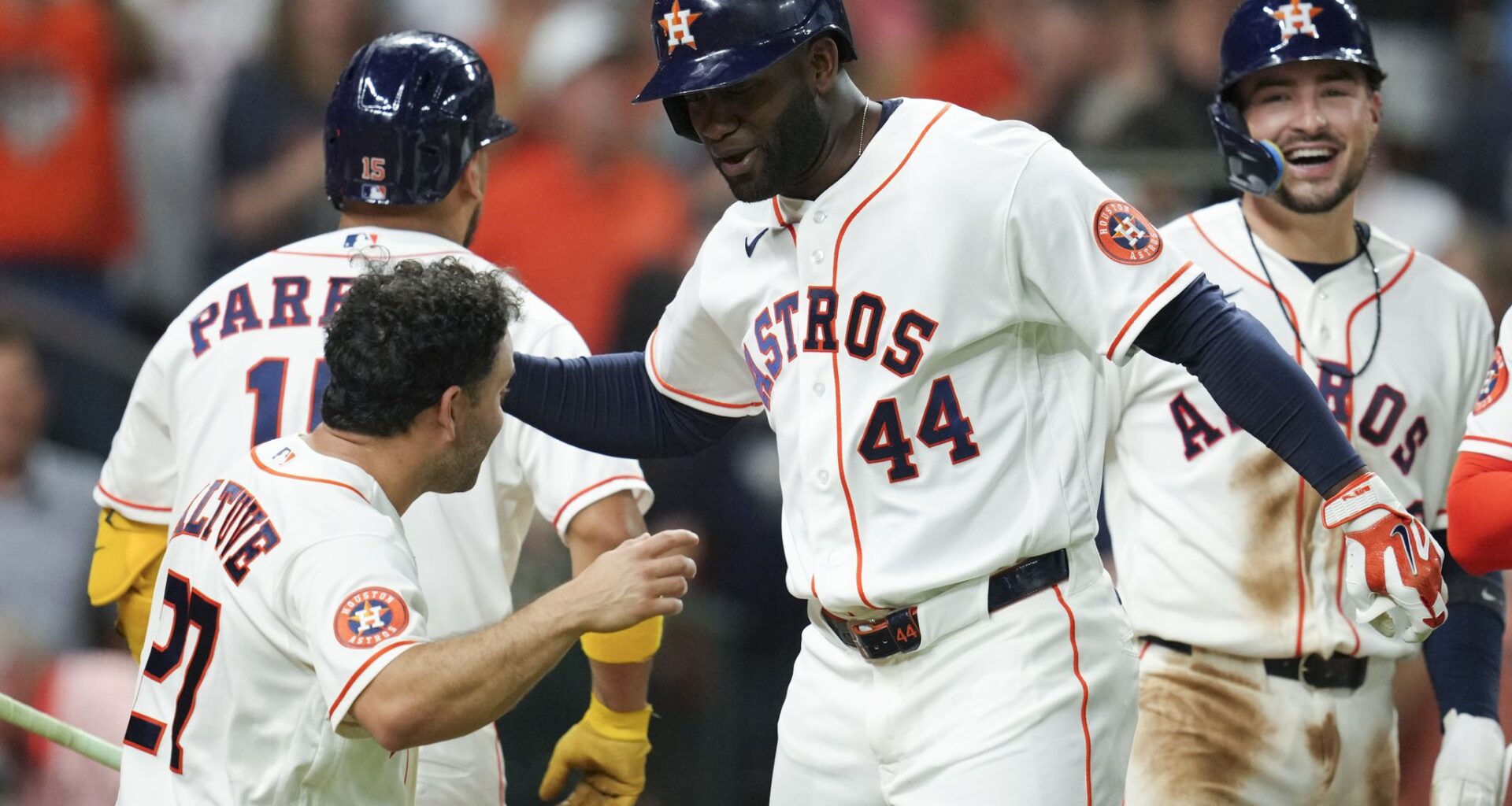
A brutal April echoed through the first half for the Houston Astros, who clawed back into contention yet remain in the bottom half of a muddled American League.
The Astros reached the All-Star break at four games below .500 but just three games out of first place in the AL West. A reprieve for a subpar start exists, if Houston can seize it.
Its attempt will resume on Friday, when the Baltimore Orioles arrive at Daikin Park to start a three-game series. Here are five questions the Astros face looking to the second half:
Astros general manager Dana Brown once again figures to be a buyer before the trade deadline, but what will he prioritize?
Jason Fochtman/Houston Chronicle
What is the bigger trade deadline need, a bat or rotation help?
General manager Dana Brown stated this month that a left-handed hitting outfielder is the “main need” for the Astros ahead of the Aug. 3 trade deadline. That a need exists there is impossible to argue.
Article continues below this ad
Astros outfielders own the third-lowest OPS in the majors, ahead of only the Guardians and Padres, and rank last in on-base percentage. No club has taken more right-on-right plate appearances than Houston, meanwhile, and a set infield makes the outfield the clearest place to plug in a left-handed bat.
What is debatable is whether the starting rotation is a greater concern. Houston starters have combined for a 5.26 ERA, third-highest in the majors. Just six teams are averaging fewer innings per start, a pattern putting pressure on an Astros bullpen that has logged the eighth-most innings in the sport.
The Astros expect reinforcement from the injured list soon. But beyond Hunter Brown and surprise Peter Lambert, starters have lacked consistency. Tatsuya Imai has a 6.06 ERA. Spencer Arrighetti has struggled since a brilliant May. Cristian Javier was placed in the bullpen upon his return from a shoulder strain.
Acquiring both an outfield bat and pitching help might be ideal. But it’s unclear if the Astros, who balked at asking prices for starting pitching at last year’s trade deadline, will have the appetite to part with what significant upgrades in both areas may require.
Article continues below this ad
Proximity to the competitive balance tax is also worth noting, given Houston exceeded the CBT each of the past two years and made efforts to pare payroll last offseason. Its projected CBT payroll is currently about $10 million below the first tax threshold, per Cot’s Contracts.
Jose Altuve did hit a homer in three of his final six games before the All-Star break to cap a first half that’s frustrated him at times.
Jacob Lujan/Houston Chronicle
Can Jose Altuve heat up after the break?
Altuve’s first half fell short of his career standards. A career .301 hitter, Altuve is batting .235. His .710 OPS is more than 100 points below his career mark, and his 98 OPS-plus below MLB average. Altuve, who also missed 2 ½ weeks to an oblique injury, admitted last month being “frustrated” by the results.
Altuve’s strikeout rate of 22.1% is nearly 9 percent above his career mark. His swing-and-miss rate of 24.2% is still below league average but his highest since Statcast started tracking the metric in 2015. More of his contact has been on the ground, contributing to a dip in slugging, as he has seen a higher dose of sinkers and fewer four-seam fastballs.
Article continues below this ad
In 10 games in July, Altuve does have an .868 OPS. Homering in three of his final six games before the break offered a hint of the boost a productive Altuve could give the Astros’ lineup.
Yordan Alvarez was baseball’s most productive hitter in the first half, while Jeremy Peña, Isaac Paredes and Christian Walker were all above-MLB average in OPS-plus. Houston ranked fourth in the AL in runs scored even with minimal offense from its outfield, injuries, Altuve’s drop-off and a lineup that skewed top-heavy.
Altuve is not being asked to carry the offense — he has hit fifth in a full-strength lineup — but the Astros know his capacity for hot streaks and the impact on their club. Seeing one in the second half could be invaluable.
Ronel Blanco, a revelation as a rookie in 2024, is nearing a return from Tommy John surgery that ended his 2025 season early.
Jason Fochtman/Houston Chronicle
What can the Astros expect out of pitchers returning from injuries?
In-house help appears on its way for both the rotation and bullpen. Starters Ronel Blanco and Hayden Wesneski are nearing returns from elbow surgeries. Blanco could return shortly after the break, with Wesneski possibly one or two rehab outings away. Lance McCullers Jr. is making rehab starts, as well.
Article continues below this ad
To what extent the Astros believe those pitchers can help stabilize the rotation may impact their trade deadline approach. Yet relying on such help also involves some risk, as last season illustrated.
Last year, the Astros regained starters Cristian Javier and Luis Garcia from elbow surgeries post-break. Javier had a 4.62 ERA in eight starts and Garcia reinjured his elbow in his second outing back. Spencer Arrighetti, returning from a broken thumb, made five starts before an elbow issue arose.
Blanco and Wesneski could break from that precedent. McCullers owns a 6.86 ERA in eight starts this season, making his outlook unclear. So is that of Mike Burrows, the Astros’ innings leader who was optioned to Triple-A this month, then placed on the major-league IL due to elbow neuritis.
For the bullpen, Bennett Sousa is close to returning, while Kai-Wei Teng is working again as a reliever while he rehabs a knee injury. Both could help a bullpen that worked the seventh-most innings in the majors in the first half. Sousa has made just five outings for Houston due to injuries this year, though, and Teng acknowledged fatigue amid a rising workload as a starter before his IL stint.
Brice Matthews has transitioned well defensively to the outfield, but his bat remains a work in progress in his first full major-league season.
Jason Fochtman/Houston Chronicle
Will any outfielders step up?
The Astros started nine different players in left field before the break. Six players made at least one start in center field. Jake Meyers and Joey Loperfido, their opening-day center and left fielders, are at Triple-A. Even if the Astros trade for an outfielder, they are seeking impact at multiple spots.
Article continues below this ad
With Cam Smith stationed in right field, Brice Matthews may be the current group’s biggest variable. The 2023 first-round pick has made an admirable transition to the outfield defensively, handling both left and center field. Public metrics rate him above-average at both positions.
Matthews, though, has a .582 OPS. That he has taken the second-most plate appearances among Astros outfielders after Smith underscores both the opportunity available to him and a dearth of other options.
For a team trying to stay in a playoff race, runway for such production is short. Matthews could lengthen it with an upturn, yet no track record for one exists. Meyers had a .580 OPS before being optioned. Zach Dezenzo has a .652 OPS in limited time in the outfield corners.
LaMonte Wade Jr. and Taylor Trammell profile as platoon options given their career numbers against left-handed pitching. That Dana Brown declared the need for a left-handed hitting outfielder even with both on the roster is telling. So was sending down Loperfido upon Wade’s return from a hamstring injury.
Brown hedged that outfield help “could come from the minor leagues,” citing Lucas Spence, who has 17 games above Double-A, as a potential call-up. Houston’s need for offense there is obvious, and one that in-house options, despite underwhelming badly so far, could still help address.
Bryan Abreu has largely struggled this year after being a reliable setup man in recent seasons.
Jason Fochtman/Houston Chronicle
Can Bryan Abreu reclaim a setup role?
Three of the Astros’ top leverage relievers are left-handed in closer Josh Hader, Bryan King and Steven Okert. Lefty Bennett Sousa could also return soon from the IL. While Houston carried those four lefties for much of last season, it had Abreu lending right-handed balance to the back of the bullpen.
That is not the case right now, due to Abreu’s acute struggles in the first half. Its leverage options skew left-handed as a result. Righty Enyel De Los Santos has pitched in the late innings but had a 6.48 ERA in his last 16 outings before the break. AJ Blubaugh remains mostly a multi-inning reliever.
Abreu still has a 5.81 ERA, with only six outings since June 15. Yet he has shown some modest signs of improvement. His average fastball velocity his month is 96.5 mph, up from 94.4 mph in May. His slider has generated a 50% whiff rate this month, and he added a cutter to break up his two main pitches.
Dana Brown said recently it “would be great” for the Astros to add right-handed relief help before the trade deadline. Getting Abreu to some semblance of his previous form could serve the same purpose, and perhaps ease others’ workload. Okert, King and De Los Santos all have at least 40 appearances.
If not, the Astros have two intriguing in-house options for right-handed relief help, albeit neither with Abreu’s track record. Alimber Santa has a 1.17 ERA in 15 1/3 innings with Houston while Miguel Ullola impressed in a brief debut stint, inviting wonder of whether either could play a second-half role.