
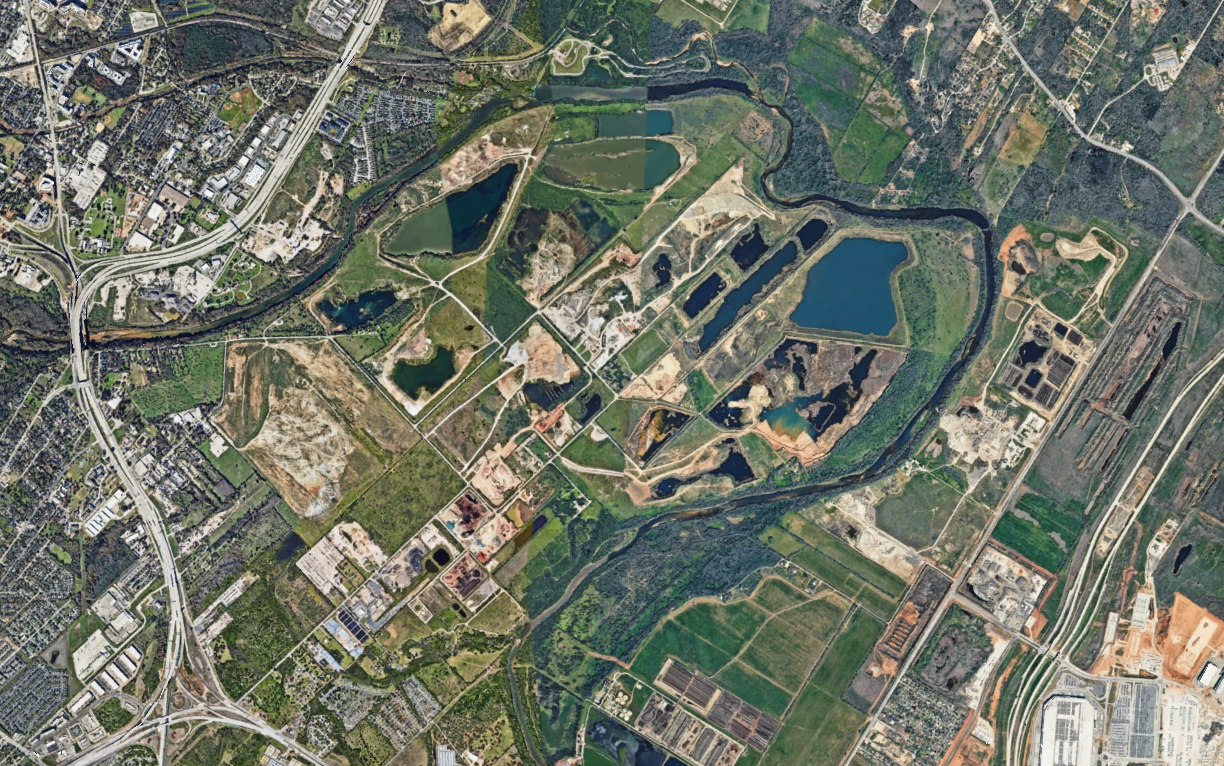
Aerial view of the Dog’s Head tract near Austin-Bergstrom International Airport, where a proposed tax increment reinvestment zone would help fund roads, utilities and other infrastructure.
Google Earth
Citing multiple concerns and a desire to wait on a decision by city officials, Travis County delayed a decision on a financing agreement that would use future tax revenue to help pay for redevelopment of a massive tract known as Dog’s Head.

Commissioners raised concerns about transparency into the plan, potential environmental effects and the development’s impact on nearby residents.
Article continues below this ad
“It’s a very exciting possibility and we’d really like to support a project that reflects our values, something that has guarantees for affordability, community input and environmental protections, robust economic growth, great transportation access and more,” Judge Andy Brown said. “We are not saying no today, but we would like some more time to think it through and come back with some ideas of our own.”
Commissioners postponed a vote until after the Austin City Council considers its portion of the financing plan on July 23.
“We kind of like to know what the city’s going to do,” Precinct 2 Commissioner Brigid Shea said shortly before commissioners met in a closed session.
Endeavor Real Estate Group, the developer behind The Domain and long-stalled plans for the former Austin American-Statesman property, is seeking a tax increment reinvestment zone to help finance roads, utilities and other infrastructure across the roughly 2,600-acre site near Austin-Bergstrom International Airport.
Article continues below this ad
Austin officials estimate the infrastructure could cost $5.63 billion, with the proposed financing arrangement covering about one-fifth of that amount.
Under a tax increment reinvestment zone, or TIRZ, a portion of the additional tax revenue generated as property values rise with development is reinvested in public improvements within the zone.
Under the plan being considered, Austin would contribute 75% of new property and sales tax revenue for 20 years, then kick in 66% for 15 years. Travis County would contribute 50% of the growth in property tax revenue over the same period. The agreement would run through Dec. 31, 2061.
Kimberly Olivares, Austin’s director of financial services and deputy chief financial officer, said the undeveloped site has virtually no infrastructure, limiting its current development potential.
Article continues below this ad
“If not done by a TIRZ, it will struggle to develop,” Olivares said.
Austin City Council unanimously approved a 45-year annexation and development agreement for the area, named for a bend in the Colorado River resembling a dog’s head, in May. If the city does not create the TIRZ, the owner could seek disannexation and release from Austin’s extraterritorial jurisdiction.
Parcels in the Dog’s Head area near Austin-Bergstrom International Airport.
Travis Central Appraisal District
Development details
A preliminary plan for the proposed development modeled 12,395 homes and more than 9 million square feet of commercial, industrial and hospitality space. Those figures were used to evaluate the project’s financial viability and are not binding requirements, city officials said.
Article continues below this ad
The projections include 4 million square feet of industrial space, 2.5 million square feet of retail, 1.5 million square feet of office space, 1 million square feet of hospitality space, 6,195 single-family homes and 6,200 apartments or condominiums.
Plans call for the first portions to be delivered by 2030 and the overall development completed by 2057. Dog’s Head could represent more than $26 billion in property value by the time the TIRZ expires, according to city documents.
About 20% of any housing built would be designated as affordable. Supporters said the project also could bring grocery stores, health care and other services to an area where residents have limited access to them.
The development agreement calls for open space and a public trail along the Colorado River. It also generally requires compliance with Austin’s current land development code, with modifications.
Article continues below this ad
A map in the preliminary TIRZ plan shows a proposed bridge across the Colorado River carrying an extension of Tesla Road toward the Austin-based automaker’s nearby Gigafactory site. Tesla’s presence figures prominently in the draft, which cites the Gigafactory, Austin-Bergstrom International Airport and Texas 130 as sources of demand for industrial and office development.
Richard Suttle, an attorney representing Endeavor, previously said an unidentified Fortune 100 company would become the site’s first tenant and build an advanced manufacturing operation on about 300 acres.
Endeavor has said the tenant is not Tesla or SpaceX and that the operation is not a data center. The broader agreement, however, does not prohibit data centers elsewhere on the property.
A map in the preliminary TIRZ plan shows a proposed bridge across the Colorado River carrying an extension of Tesla Road.
City of Austin
County officials seek guarantees
Commissioners first received a detailed briefing in June, when Endeavor officials acknowledged that the housing and commercial figures were projections rather than binding construction commitments.
Article continues below this ad
The briefing also raised questions about the absence of a firm site plan, development in flood-prone areas, impervious cover and environmental protections. Those concerns resurfaced Tuesday as commissioners questioned what the county would receive for its tax contribution.
“There’s so much ‘trust me,’” Shea said.
Shea said the lack of transparency over the potential Fortune 100 tenant and the lack of a firm promise to ban data centers from the site has made her and many residents “extremely nervous.”
“You saw the potential to make more money,” Shea told Suttle.
Article continues below this ad
Suttle said developers must generate a return on their investments and argued that major transportation infrastructure has historically been publicly financed.
“Developers didn’t build Lamar. Developers didn’t build I-35,” Suttle said. “This is a function of return. Developers are not nonprofits.”
Commissioners also questioned the effects on flooding, impervious cover requirements and environmentally sensitive land. Mining permits remain active on portions of the property, and development could require revisions to federal flood maps.
Endeavor representatives have said federal flood maps do not accurately reflect conditions on the property and could be revised as the site is engineered and developed.
Article continues below this ad
Earlier this month, the Austin Environmental Commission unanimously recommended delaying the TIRZ vote until January, although that recommendation is nonbinding.
Meanwhile, residents said officials were moving too quickly without adequate environmental review or public involvement.
“There hasn’t been enough time for meaningful public comment and public engagement,” resident Kirsten Johansson told commissioners Tuesday. “So I’m urgently asking you to postpone, to have those environmental reviews and have time for the public to say what they want for this space if it’s really supposed to benefit us, the community.”
Precinct 1 Commissioner Jeff Travillion said he wanted a clearer understanding of what the county would receive and how surrounding communities would be affected.
Article continues below this ad
“I just want to be able to know what it is I’m buying,” Travillion said.
Supporters said the financing would allow greater density, create construction and permanent jobs, and help bring housing and services to eastern Travis County.
Opponents argued that the county should not subsidize a wealthy developer without stronger guarantees.
“What this is is bullying,” said Craig Nazor, president of the Austin Environmental Democrats. “Not helping our poorest people is a choice. And we don’t have to give money to rich people.”
Article continues below this ad
The Austin City Council is scheduled to negotiate and vote July 23 on the proposed TIRZ and roadway annexations. Travis County commissioners did not set a new date for their vote.
Kumba Jagne contributed to this report.