
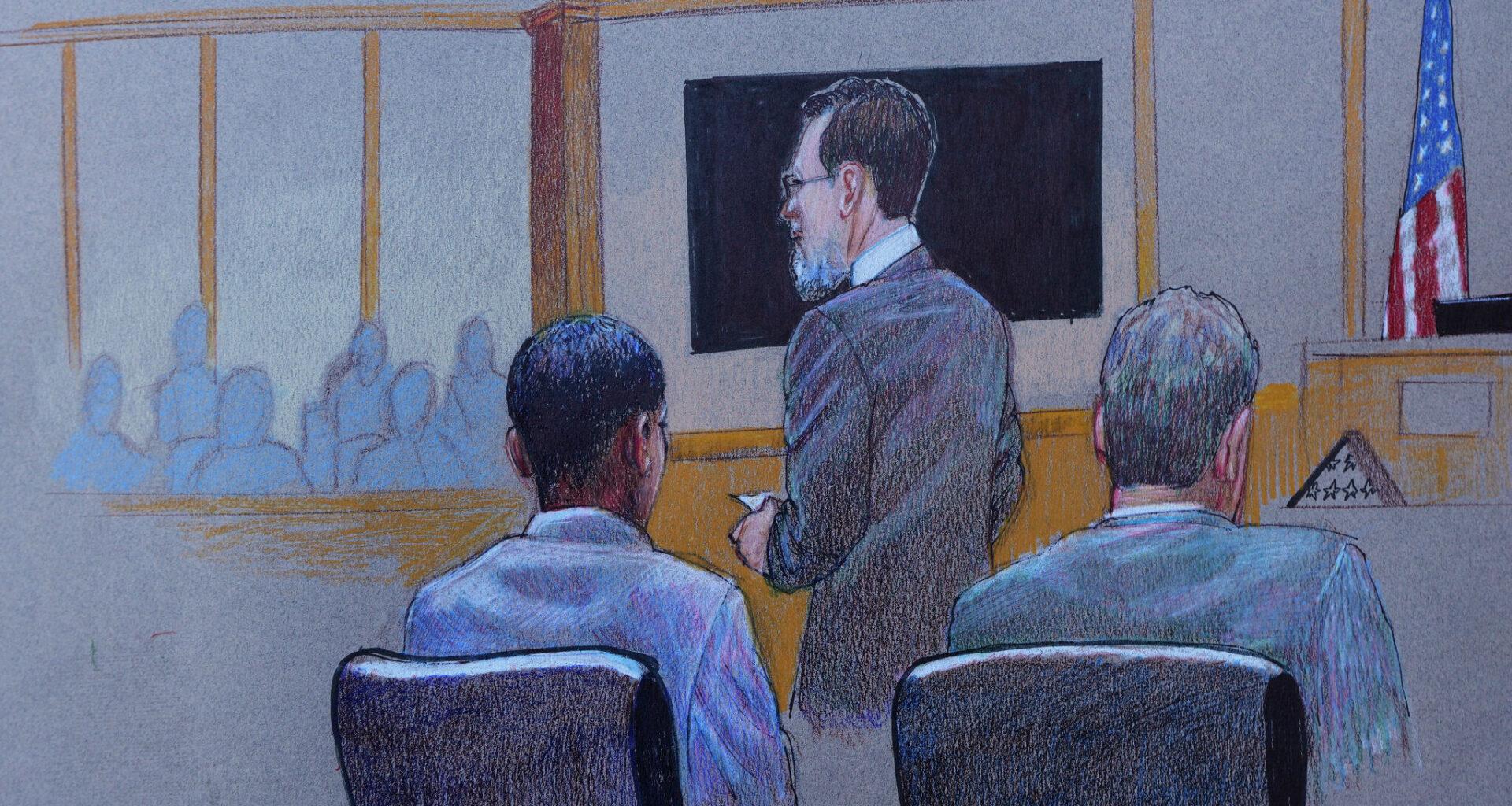
A courtroom sketch shows the district attorney pointing at Karmelo Anthony, center, at the defense table in opening arguments Thursday, June 4, 2026, in McKinney, Texas, during the trial of a teen accused of fatally stabbing another during a track meet in suburban Dallas last year.
Paat Lopez/Associated Press
Karmelo Anthony’s defense attorneys struck a handshake deal intended to protect their client from his past.

Each side stood to gain from the idea floated by the lead prosecutor, wrote Mike Howard, Anthony’s trial attorney, in a sworn affidavit appealing Anthony’s conviction. Jurors and reporters would never hear that the victim and his twin brother had been accused of bullying and racism. They’d never see Anthony’s cellphone records; his school disciplinary history would stay sealed.
The “gentleman’s agreement,” detailed in Howard’s affidavit, meant the jury would see the case through a narrow lens, zoomed in on the morning of April 2, 2025; the minutes before and after Anthony fatally stabbed Austin Metcalf. Anthony called it an act of self-defense. The state called it murder.
Article continues below this ad
Howard’s statement offers the clearest look yet at the defense team’s strategy — and how it unraveled under the confines of an agreement designed to shield the histories of three teenagers at the center of the case.
In Howard’s telling, prosecutors backed out of the deal on the cusp of the trial’s most consequential moment, a betrayal that would cost Anthony his chance to take the stand. The timing was so unjust, his lawyers argued in the appeal filed last week, that Anthony deserves a new trial. The prosecution has denied the accusations of misconduct.
Related: How the case against Karmelo Anthony unfolded
Lawyers who spoke with The Dallas Morning News said the agreement — and the dispute over whether it was honored — illustrates the risks of relying on informal courtroom understandings and raises broader questions about how such agreements are handled in Collin County courts. What impact the deal could have at the appellate level remains to be seen, but experts said the new filings will force the court to take a hard look at what happened behind closed doors as they weigh whether justice was served.
The agreement does not appear anywhere in public record. Bill Wirskye, the case’s lead prosecutor, did not respond to questions about the deal, though he didn’t deny its existence.
Article continues below this ad
“I and the entire prosecution team conducted this trial ethically and in full compliance with the court’s rulings and any agreements with defense counsel,” Wirskye previously told The News in a text message. “The jury heard extensive evidence over the course of the trial and returned a unanimous verdict. We remain confident in that verdict and the fairness of the proceedings.”
Collin County Judge John Roach Jr, who the defense now says is too biased to hear their appeals, declined to comment.
Ten minutes to weigh testimony
When opening statements began June 4 on the second floor of the McKinney courthouse, the defense was orbiting around a central theme: Karmelo Anthony feared for his life when Austin Metcalf demanded he move out from under his school’s tent in the stands of David Kuykendall Stadium.
As bystanders took the stand to testify, Howard and his co-counsel Toby Shook took turns asking a series of questions: Did anyone try to gang up on Karmelo, surround him, to get him out? Austin was much larger than Karmelo, wasn’t he? He could look intimidating, just by his size, to someone who didn’t really know him, right?
Article continues below this ad
Related: Karmelo Anthony defense team seeks new trial in murder case
They got little in return. Witness after witness said Anthony was the aggressor, that there was no reason to justify bringing a weapon to a track meet, and that the stabbing did not fit their understanding of self defense.
On June 8, the fourth day of testimony, an early lunch break stretched three hours without explanation.
The defense then announced it was resting its case after calling only six witnesses. Anthony wasn’t among them, even as his case relied on putting jurors inside his head, convincing them he feared for his life. Howard’s affidavit is the first public explanation of why.
According to Howard’s narrative, as both sides headed toward the chambers on break, Wirskye told Shook the defense had violated their agreement when Howard mentioned — back in opening arguments — Anthony’s involvement in chess club.
Article continues below this ad
Howard argues he adhered to the agreement. He said in the affidavit he actually told jurors Anthony played chess, during a broader description in which Howard also noted Anthony was an “A” student who worked two jobs.
Roach sided with the defense.
But Wirskye also told Shook, according to the affidavit, that he did not see how their agreement covered a testifying defendant, something Howard disputed repeatedly.
“Any competent criminal trial lawyer knows that for a self defense argument to have any chance of succeeding,” he wrote, “the defendant must testify.”
To Howard, the message was clear: Put Anthony on the stand and the deal is off.
Article continues below this ad
When this came up with Roach, the affidavit said the exchange between the defense and prosecution “devolved into a shouting match.”
Related: ‘Efficient and consistent with justice’: Judge offers inside look at Karmelo Anthony trial
They took 10 minutes to “cool off,” and afterward, Howard said he and Wirskye met to continue debating Anthony’s potential testimony. Howard said he decided the only way to reach common ground was to go over his planned examination line by line with Wirskye. “I have never taken such a drastic step of previewing my strategy and even my questions with a prosecutor,” he wrote.
When Howard and Wirskye brought their compromise to Roach, Howard said the judge concluded there was no way for Anthony to testify without opening the door to evidence both sides had vowed for weeks to keep closed. Roach said he was not aware of any “mechanism at his disposal” to enforce the agreement if either side violated it. By then, it would be too late for the defense to counter with all they’d learned about the Metcalf twins.
The judge gave Anthony 10 minutes to decide whether he would gamble his future with his own testimony. Ten minutes for Howard to explain the pros and cons of testifying. On the one hand, it might be the best path to a lesser sentence if convicted. On the other, dredging up his past could turn the jury against him.
Article continues below this ad
Anthony decided the risk was too high. The “180-degree change” near the end of the trial, Howard argued, “affected all aspects of the defense case.”
An impossible task
Informal gentleman’s agreements are woven into courtroom culture in Collin County, said Dallas defense attorney Paul Saputo, and serve as a way for lawyers to streamline proceedings without filing formal motions.
They’re typically reserved for “relatively minor issues,” said McKinney defense attorney Alex Fuller, who was also not involved in Anthony’s trial. But in this case, Howard says the botched agreement “coerced the Defendant’s silence and gutted his self-defense presentation.”
Related: Frisco stabbing unleashed a flood of online hate and misinformation
Howard wasn’t blindsided by the agreement itself. He said he worked with opposing counsel a month before the trial after the prosecution proposed the deal in a May 5 phone call. Each side was, in a way, agreeing to disarm the same weapon at the same time.
Eleven days before the trial was slated to begin, Howard said the prosecution and defense sat down with Roach to walk him through the arrangement.
To document it without tipping off the press, they agreed to draft a motion in limine: a broad pretrial request asking the judge if they could exclude details about the character and reputation of all witnesses. After Howard drafted the agreement and emailed it to Wirskye, the affidavit said, it was hand-delivered to Roach on the first day of the trial.
When the deal fell apart, and Anthony decided against taking the stand, Saputo said the defense was left with an “essentially impossible” task: Establishing Anthony’s frame of mind — without Anthony.
The next day, a jury found Anthony guilty of murder. He was sentenced to 35 years in prison.
Staff writers Jane Harper, Sally Avila Edwards and Lola Jahant contributed to this report.