
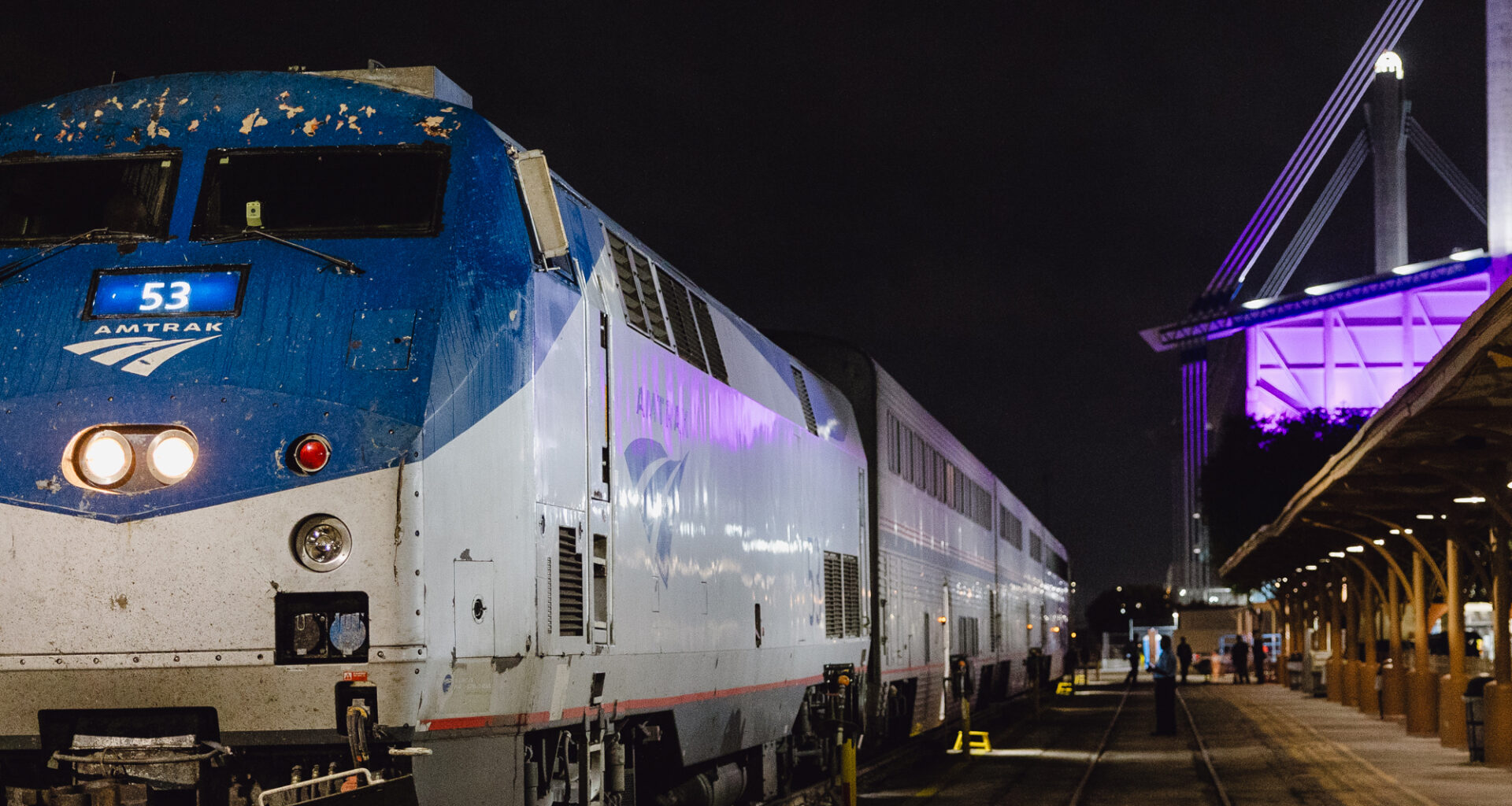
Passengers in San Antonio board Amtrak’s Texas Eagle train that heads to Austin. This service is poor, but a recent study from the Texas Department of Transportation says true passenger rail service between the cities is possible.
Christopher Lee / Staff Photogra
The most important takeaway from a recent Texas Department of Transportation study about passenger rail between San Antonio and Austin is that this is doable.

Passenger rail between two of the fastest-growing metro areas in the country — while also serving booming bedroom communities — need not be aspirational, hypothetical or consigned to the dreams of planners. It can happen.
Article continues below this ad
But making it happen will not only require Union Pacific, which owns the track and did not participate in the study, to work with state and local officials. It will also require political pressure from Gov. Greg Abbott and other Texas officials, as well as state investment.
Texas leaders repeatedly tout economic development, population growth and a business-friendly climate. Passenger rail between Austin and San Antonio fits this mindset and would be a game changer for Central Texas.
As reporter Richard Webner recently outlined, updating and improving Union Pacific’s tracks along Interstate 35 could support up to eight round trips between Austin and San Antonio per day without interrupting freight service.
The cost is also within the realm of possible: $810 million to $1.9 billion, depending on the infrastructure improvements. This cost is high, but the state has billions of dollars in reserve.
Article continues below this ad
Now, governments have a long history of lowballing costs and creating bureaucratic obstacles that bog down huge projects. Texas would need to guard against that, which is all the more reason for Abbott to apply political pressure.
There is so much to be gained. Service between Austin and San Antonio would take about two hours. Thousands of people would travel on the line each day, the study concluded.
We get it. Union Pacific officials have said they are focused on moving freight. But they should be willing partners in making this happen. They should care about investments that ease congestion and help make Austin and San Antonio better connected. The stronger and deeper the connections between these two cities, the better for the regional economy and all that freight Union Pacific is moving.
This should be a political priority for Abbott and company, who certainly know the mind-numbing, knuckle-whitening schlep on I-35 between Austin and San Antonio well. The growth in this region has been explosive in recent years, and there is no sign it will slow nor any indication that expanding I-35 will adequately serve the region’s population.
Article continues below this ad
Here are population growth figures from 2015 to 2025, according to data from the Federal Reserve Bank of St. Louis:
Travis County, home to Austin, grew from 1.18 million people to 1.39 million people.
Bexar County, home to San Antonio, grew from 1.89 million people to 2.16 million people.
Hays County, home to San Marcos, grew from 195,000 people to 304,000 people.
Comal County, home to New Braunfels, grew from 129,000 people to 209,000 people.
That’s an increase of roughly 670,000 people in these communities that share the I-35 corridor. More people. More vehicles. More congestion. Something must change.
Abbott is arguably one of the most influential and powerful public officials in the country. He should be going at this with full force.
Article continues below this ad
There is another potential route, but it is not nearly as promising.
As Webner reported, Travis County is studying a route that would follow Interstate 10 and the Texas 130 toll road, which would link downtown San Antonio and Austin-Bergstrom International Airport. Such a route could potentially undercut San Antonio International Airport, so it would likely need to be adjusted.
And, of course, Amtrak provides anemic passenger service between Austin and San Antonio, but it is scheduled at terrible times and takes forever. It is even less appealing than driving on I-35 at rush hour, which is a true feat.
Passenger rail could spur economic development between San Antonio and Austin in powerful ways, linking public universities, biomedical industries, conventions and sporting events.
Article continues below this ad
Politics is the art of the possible. With the right political will, passenger rail is entirely possible.
This editorial is a collaboration between the San Antonio Express-News and Austin American-Statesman editorial boards.