
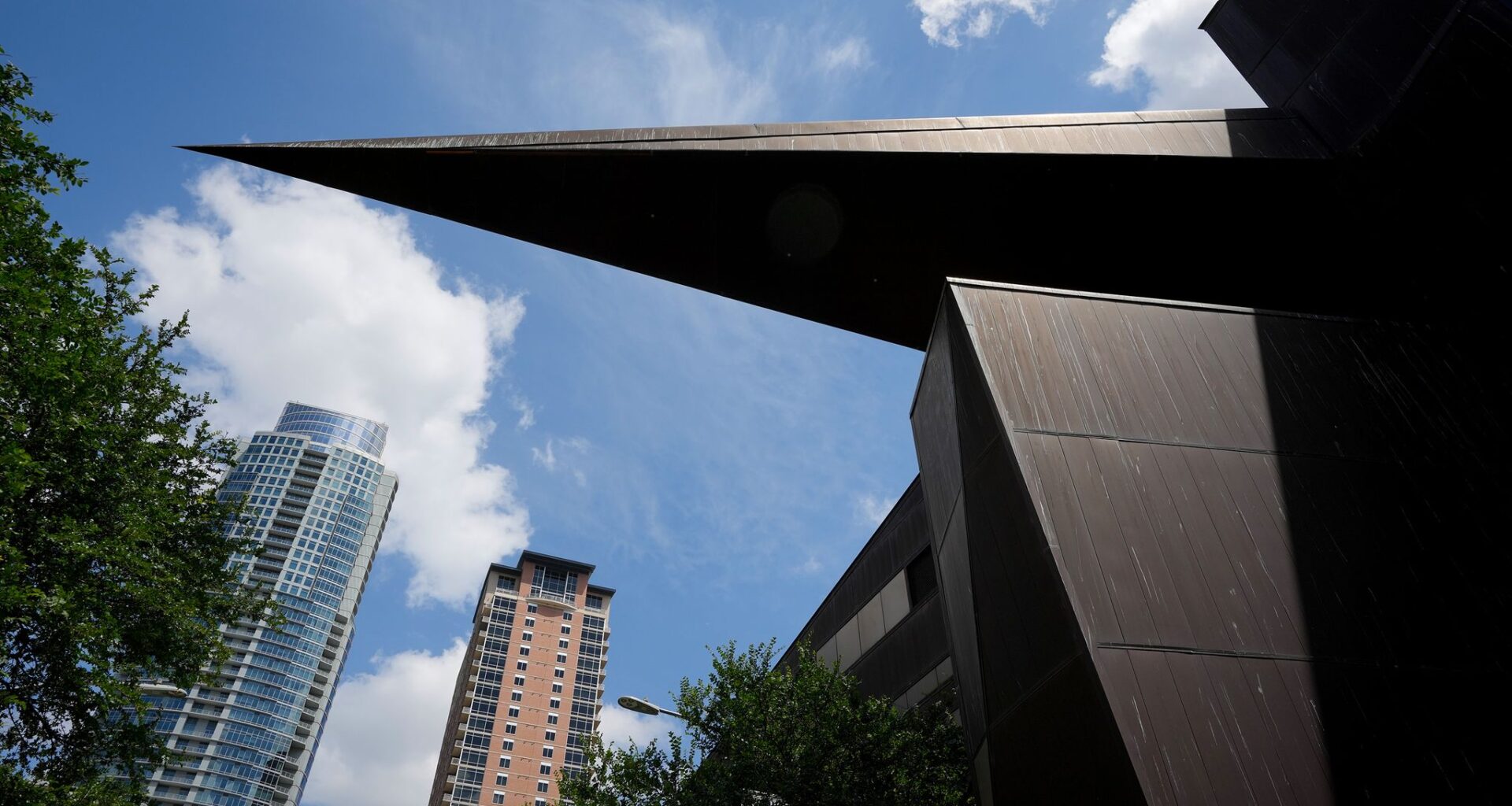
The “stinger,” an architectural feature of Austin City Hall, extends over West Second Street on Monday, May 18, 2026.
Jay Janner/Austin American-Statesman
Austin City Manager T.C. Broadnax and his staff will present their $6.6 billion budget proposal to the City Council on Thursday, opening a debate over a spending plan that would cut social service contracts, boost police spending and raise taxes and fees for residents.

The plan proposes closing a projected $26 million deficit through spending cuts, reallocations and additional revenue. It also boosts funding for some priority initiatives such as homelessness, parks and employee raises. Residents would pay more through higher utility and drainage fees and a 3.5% tax increase – the maximum allowed under state law without triggering a voter-approval election. Together, the increases are estimated to cost the average Austin homeowner nearly $346 a year, or about $29 a month.
Article continues below this ad
But the proposal is a starting point. City Council members can make changes to the spending plan before adopting a final budget Aug. 12.
In the days since Broadnax released the plan, the American-Statesman asked community groups, union leaders and City Council members for their thoughts on the proposal.
Raises win praise while proposed tax increase draws scrutiny
Marc Duchen, the most fiscally conservative council member, said he firmly opposes the tax hike and thinks Austinites won’t go for it, either. He cited voters’ overwhelming rejection last November of a city tax hike known as Proposition Q.
Article continues below this ad
“I appreciate the effort the city manager’s staff put into their initial proposal, but passing it as-is would require a major tax increase, something I firmly oppose,” he said in a statement. “That’s why my team and I are going through it line by line, looking for ways to reduce unnecessary costs.”
Duchen said the council should be able to protect essential services without imposing another increase that struggling residents cannot afford.
Austin City Council Member Marc Duchen, who represents District 10, speaks at City Hall on Thursday, March 12, 2026 in Austin.
Aaron E. Martinez/Austin American-Statesman
Mayor Kirk Watson said in an interview that he thinks city officials owe it to the public to look at all aspects of affordability, especially as council weighs whether to have a bond election in the fall. Watson said he started the budget process by asking for a no-new revenue forecast so that he and council could be more transparent.
Article continues below this ad
“At a time when I truly believe the public is feeling a significant pinch, I think we owe it to the public to explore all of the possibilities,” he said.
Council Member Zo Qadri meanwhile flagged a proposed $5.1 million reduction to social service contracts, saying it’s something he would “be paying close attention to” to ensure continuity of services, while praising the inclusion of a 3% cost-of-living raise for civilian city employees.
“It’s a meaningful step, and I want to continue building toward a long term commitment to regular cost of living adjustments so the people who keep our city running can keep pace with Austin’s rising cost of living,” Qadri said in a statement.
Austin City Council Member Zohaib “Zo” Qadri attends a press conference regarding the West 6th Street mass shooting in Austin Monday, March 2, 2026.
Mikala Compton/Austin American-Statesman
AFSCME Local 1624, which represents city workers, said the raise demonstrated a commitment to retaining the workforce.
Article continues below this ad
Union President Brydan Summers said that the group continues to support a progressive pay structure that would provide a flat-dollar raise for employees earning the city’s minimum living wage.
“In light of high inflation and economic uncertainty, we recognize that the workers earning the least should be uplifted,” he said in a statement.
He said the union also would remain involved in discussions about social service cuts because many city employees work with those programs and understand their value.
Some community groups question cuts to Austin’s social safety net
Social service contracts would absorb one of the largest reductions in Broadnax’s plan, with funding cut by $5.1 million. Budget documents do not identify which organizations or programs would lose funding.
Article continues below this ad
The proposal comes after Broadnax began scrutinizing contract spending and oversight following voters’ rejection last year of Proposition Q.
A coalition of more than 30 community groups called on city leaders in June to preserve social service funding by limiting growth in the Austin Police Department’s budget. Coalition members renewed those objections after Broadnax released his proposal.
“This budget does not reflect the needs or values of our community,” Paulette Soltani, director of the low income grassroots advocacy group VOCAL-TX, said in a statement. “Every dollar poured into policing and ineffective camp sweeps is a dollar pulled away from housing, services, and public health that keep our community safe.”
Paulette Soltani of VOCAL-TX speaks during a news conference about homeless encampment sweeps at the Terrazas Branch Library in Austin on Thursday, April 9, 2026.
Jay Janner/Austin American-Statesman
Yaneth Flores, political director for the reproductive justice group Avow Texas, questioned why the city would increase police spending when state law restricts its ability to later reduce or redirect that money.
Article continues below this ad
Hans Maverick, a policy and research organizer for Grassroots Leadership, said in a statement that the city should compare what it spends clearing homeless encampments with what it could invest in social services. Still, he said the budget could have been worse.
Walter Moreau, executive director of the housing nonprofit Foundation Communities, also said the reductions were not as deep as he had feared.
The Homeless Strategies and Operations Department’s budget would increase from about $10 million to nearly $32 million, largely because shelter contracts would be transferred from another budget category. Moreau said it remains unclear which contracts would move and whether Foundation Communities’ agreements would be among them.
Walter Moreau, left, Executive Director of Foundation Communities, and U.S. Rep. Lloyd Doggett speak at Foundation Communities’ Prosper Center South on Friday, Oct. 31, 2025.
Jay Janner/Austin American-Statesman
Police see gains, but firefighters and EMS seek more
The Austin Police Department would receive $549.6 million, an increase of $24.2 million, under the proposal. Much of the increase would cover staffing costs under the city’s five-year police labor contract, while recruiting also would receive additional funding.
Article continues below this ad
Austin Police Association President Michael Bullock said he had no major concerns about the proposal.
“We certainly recognize that we are the largest chunk of the general budget, but also, at the core of our city is public safety,” Bullock said. “While it is expensive, it’s also an investment that’s very important for the city to maintain and not make mistakes that have been made in the past.”
Austin Police Association President Michael Bullock, right, at City Hall Thursday October 24, 2024.
Jay Janner/American-Statesman
Austin Firefighters Association President David Girouard praised the proposal for funding a negotiated 3% wage increase for firefighters but questioned whether the proposed overtime budget would be sufficient.
Article continues below this ad
The city previously reduced the fire department’s overtime budget by about $8.3 million before approving a union contract. Broadnax’s proposal would restore $6 million of that funding.
Girouard said in a statement that the union wants the city to explain how that amount would support four-person staffing and meet operational demands when recent overtime spending exceeded the reduced budget.
Austin Firefighters Association President David Girouard at his swearing-in ceremony at AFA headquarters, Jan. 13, 2026.
Sara Diggins/Austin American-Statesman
Austin-Travis County Emergency Medical Services would receive $157.1 million, a $6 million increase. That’s the smallest increase among the city’s three public safety agencies.
Article continues below this ad
Austin EMS Association President James Monks said in a statement that he was disappointed that Broadnax’s proposal did not appear to make EMS a higher priority and urged the council to add funding.
Monks said that EMS currently has an 18% staffing shortage that “is going to take investment — as inconvenient as that may be for those in city leadership.”
Austin EMS drives on Riverside Drive during a winter storm in Austin Sunday, Jan. 25, 2026.
Mikala Compton/Austin American-Statesman
What happens next
Thursday’s presentation begins several weeks of public hearings, questioning of department leaders and council debate.
Article continues below this ad
Council members may restore cuts, reduce spending or change proposed taxes and fees before voting Aug. 12.
“I encourage community members to participate because this is the opportunity to help shape the final budget,” Qadri said.