
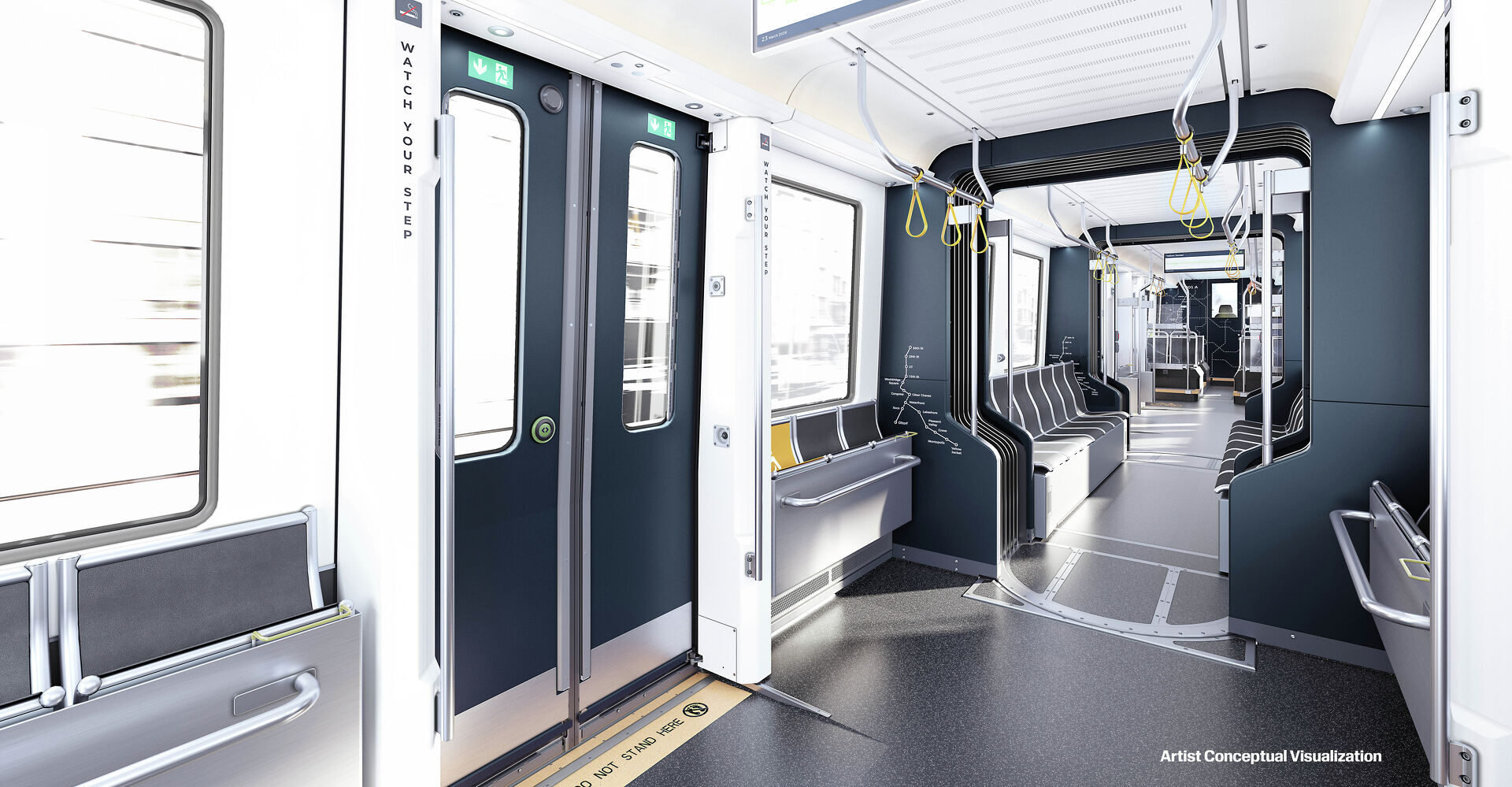
A conceptual rendering shows what the inside of Austin’s future light rail trains could look like when completed.
Austin Transit Partnership
Austin transit leaders on Wednesday approved the first phase of a $352.8 million contract to build the vehicles that will eventually carry passengers on the city’s long-awaited $7.1 billion light-rail system.

The Austin Transit Partnership board unanimously agreed to award $39 million to the U.S. division of Swiss company Stadler for the vehicles’ preliminary design. Future phases, including final vehicle design and manufacturing, must receive separate approval from the board before moving forward.
Article continues below this ad
The electric trains, which will carry about 240 people apiece, will be based on Stadler’s existing Citylink platform, but with some custom features. The vehicles will be designed alongside the rest of the system to maximize compatibility, ATP staff said.
Stadler beat out three other bidders to win the contract, according to ATP executive Brad Cummings. Stadler’s bid was the second lowest by a small margin, but the Citylink vehicles offer more features and better value, Cummings said. The model is currently in use across Europe and in Mexico.
Stadler U.S., headquartered in Utah, has produced vehicles for other Texas transit systems, including Capital Metro’s Red Line and Dallas Area Rapid Transit.
The Stadler contract marks the last of three major procurements for ATP, the local government entity responsible for building the voter-backed rail system. ATP previously chose Austin Rail Constructors — a joint venture between civil infrastructure firms Stacy Witbeck and Sundt Construction — to design and build the system. Kiewit Austin Partnership, another joint venture between Kiewit Building Group and Austin Commercial, will construct the maintenance facility.
Article continues below this ad
Questions over cost
The cost of the vehicle contract had raised concerns among those questioning the need for tailor-made vehicles as federal funding and legal challenges remain in limbo. The Federal Transit Administration has not yet awarded an expected $4 billion grant for the project, though it has signaled confidence in the plan.
“I want to make sure that we’re trying to be independent and challenge the staff on the bloats of contracts, because right now, as we all know, taxpayer money is at risk,” said Jeffery Bowen, a City Hall watchdog, during Wednesday’s meeting.
A conceptual rendering shows what the Austin Light Rail system could look like along the Drag.
Austin Transit Partnership
Voters approved the light-rail line in 2020 as part of Project Connect, a ballot measure that authorized a 20% increase to the city’s property tax rate for transit improvements. Under the plan, the city would transfer that revenue to ATP, which would use the money to repay bonds issued to finance the project’s construction.
Article continues below this ad
Early proposals envisioned as many as 28 miles of track across the city, but local officials later reduced the plan to fewer than 10 miles, citing rising construction costs. As currently envisioned, the light-rail system would stretch from 38th Street to Oltorf Street, while another branch would take passengers from near Lady Bird Lake to just inside Texas 71 near — but not to — Austin-Bergstrom International Airport. Construction could begin next year and finish by 2033.
A Monday report from CBS Austin (KEYE-TV) became a talking point during Wednesday’s meeting. In the report, New York University transportation expert Eric Goldwyn told the television station that the contract is “extremely expensive” and perhaps the priciest he’d ever seen. Dividing the total contract amount by the 21 vehicles ordered would put the cost at $16.8 million per vehicle.
By comparison, the Utah Transit Authority in Salt Lake City ordered 20 Citylink vehicles from Stadler for $129 million in late 2024. That’s $6.45 million per train.
But those numbers require additional context, according to Lindsay Wood, ATP’s executive vice president for engineering and construction. She said the $352.8 million is a “not-to-exceed” amount that includes contingency funding — not necessarily what the agency will ultimately pay for the trains.
Article continues below this ad
“Use of that number to try to figure out a cost per vehicle is incorrect math,” Wood said in an interview. “We hold roughly 25% of the contract value in contingencies and reserves to plan for a number of unknown future conditions: everything from market escalation to what spare parts we might need.”
Unique trains for unique needs
Wood also said Austin’s unique geography and system needs call for specially designed vehicles.
“Our alignment is far more hilly than most other light rail systems in the U.S., and we are basically maxing-out how steep these trains can run,” Wood said, meaning the vehicles will need additional motors to make sure they have enough power to get up the hills.
Article continues below this ad
Artist conceptual visualization shows how the light-rail line might look at the intersection of East Riverside Drive and South Pleasant Valley Road.
Austin Transit Partnership
The biggest difference between Austin’s trains and those in Salt Lake City is their length. Shorter trains used in other cities would not be able to accommodate Austin’s projected ridership, Wood said.
“If we just bought that off the shelf … we would need significantly more trains to carry the number of riders we are projecting,” Wood said. “We would have to buy twice as many vehicles, and the cost of twice as many vehicles, even if shorter, is far more than the cost of a longer, little-bit-uniquely designed” train.
Austin’s light-rail trains will also be the first in the U.S. to eliminate steps from the cars to better accommodate passengers with disabilities, Wood added.
Article continues below this ad
“We’re seeking something a little bit different here in Austin to remove as many obstacles to ridership as possible,” she said.
Mayor Kirk Watson, who serves as vice chair of the ATP board, emphasized that the contract approved Wednesday commits the agency to only a portion of the vehicles’ potential overall cost. It does not obligate the board to follow through with the full contract if obstacles arise — a critical safeguard given the uncertainty surrounding funding, he said.
“Today isn’t just about trains. It’s about how we’re going to govern during uncertainty,” Watson said. “We ask the taxpayers to trust us, and we will demonstrate that they can trust us if we recognize the circumstances we operate in and we respond.”
Article continues below this ad
Watson said it’s crucial to keep the project moving forward while protecting taxpayers from unnecessary financial risk.
“We only fund the work needed to preserve readiness, and nothing moves forward without us as a board saying yes again,” Watson said. “That’s what stewardship needs to look like: staying ready without writing a blank check.”