
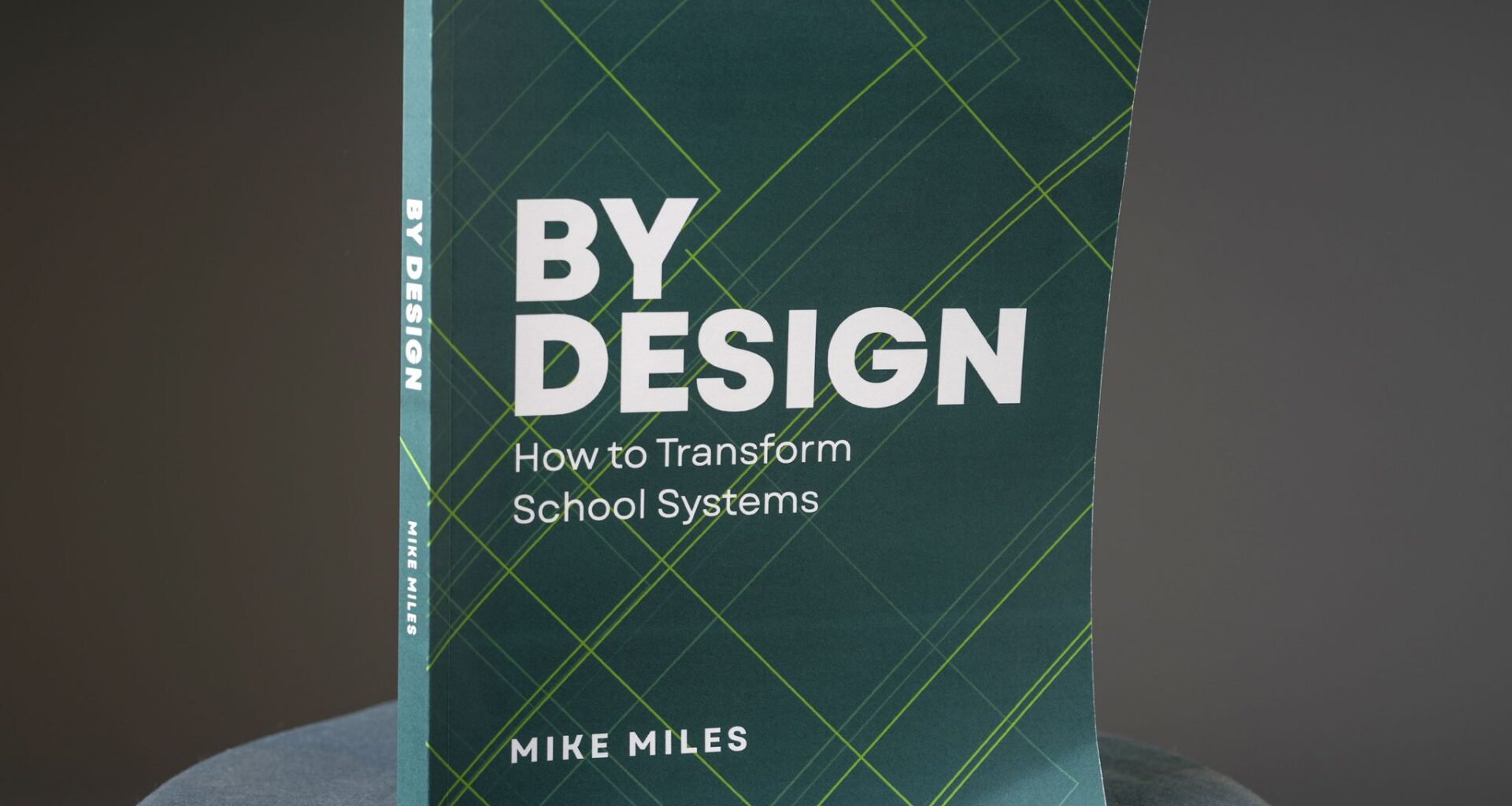
By Design, a book by HISD Superintendent Mike Miles, is shown in the Chronicle studio in Houston, Tuesday, July 14, 2026.
Brett Coomer/Houston Chronicle
In his new book, state-appointed Superintendent Mike Miles explains his thinking and strategy for education reform, using his controversial leadership of the state takeover of Houston ISD as a model for other school leaders.
Miles refers to HISD and his three years leading the district as the book’s main case study, citing examples like HISD’s pay-for-performance model, its crackdown on chronic teacher absences and “high-quality instruction” to illustrate his broader approach to systemic reform.
“These brief narratives are not presented as a template to be copied, but as illustrations of how systemic thinking can guide real decisions during periods of large-scale change,” Miles writes.
Article continues below this ad
The 200-page book offers rare insight into the thinking of Miles — a former Army Ranger turned leader of the state’s largest district — and how he approaches decision-making, working with a board, responding to criticism and more.
Amazon reviewers have largely panned the book, giving it an average score of 1.5 out of five stars. However, some Houston education leaders, such as Aldine ISD superintendent LaTonya Goffney, have expressed support for the book.
Here are five takeaways from “By Design: How to Transform School Systems” by Miles:
DISTRICT OVERHAUL: HISD will continue special education reforms. Experts say its plan conflicts with state orders.
Article continues below this ad
Governance is a ‘constraint to be managed’
Miles writes that the role of elected school boards in shaping accountability is “intentionally treated lightly” in the book. He says in many districts, governance plays a significant role in preserving the status quo or slowing reform. But he writes that it is a “constraint to be managed,” not a reason to abandon systemic reform.
Due to the state takeover, the Texas Education Agency appointed Miles and a nine-member board to oversee HISD in June 2023. Miles writes that while governance can limit the pace of change, school leaders can redesign systems even under elected boards. He cited his experience as superintendent of Dallas ISD as an example.
“In Houston, the presence of a non-elected, appointed Board of Managers created conditions that allowed for whole-scale system transformation without the typical forms of political interference,” Miles writes. “That context made it possible to move quickly, redesign accountability structure decisively and sustain focus on student outcomes.”
SCHOOL CLOSURES: HISD alumni, families scramble to preserve the histories of their closing schools
Article continues below this ad
Enforcing expectations for teacher absences
Miles uses the district’s approach to teacher attendance as an example of how he articulated — and consistently enforced — high expectations as state-appointed superintendent. He writes that 17% of HISD teachers were chronically absent in the 2022-23 school year, meaning they used more than the 10 days of leave allocated to them by the district and state.
Starting in 2023, he says teachers were not allowed to exceed 10 absences or request leave without pay after using their allocated days off. If a teacher exceeded those absences, the district initiated a formal review of their situation and moved to fire them if they were ineligible for further leave.
Miles said this policy drove down chronic absenteeism and helped students receive more consistent, high-quality instruction. He said fewer than 100 teachers were chronically absent at the end of the 2025-26 school year, and the district removed nearly all of those employees.
HISD teachers previously told the Chronicle that they were reprimanded for missing more than a handful of days and were asked to sign memorandums that warned them about “excessive absences.” Some teachers shared they felt scared to take days off, even for illness.
Article continues below this ad
“Some readers will no doubt view the attendance regulations as overly strict and insufficiently understanding of the challenges teachers face,” Miles writes. “That perspective deserves less weight when measured against the needs of students who depend on consistent, effective instruction from their assigned teacher.”
TEST SCORES: HISD’s reform schools see big STAAR gains. Here’s why some experts urge caution.
‘No vendors on the field’
Miles writes that “one of the most consequential steps” that HISD took to improve instruction and student achievement was cracking down on a heavy reliance on instructional vendors.
Before his administration, Miles wrote that HISD principals could purchase external services for their own campuses, resulting in a sprawling and “incoherent” marketplace of vendors and contractors. He implemented a “no vendors on the field” policy for HISD, which prohibited vendors from training employees on instruction. He said the policy cut purchased services by more than $60 million in his first year.
Article continues below this ad
Miles writes that districts will always need specialized expertise in areas such as medical services, legal compliance, information systems or technical operations. However, he writes district leaders should train principals and teachers on instruction — not vendors.
“Instruction should not be treated as something external experts deliver,” Miles writes. “It is the school leader’s most important responsibility and should not be abdicated.”
As superintendent, Miles has invested heavily in developing HISD’s own curriculum, which all schools in the New Education System model must teach. However, nearly all schools in HISD, including high-performing campuses outside the reform system, use the district-developed lessons in some capacity.
BUDGET: HISD passes $2 billion budget, with $25M deficit heading into 2026-27 school year
Changing student promotion requirements
Miles writes that schools currently promote students to the next grade based primarily on “time spent in classrooms” and not their academic readiness. He urges district leaders to take a different approach.
“District leaders should ask a more fundamental question: What must a student truly demonstrate before moving to the next stage of learning?” Miles writes. “If the answer includes competencies such as critical thinking, problem-solving, collaborating, leadership or civic awareness, then those competencies must be intentionally taught, practiced, and assessed.”
Miles notes that, as HISD’s superintendent, he did not immediately make changes to student promotion requirements. In HISD, students are promoted to the next grade level if they earn at least a 70 in core subjects and attend at least 90% of classes.
However, HISD plans to recommend a change to literacy promotion requirements for students to advance to third grade starting in the summer of 2028. HISD’s state-appointed board will have to approve that change first.
In 2026-27, students at HISD’s nine Future 2 schools must complete a two-year sequence of coursework, experiences and workshops to move on to the next grade. The schools are supposed to prepare students for an AI-focused world.
Future 2 students also must have an attendance rate of at least 93% and pass the reading and math STAAR exams, or score in the top 40% nationally on the MAP exam.
Advice for handling personal attacks
Miles outlines a list of how he handles personal attacks, including holding onto a “warrior’s spirit” and knowing that his actions are an “absolute good” because they are putting children first. He also tells readers that critics “do not know you” and the “tyrannical five percent” are going to be much louder than reasonable people.
He warns school leaders that they will face anger, mistrust and hatred from people prioritizing adult issues, such as board members aiming to appease the loudest critics, politicians marching with protesters against change, and news editors abandoning their “professional ethics to get clicks, a Pulitzer or a promotion.”
“No one can truly prepare you for the dark days or for what it feels like to face a crowd whose sole objective is to attack you personally and defame you,” Miles writes. “Everyone must find their own way to stay strong.”