
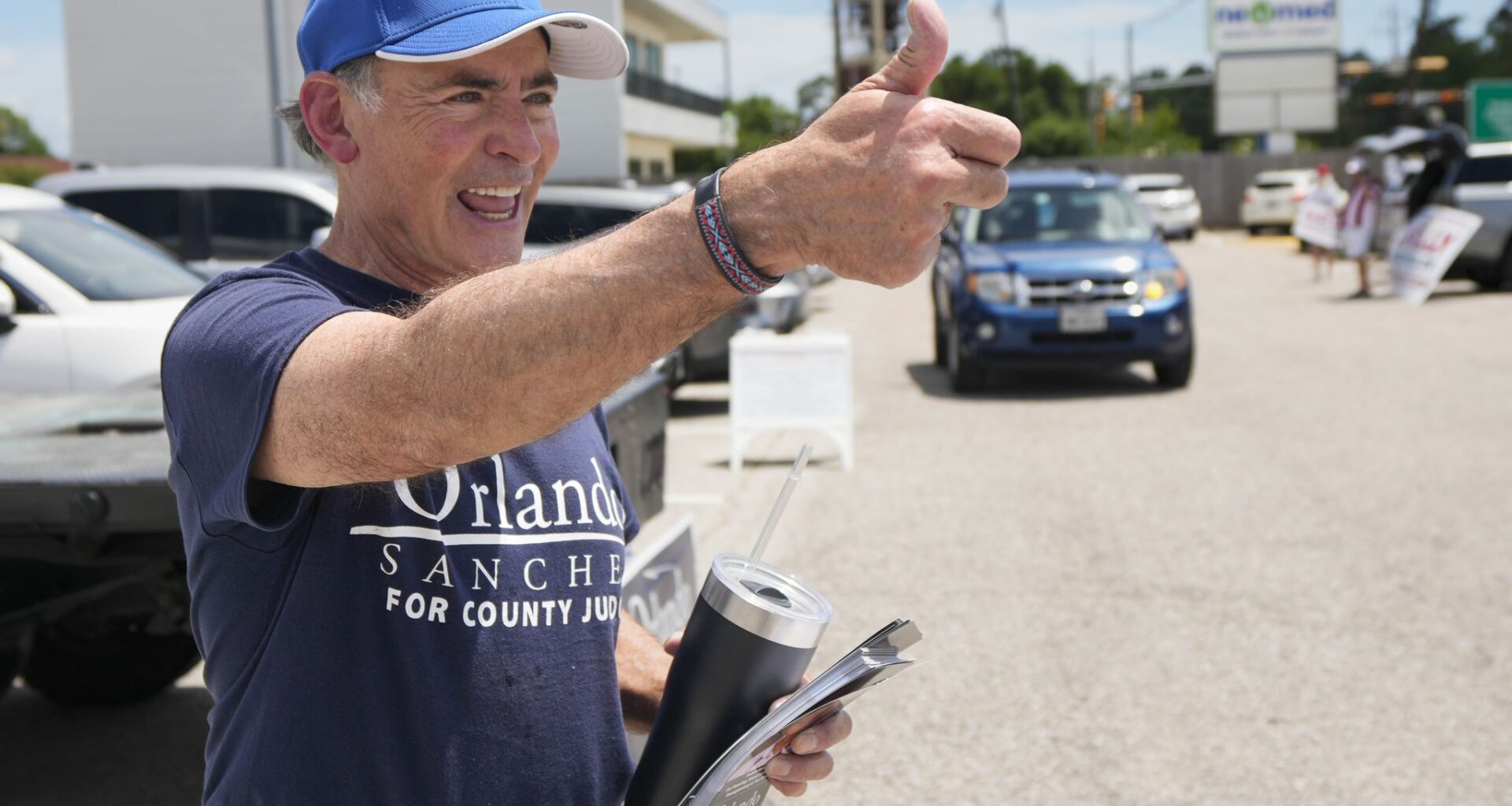
Orlando Sanchez, who is running for the Republican nomination for Harris County Judge, greets voters at a polling place in the Trini Mendenhall Community Center in Houston, Tuesday, May 26, 2026.
Brett Coomer/Houston Chronicle
In the closely watched race for Harris County judge, Republican nominee Orlando Sanchez outraised his Democratic opponent, Letitia Plummer, by roughly $35,000 from May 17 to June 30, according to campaign finance reports.
The July 15 filings are the first to be published since the May primary runoffs, and the pair have only just begun to turn their attention to November. But their campaigns have received renewed attention from donors: Both candidates received more contributions in the recent six-week reporting period than in the last six months of 2025.
Both parties’ contests this spring ended with runoff elections. Plummer delivered a narrow upset to former Houston Mayor Annise Parker, while Sanchez cruised to victory over businessman Warren Howell. Incumbent Harris County Judge Lina Hidalgo is not seeking re-election.
Article continues below this ad
The new reports show Sanchez brought about $181,100 during the period and spent about $66,300. Plummer collected about $145,900 and spent about $70,500.
Sanchez had $132,680 on hand as of June 30, and had an outstanding loan from himself for $234,513. Plummer finished with $70,161 and an outstanding loan of $45,000.
“Sanchez has been a strong fundraiser in every office he’s run for and has got deep ties to the Houston community,” said University of Houston political scientist Brandon Rottinghaus. “Republicans are also hungry for a win, particularly business leaders and fiscal conservatives.”
Article continues below this ad
BIGGEST GIVERS: Who are the top donors to Harris and Montgomery county officials? Here’s the top 5 in each county.
But fundraising will be more crucial for Sanchez than for Plummer, Rottinghaus said.
Democrats are headed into November on strong footing as outrage to Trump administration policies builds among progressive voters, he said. Coupled with a competitive race for U.S. Senate topping the ballot, Rottinghaus said down-ballot Democrats are likely to benefit from the excitement generated by their counterparts running for statewide offices.
These broader headwinds mean Sanchez will have to significantly outraise Plummer to compete, he said.
“This is going to be a race where message beats money,” Rottinghaus said. “The message is what’s important, so in that way, the fundraising advantage that Sanchez has is sort of nullified.”
Article continues below this ad
Commissioners races
Two of the four county commissioner seats also are on the November ballot, and both are contested by incumbents.
“Incumbency, especially in commissioners court battles, provides a major fundraising advantage,” Rottinghaus said. “Most people aren’t excited about these races, so the money is likely to come from people who have business with the court.”
Challengers in both races ended the reporting period with roughly one-tenth the cash of their incumbent opponents. Unlike the race for county judge, the data included in the commissioners’ reports covers a six-month period.
Article continues below this ad
Precinct 4 Commissioner Lesley Briones, a Democrat, is running against Republican Steve Radack, a former Precinct 3 commissioner who left office in 2020 after 32 years in the seat.
Briones collected more than seven times what her opponent did during the period, and had more than $4 million on hand as of June 30 to Radack’s $482,649.
Precinct 2 Commissioner Adrian Garcia, also a Democrat, is running against Republican Richard Vega, a pastor and political newcomer.
Article continues below this ad
Garcia raised more than nine times what Vega did during the period, and finished with a remaining balance of nearly $2.5 million to Vega’s $35,744.
Already well behind on fundraising, Rottinghaus said the challengers on the ballot face will have to find another way to amplify their messages to voters.
Commissioners have significant staying power, he said, and unseating them requires either a major political scandal or sweeping political movement, such as the 2018 Blue Wave, which saw Democrats swept into office across county government.
“You would need a major disruption politically that changes the balance, or some kind of glaring, ethical or financial problem that voters are totally offended by, and those are hard to come by,” Rottinghaus said.