
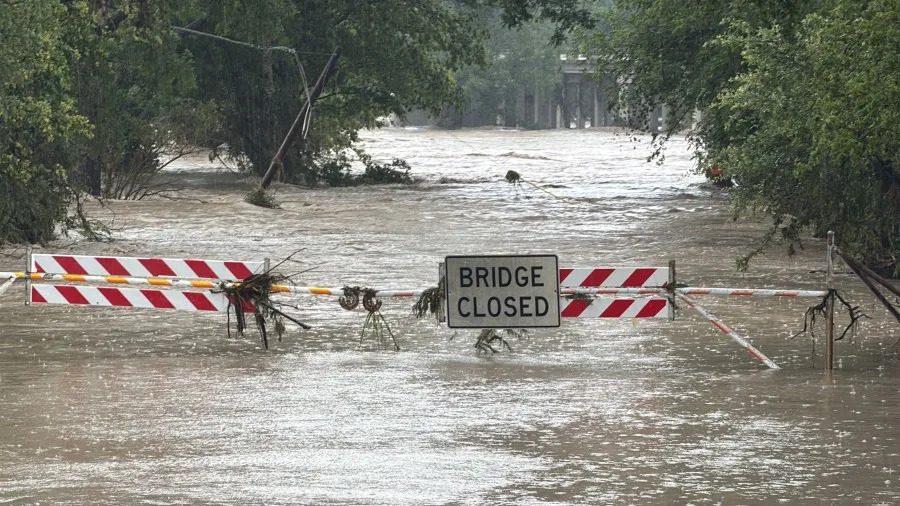
AUSTIN (Nexstar) — Summer camp operators in Texas’ Hill Country were on high alert for severe flooding Wednesday and Thursday.
This week’s flooding has had striking similarities to the catastrophic floods on July 4, 2025, which topped the banks of many of the same rivers. That storm took the lives of at least 138 people, 119 of which were in Kerr County. At Camp Mystic, near Hunt, Texas, 25 girls and two counselors died during the flood.
‘Catastrophic’: How the July 2025 flash flood disaster unfolded
Since then, camp operators in the area have been extremely watchful for weather problems and camper safety, said Kathy Ragsdale. She started the Camp Stewart for boys in Hunt 60 years ago with her late husband.
“After last summer, everyone is super vigilant and hypersensitive,” said Ragsdale, whose son now operates the camp. “We were fortunate, but we had probably an 8-to-9 foot river rise. It’s going down now, but the low bridges still should not be crossed.”
The campers at Stewart were all safe, and the water didn’t come close to buildings, Ragsdale said by phone this week. A KXAN crew attempted to reach Camp Stewart but couldn’t, due to high water and road closures.
Live updates: One death confirmed as Flash Flood Emergency continues in Central Texas
KXAN reached out to more than 30 other overnight youth camps in the Hill Country on to ask about the flood impact. Nearly all of the camps that responded had no issues with flooding or camper safety.
One camp, Camp La Jita near Utopia, evacuated its campers on Wednesday. They were bussed to a Girl Scouts headquarters in San Antonio.
“As we closely monitored weather forecasts, National Weather Service updates, and conditions at Camp La Jita throughout Tuesday, we recognized that while the Sabinal River had not yet reached flood stage, conditions had the potential to change rapidly,” said Lisa Garcia, director of property at Girl Scouts of Southwest Texas, which runs La Jita. “Rather than wait until conditions worsened, we made the decision to evacuate out of an abundance of caution.”
Other camps said they were watching the weather and operating on rainy-day protocols.
“There has not been any flooding or threat to campers or guests,” said a representative of Presbyterian Mo-Ranch Assembly camp near Hunt on Thursday.
Brandon Briery, chief operating officer of CAMP Camp located near Center Point said operations were continuing and all were safe.
“While the Guadalupe River has risen to very high levels, similar to last year’s July 4th flood, here at CAMP Camp all are safe on high ground, where all of our buildings are located, and are enjoying rainy day activities,” said Briery. “I can reiterate that there has been no threat to people or buildings at Camp CAMP, and due to the geography of our property, we do not expect any. Skyline Drive, which leads to Camp CAMP, is currently closed, but we have all resources we need to continue with our regular rainy-day plans.”
Briery said updates are available on the camp’s website and social media channels.
All Texas youth camps operating this summer have come under increased regulation by the Texas Department of State Health Services, following law changes in Senate Bill 1 last year that were prompted by the July 4, 2025, floods.
Camps now have stronger oversight, enhanced inspections, and there are new requirements for emergency operations plans and communication requirements.
Lawmakers received an update on the new rules at a July 8 Senate Committee on Health and Human Service hearing. DSHS Deputy Commissioner Timothy Stevenson said there were 307 camps licensed this year compared to 378 in 2025, and 107 camps that were licensed last year did not apply for licensing this year.
Regarding that decrease in licenses, DSHS spokesperson Lara Anton said that camps are not required to inform the department if they “do not want to renew or when they change their program so that they do not need a youth camp license.”
“Some camps changed the number of specialized activities that they do so that they no longer meet the definition of a ‘youth camp’ and therefore, do not need to be licensed by DSHS,” Anton said.
Youth camps offer at least two specialized activities. By only offering a single activity, the camp wouldn’t require a DSHS youth summer camp license, Anton said.
Stevenson ran through an extensive implementation process for the new laws, including reviewing camps’ emergency plans.
“Not a single plan was approved the first time,” Stevenson said.
He also noted that internet fiber optic connections required by the new law were “a big issue for a lot of camps.”
Every camp is undergoing two inspections, including an operational inspection once camp season has started, he said. Going forward, a multi-disciplinary safety committee will give advice on camp rules, implementation and suggestions on revisions to the laws, Stevenson said.
Flood warning sirens ‘put to the test’
Newly installed flood warning systems were tested Thursday morning as historic rainfall hit the same Hill Country areas where more than 100 people died during the July 4 floods more than a year ago.
Following the devastating floods last year, Gov. Greg Abbott signed a new law requiring outdoor warning sirens in 30 flood-prone areas. The state allocated $50 million in grants to assist local entities with the purchase, instillation and implementation of the new warning systems.
INVESTIGATION: New Hill Country flood sirens activated for first time since being installed
“When you lose more than a hundred fellow Texans in a single night, you can either look away or recognize the obvious and fix the problem. We chose to fix it,” said Texas State Sen. Paul Bettencourt, R-Houston, who authored the flood warning siren bill.
Bettencourt said the new siren warning system was “put to the test” and “proved effective in delivering early warnings when they were needed most.”
State Rep. Virdell says awareness helped save lives in latest flood
State Rep. Wes Virdell has a unique perspective on the deadly flooding in Texas.
Virdell’s House district includes Kerr County, and he was on the ground last July in response to the flooding that killed more than 130 people across the Hill Country and Central Texas. A year later, Virdell is once again on the ground aiding in the county’s flood response.
Virdell says that while water levels are comparable to last year’s flooding, he noted a key difference this time around.
“When we look at the flood that happened, you know what hit Camp Mystic, everybody went to bed that night without a lot of indication that they were going to have a 30 foot wall of water coming down down the river,” Virdell said. “This time, the difference is, for about two days before the flood hit here, our neighboring counties ended up having a lot of rain and a lot of flooding, so people were very aware there.”
While there has been praise for the effectiveness of flood sirens, Virdell said Texas lawmakers need to provide more funding to help local communities cover the cost of the requirement for the warning systems.
“I think if the state’s going to mandate that we have these sirens and they need to pay up to do that,” Virdell said. “Right now, I think they allocated around $50 million divided to 22 counties or 29 counties, which is not enough,” he added.
Rep. Virdell said that he’s already hearing concerns about long-term needs to help people recover from this latest devastating flood.
“There’s a lot of damage we’re trying to, we’re going to have to work through,” Virdell said. “It’s going to take weeks, maybe even a month to figure out how much damage is actually out there.”
Families evacuate amid flood devastation in Uvalde
Early Thursday morning, another round of thunderstorms and heavy rain drenched an already saturated Uvalde County. Its river and tributaries swelled to the highest levels some lifetime locals had ever seen, dissecting the town into different sections where people could not cross the flooded city streets.
Since Monday, more than two feet of rain has fallen on some parts of Central Texas. At least 28.23″ of rain fell in the Knippa area in Uvalde County. The rising water forced several families to evacuate their homes throughout the county. Some had to be carried to safety by helicopters and rescue boats.
‘It literally has destroyed everything we have’: Uvalde resident describes flood devastation
The American Red Cross began working with Uvalde emergency management Wednesday to provide shelter and other assistance for displaced residents.
Betsy Calderon with the American Red Cross said volunteers are needed to support relief efforts.
“Volunteers are always needed,” Calderon told KXAN Wednesday. “So if you want to help your neighbor in need, you can definitely volunteer by signing up at redcross.org.”
Copyright 2026 Nexstar Media, Inc. All rights reserved. This material may not be published, broadcast, rewritten, or redistributed.
For the latest news, weather, sports, and streaming video, head to KXAN Austin.