
The Houston City Council hosted its usual public session on Tuesday, a week to the day Lorenzo Salgado Araujo was shot and killed by an ICE agent in the East End. The council was also commemorating World Refugee Day, so, along with issuing a proclamation “to honor the courage, resilience, and contributions of refugees and to raise awareness of their rights, needs and aspirations,” Mayor John Whitmire found himself submitting to three hours of outrage from Houstonians alleging that he and the council had failed to protect its people, resulting in the death of one of the city’s very own aspiring citizens. The crowd was mostly Latino, but speakers of all ages, all races, all creeds came from all parts of town to take the podium and shame the mayor and council members, despite Whitmire’s attempt when he opened the meeting to pull everyone together. “The pain has not subsided,” he said, adding that the city would “make certain that everything is done to support this family.”
The problem with the shiny-pated, always nattily dressed Whitmire is that his passion monitor never seems to go beyond 49 on a scale of 0 to 100, leaving the impression that he lacks that empathy thing, at least in public. On this day in particular, he exuded the put-upon demeanor of a monarch meeting with unruly subjects, sinking lower in his high-backed leather chair as the grievances and remonstrations piled up. Around 150 people signed up to speak in the council’s vast art deco chamber—a record, one police officer told me. The same amount or more crammed into folding chairs on risers in an overflow room, many chanting “Justice for Lorenzo” and wearing T-shirts emblazoned with everything from “Chinga la Migra” to “The Bible Is About Immigration” while watching the drama unfold one floor up.
The message many residents shared was encapsulated best by the words of activist, influencer, and DACA recipient Frida Adame—26,000 followers on Instagram, 157,000 followers on TikTok—who could claim “I told you so.” A pretty, petite young woman with wide eyes, a fashionable ombre do, and Clarence Darrow delivery, she raised one fist as she read her speech from her phone with her other hand. “WE . . . are being hunted like DOGS! WE are getting killed! And no one is doing ANYTHING!” she began, proceeding to remind the civic leaders that she had come before them in January to demand that they send ICE packing. “I asked this council, ‘Must you wait until it happens here in Houston? Must one of your own DIE before you ACT?’ You did nothing. Now a Houstonian is dead.” One by one, others took the podium to echo her sentiment. “You work for US!” more than one speaker admonished.
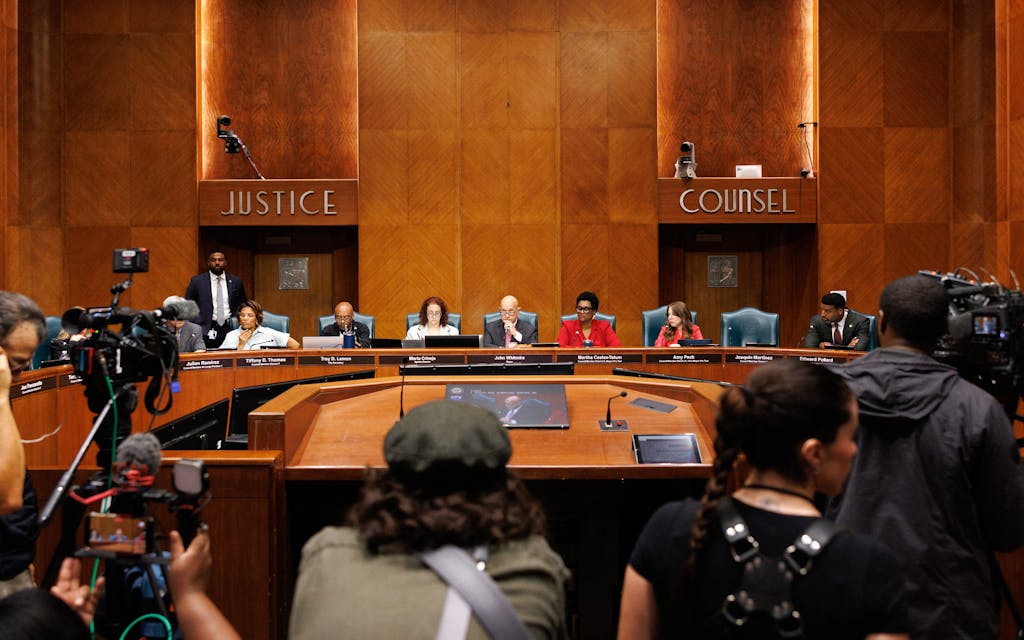 Houston Mayor John Whitmire speaking at the city council meeting Tuesday.Mark Felix/AFP via Getty
The mayor didn’t like it one bit—and, failing to read the room, he griped about the crowd’s “bad behavior” on Wednesday. But the mayor and council’s delicate sensibilities aside, it was heartening to see residents claiming their places in the community, where, after all, Hispanics and Latinos make up 46 percent of the city’s population, and about 21 percent of Hispanics in Harris County live below the poverty line, which has historically made them all too easy to ignore. Here, at the council meeting, the flex of new power seemed to be appearing in real time. But that public outrage was buttressed by something old: The sometimes fractious Harris County Latino caucus was clearly acting as one to push for answers about ICE’s actions; from precinct chairpeople to lawmakers in the nation’s capital, politicians ratcheted up the pressure and called in chits behind the scenes. Congresswoman Sylvia Garcia and state Senator Carol Alvarado, both of whom have spoken out about the shooting, campaigned hard for Whitmire in his hotly contested mayoral campaign against Congresswoman Sheila Jackson Lee. We can assume Whitmire, known as dean of the Texas Senate for his longevity in the statehouse, understands the loan requirements of the political favor bank.
This combo of new and old could mark a tipping point in Latino power in Houston, made evident by the mayor’s about-face—oh, right, okay, we will have a transparent investigation with local input!—and even the governor’s declaration that the Texas Rangers will be conducting an independent investigation into Salgado’s killing. (Though cynics have questioned how independent the investigation will be and pointed to the agency’s checkered history.) As my colleague Michael Hardy pointed out this week, election and reelection campaigns are coming on fast, and if upsets in other states are any indication, no incumbent should feel too comfortable.
More important, though, the killing of Salgado, like that of Houstonian George Floyd in Minneapolis, has held up a mirror to the rest of the city—to show us who we are, not who we like to think we are. Houstonians put up with a lot on a daily basis—bad roads, bad bugs, floods, a nearly unlivable climate for half the year—but its diversity is a source of enormous pride. Since the Trump administration began its immigration purge, just about everyone knows someone who has been swept off the street or who lives in fear of it. Spreading that fear is the point, after all; the question is who will mitigate it for our neighbors, in public demonstrations and in private conference rooms from city hall to skyscrapers where C-suite executives run companies that depend on immigrant labor.
Salgado was like so many hardworking Houstonian immigrants. Every morning except his last was typical—rounding up his crew to build houses, eating a lunch his wife had packed, traveling through a city that had long ago made clear that his undocumented status was not a problem because his labor was needed for that city to grow. In his 35 years in the U.S., Salgado, who ran a construction crew, probably paid more taxes than some high-ranking public officials. In exchange, his children had more economic opportunity, having been raised here and educated here. In the tidy, working-class neighborhood of Magnolia Park, where Salgado was killed and near where the family made their home, most of the houses are small but well maintained, with gardens out front. It’s one of those places where everybody still knows everybody else—and their grandparents and grandchildren, and who is having a quinceañera and who is graduating from college. Established around 1890, it’s one of Houston’s oldest Latino neighborhoods. Yet Magnolia Park remains terra incognita to many Houstonians, just one indication that “otherness” still lingers for many Latinos here.
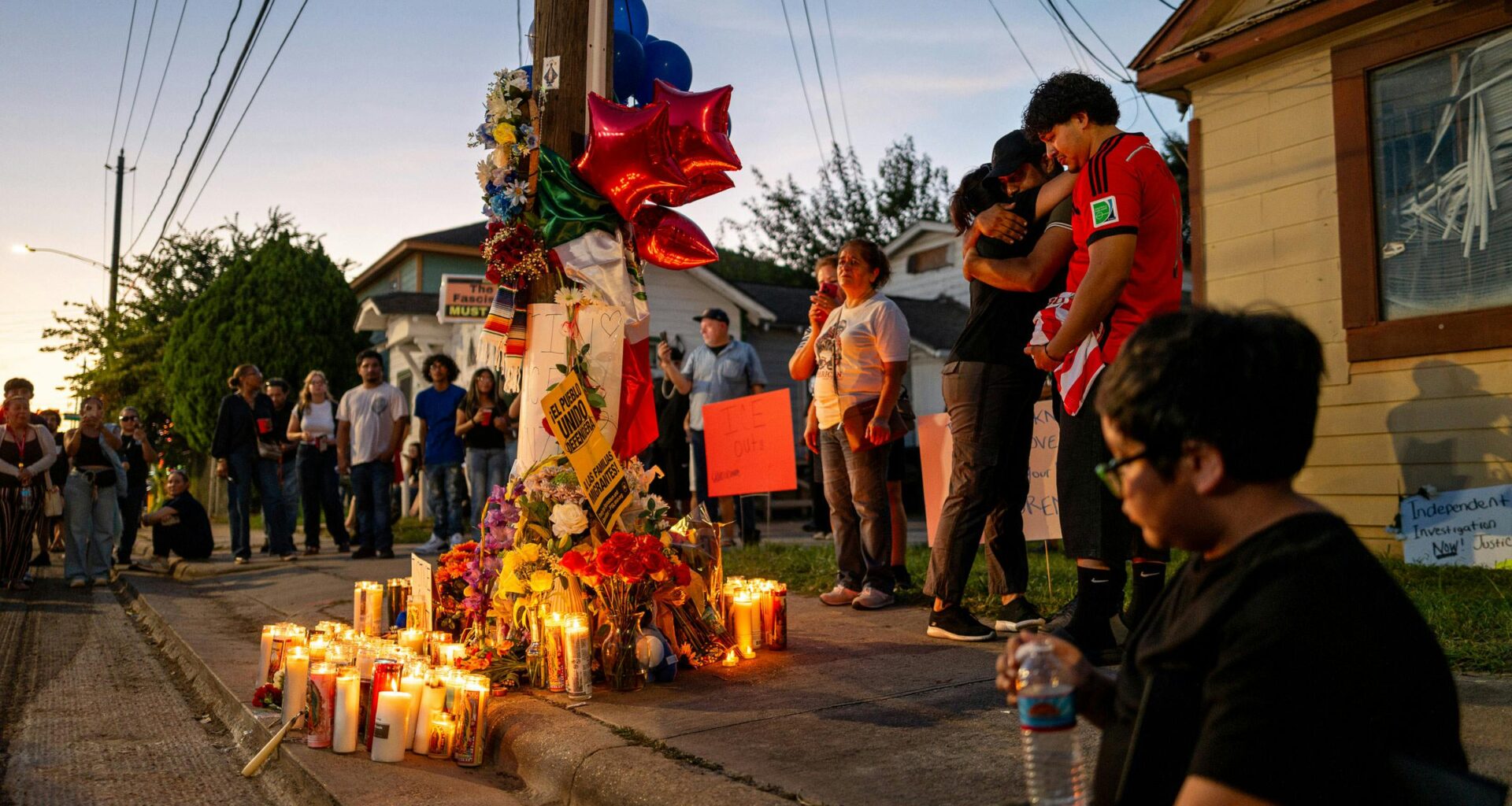
A few days before the council meeting, on Saturday, a now all-too-familiar homemade memorial sprang up at the spot where Salgado was shot on Canal Street, a main thoroughfare of Houston’s East End. In front of a frame house converted into a barbershop, mourners left cellophane-wrapped bouquets, votive candles, and handwritten signs in English and Spanish. “You can’t love our culture but hate our people,” read one.
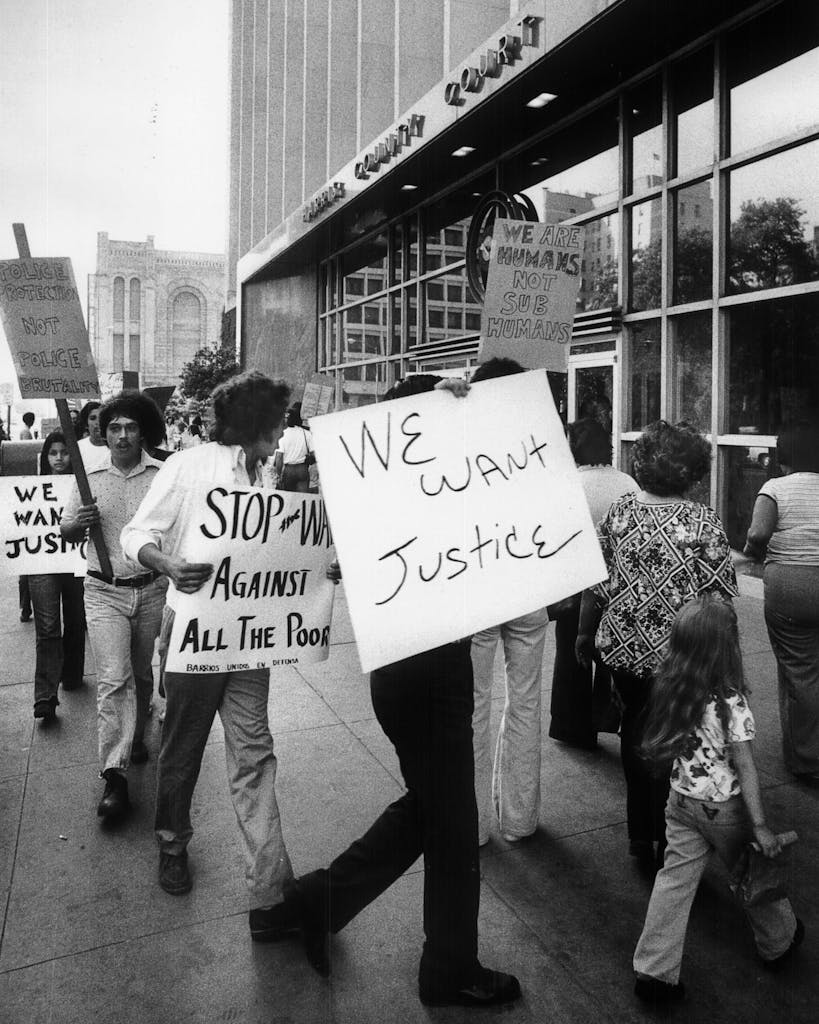 Protesters marching outside a Harris County court building on May 18, 1977, to protest the killing of José Campos Torres.Curtis McGee/Houston Chronicle via Getty
A younger, overwhelmingly Latino crowd milled about while an impromptu cortege cruised by in everything from Land Rovers to lowriders. Suddenly a small older woman stepped in front of the gathering crowd. Her graying, henna-shaded hair was pulled into a tight bun, her cheekbones so high and sharp they seemed struggling to escape her luminous brown skin. “Who remembers José Campos Torres?” she asked, referring to the American citizen and Army veteran beaten and left to drown in Buffalo Bayou by several Houston police officers in 1977. Only a handful of people raised their hands; most of those in the crowd hadn’t even been born then.
“He was my brother,” Janie Torres continued, and for the next twenty minutes or so, she acted as both a modern-day Cassandra and living proof of the lingering effects of trauma on a family. “The government did nothing,” she said, an indictment that encompassed local officials and even the largely ineffective Justice Department investigation. It was Torres’s martyrdom that galvanized his own community and made for more opportunity, more power, and more safety for its residents, documented or not. It’s a shame and a stain that Houston finds itself here again.
Read Next