
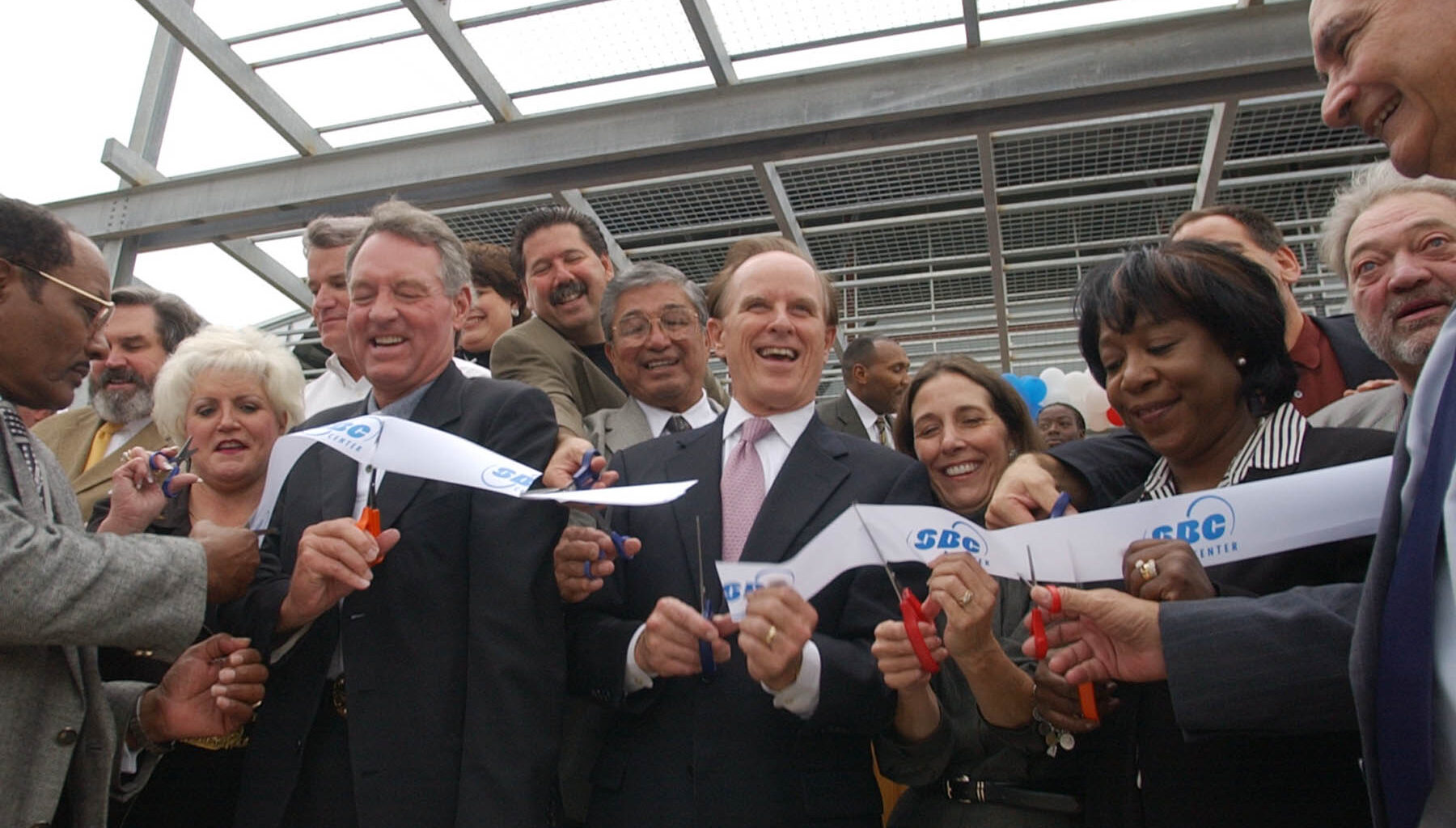
Peter Holt, chairman of the Spurs; County Judge Nelson Wolff; former county judge Cyndi Taylor Krier and Ruth Jones McClendon join others in cutting the ribbon to officially open the new SBC Center in 2002. Questions abound as to whether promised revenue sharing ever happened.
Billy Calzada/San Antonio Express-News
Mayor Gina Ortiz Jones has called for revenue sharing to be part of an arena agreement with the San Antonio Spurs. Revenue sharing with the Spurs is possible, but only if contracts are vetted and enforced.
Sam Owens/San Antonio Express-News
Mayor Gina Ortiz Jones’ request that the Spurs share revenues from a new arena is being treated as novel. It isn’t.

Revenue sharing, including a cut of tickets, concessions, parking, merchandise and naming rights, was a major selling point of the 1999 election campaign to build what is now called the Frost Bank Center.
Article continues below this ad
As Bexar County and the city of San Antonio negotiate a new downtown Spurs arena, officials should first answer a simple question: What happened to the revenue-sharing deal for the current one?
In 2015, the Express-News Editorial Board asked that question. After reviewing the paper’s investigation examining years of financial results, the board said “it seems” the 2000 arena agreement “was structured to only pay lip service to revenue-sharing,” that voters were “essentially misled” and that it was “troubling” that local officials appeared unconcerned.
Noting that county officials told the paper that the agreement “was never expected to produce any money,” the board responded bluntly: “Um, maybe Bexar County officials didn’t expect to make any money from the agreement, but the public sure did.”
The board urged the county and Spurs to modify the deal to honor the promises made to taxpayers before the 1999 vote.
Article continues below this ad
That never happened. But questions remain.
In 1999, the city offered the Spurs a downtown arena with significant public profit-sharing provisions. Bexar County countered with a more generous proposal but faced a challenging tax election.
After marathon negotiations just days before the vote began, county officials announced what they described as major concessions: Taxpayers would receive 20% of naming-rights revenue above $1.875 million annually and 20% of profits from non-Spurs events above $4.75 million.
County Judge Cyndi Krier called the agreement “great for the Bexar County taxpayers.” Commissioner Paul Elizondo declared, “We laid it on them,” describing how the county had forced the Spurs to negotiate naming rights. Spurs Vice President Leo Gomez told the Express-News taxpayers could benefit from the naming-rights provision “in the first year.”
Article continues below this ad
The message to voters was unmistakable: Taxpayers would share in the arena’s financial success.
The vote passed. But the deal wasn’t yet on paper.
When the agreements were finalized in the summer of 2000, Express-News columnist Carlos Guerra criticized the deal. Guerra explained that internal consultant projections showed the “non-Spurs profits” subject to revenue-sharing were expected to remain below the threshold required for any public payment. Moreover, the naming-rights deal was structured to exclude sponsorship revenues included in other NBA deals, and taxpayers would see little from that either.
A 2008 Bexar County audit confirmed Guerra’s projections. The county had received no money from either revenue-sharing provision.
Article continues below this ad
As summarized by the Express-News in 2015, the audit found that no revenue was received because, under the agreement, “most revenues belong to the Spurs and most expenses belong” to Community Arena Management, or CAM, the Spurs-controlled operating company whose profits determined whether the county received any payment. The Spurs kept the lucrative basketball-related revenues while CAM accumulated more than $82 million in losses.
But the naming rights story wasn’t fully explained.
In 2000, SBC agreed to pay $41 million over 20 years for the arena’s naming rights. County officials celebrated the agreement, chastising critics who said the county “would never get a dime.” Krier projected that taxpayers would receive “a lot of dimes” — approximately $1.1 million.
The payments were backloaded, but Elizondo stated that the county would begin receiving payments around the seventh year of the contract, once annual payments exceeded the $1.875 million threshold.
Article continues below this ad
The 2008 audit also noted that the Official Statement for the 2000 Series Bonds contained a statement that the Spurs projected the county would receive $1.133 million from the naming-rights agreement. It recommended further audits.
Since then, the naming rights have passed from SBC to AT&T and now Frost Bank. Public reports value the current agreement at roughly $9 million annually — far above the original trigger. The new deal is not public, which is troubling given the county is a beneficiary of it.
Has the county received the revenue promised? Was the agreement amended? Was the Frost deal structured to avoid the threshold?
County officials should answer those questions.
Article continues below this ad
They should also examine Community Arena Management. Once the team moves downtown, taxpayers will inherit operating costs for an aging county-owned arena that has lost millions on non-Spurs events. County officials should publicly audit CAM’s finances now so taxpayers understand the long-term costs they are assuming.
The lesson from 1999 is that revenue sharing is possible. But contracts without transparency, oversight and enforcement are meaningless. Before signing another arena agreement, every financial term should be public, vetted and subject to continuing independent oversight.
And to ensure the lessons stick for the new arena, taxpayers deserve a full accounting of the last one.
Article continues below this ad
Susan Strawn is an attorney and former federal prosecutor.