
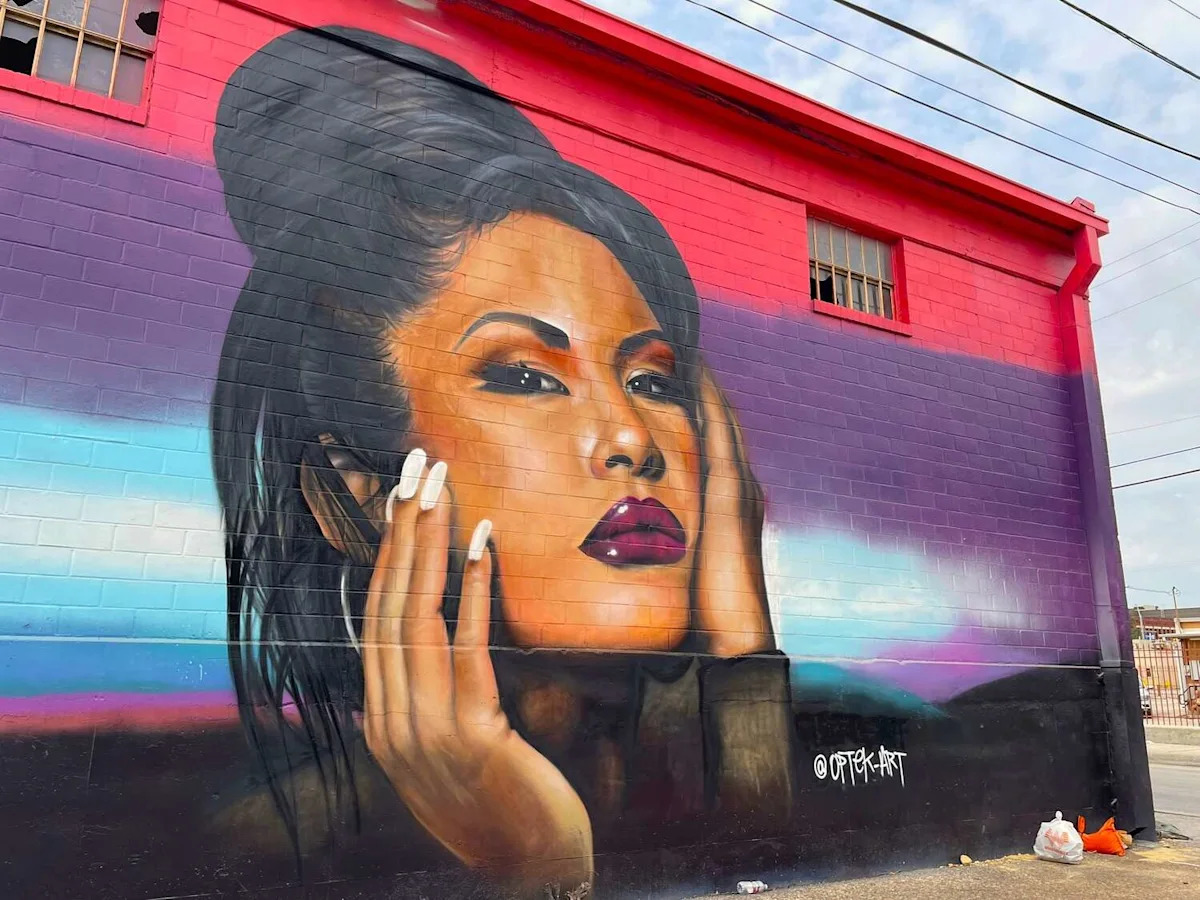
Marco Vargas has seen firsthand the evolution of street art in San Antonio.
As a teenage street artist, Vargas would ask permission of business owners to paint the exterior walls of their storefronts. They often would provide a supply of spray paint in exchange for artwork that livened up their buildings.
The experience was an outlet for Vargas and it helped him develop his craft. Now a professional artist and teacher with his own studio, Vargas also helps guide young muralists on their creative journeys.
“They’re excited to just paint on a wall,” said Vargas, the community mural coordinator at San Anto Cultural Arts, a West Side nonprofit that promotes community-based arts and engagement. “A lot of young artists love knowing about the history and love learning about murals. They find that it’s an art form of telling stories.”
This week, San Antonio Explained looks at the history of murals in the city and how the public art has evolved to become a popular and more widely appreciated creative expression.
History and evolution
Murals in San Antonio originated in Mexico, where artists used public art to honor their roots and convey political and social justice messages, including depictions of human rights issues and the struggles of the working class.
Muralists brought the art form to San Antonio after the Mexican Revolution, when many immigrated here, archives show. The Chicano civil rights movement in the 1960s and ’70s helped fuel the growth of murals.
“Murals became a way for Mexican American communities to celebrate their culture, celebrate and preserve their history and to express their identity,” Vargas said.
Most of San Antonio’s murals are on the city’s West and South sides, with many in and near downtown and a growing number on the East Side.
ALSO READ: The ultimate guide to Spurs murals in San Antonio
Art embraced
The creation of programs that helped teach the significance and artistry of murals started about 30 years ago and really took off over the past 20 years, as public art became more valued and cities found ways to fund it, local artists said. Appreciation for murals grew as the community identified with a mural’s subject matter.
“I think it’s the human connection that really gets us,” said Yadhira Lozano, executive director of Luminaria, an annual multidisciplinary arts festival in San Antonio. “You can see a piece of art and if you can feel something and it takes you back to a memory that could be emotional or celebratory or whatever, and you feel something. It moves you. I think that’s what murals do.”
Community mural programs, like the one at San Anto that has produced 67 murals on the city’s West Side since the early 1990s, is a way to engage a neighborhood by involving residents, who are included in the decision of what the mural will depict and in the actual painting of the artwork.
Go deeper with Yahoo Scout
Community paint days often involve children, teens and adults, who are guided and encouraged through the process.
“I like to say, ‘Paint covers paint.’ I tell them not to be afraid to try things, to experiment and make mistakes. It can always be redone,” said Crystal Tamez, mural preservation manager at San Anto.
For the youth involved in San Anto’s mural program, they learn about what materials work best on various “canvasses” and how exposure to the elements is important in determining a good spot for the art. Students also learn about the history and significance of murals.
Other nonprofits, including San Antonio Street Art Initiative, which offers mentorship to artists, and Centro San Antonio’s Art Everywhere Project, which helps partner artists with spaces for their public art, have promoted murals as a legitimate art form. Both programs were established within the last 10 years.
City Council District 2 this year launched its Community Canvas Small Business Mural Program, which will provide five small businesses with an indoor mural. The program will provide small businesses with custom indoor murals painted by Councilman Jalen McKee-Rodriguez.
As part of its ongoing events with artist-in-residence Rubio, Luminaria is hosting a Mural Making 101 workshop on July 23, where students will learn about creating a mural from the renowned San Antonio fine artist and muralist. It is the nonprofit’s first such program.
Change in attitude
Many local artists agree that social media has helped popularize murals, making it a more widely appreciated art form.
Murals of a lighter and more fun nature, particularly those depicting musicians and sports stars, serve as a good backdrop for photos. The city’s dozens of murals showcasing San Antonio Spurs stars, both past and present, get a lot of social media attention.
Social media has allowed artists to post images of their in-progress artwork or create time-lapsed videos of how a mural is created. This shows the amount of work and skill that goes into creating a mural, local artists said.
The perception of murals being graffiti has faded, especially as some muralists use spray paint in their work, artists said. The term now widely used to describe the medium is aerosol, not spray paint.
READ MORE: San Antonio Explained: Why was downtown’s ‘Torch of Friendship’ created
Reflection of a community
Murals have always told stories, artists said.
Whether it’s paying tribute to sports stars, honoring history or remembering loved ones, murals reflect a community. They can serve as a place to gather and pay respects or celebrate a happy memory. Years after they are created, murals can serve as a history lesson.
ALSO READ:
San Antonio Explained: What’s the story behind the iconic Mi Tierra mural
“A lot of murals transform blank canvasses, blank walls, into places we can celebrate,” Vargas said. “Communities can see themselves every time they go by a mural.”
Subscribe
There’s more to San Antonio with the Express-News. Subscribe today for just 25¢.
This article originally published at San Antonio Explained: How murals become a part of local culture, history.