
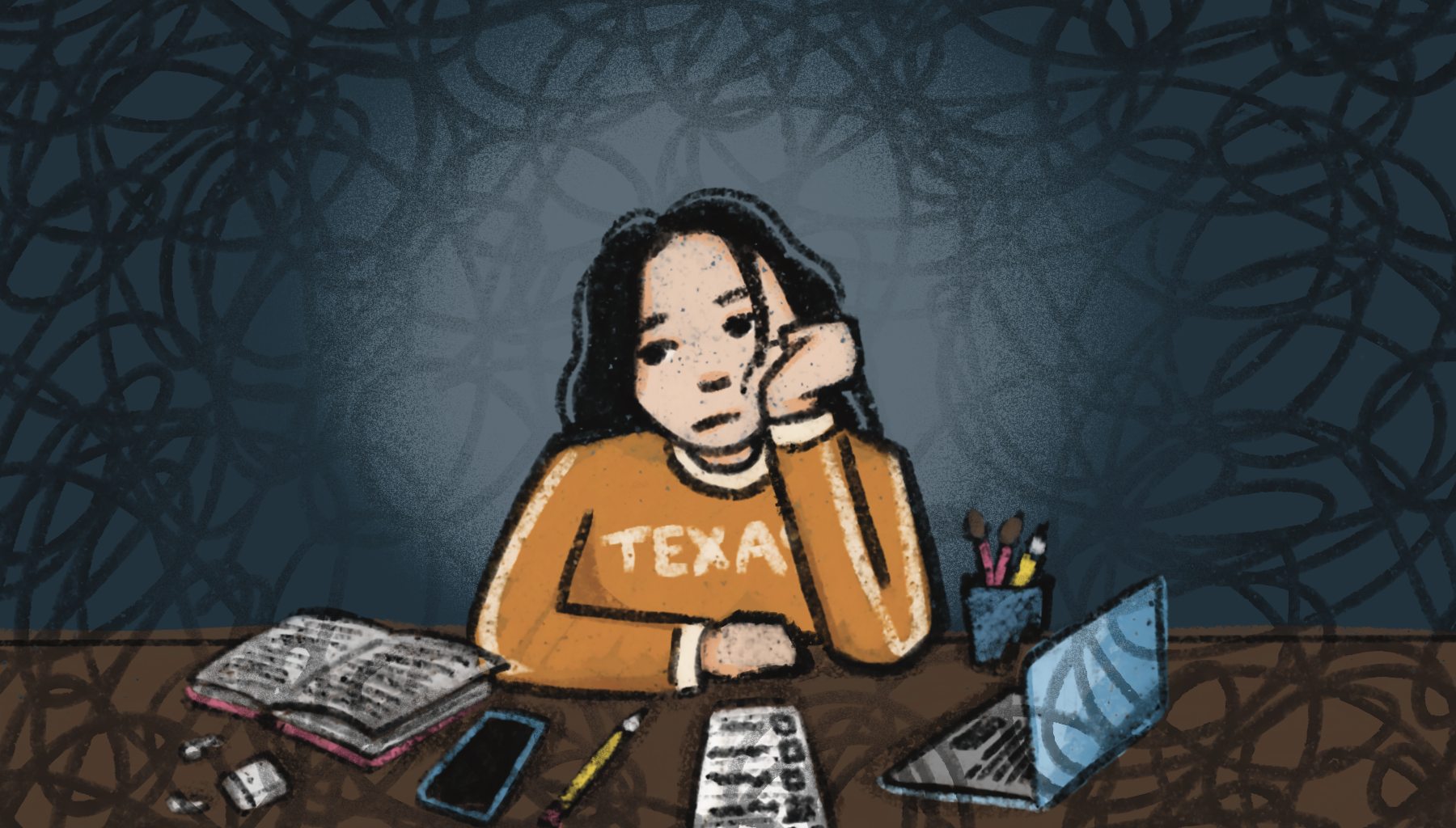
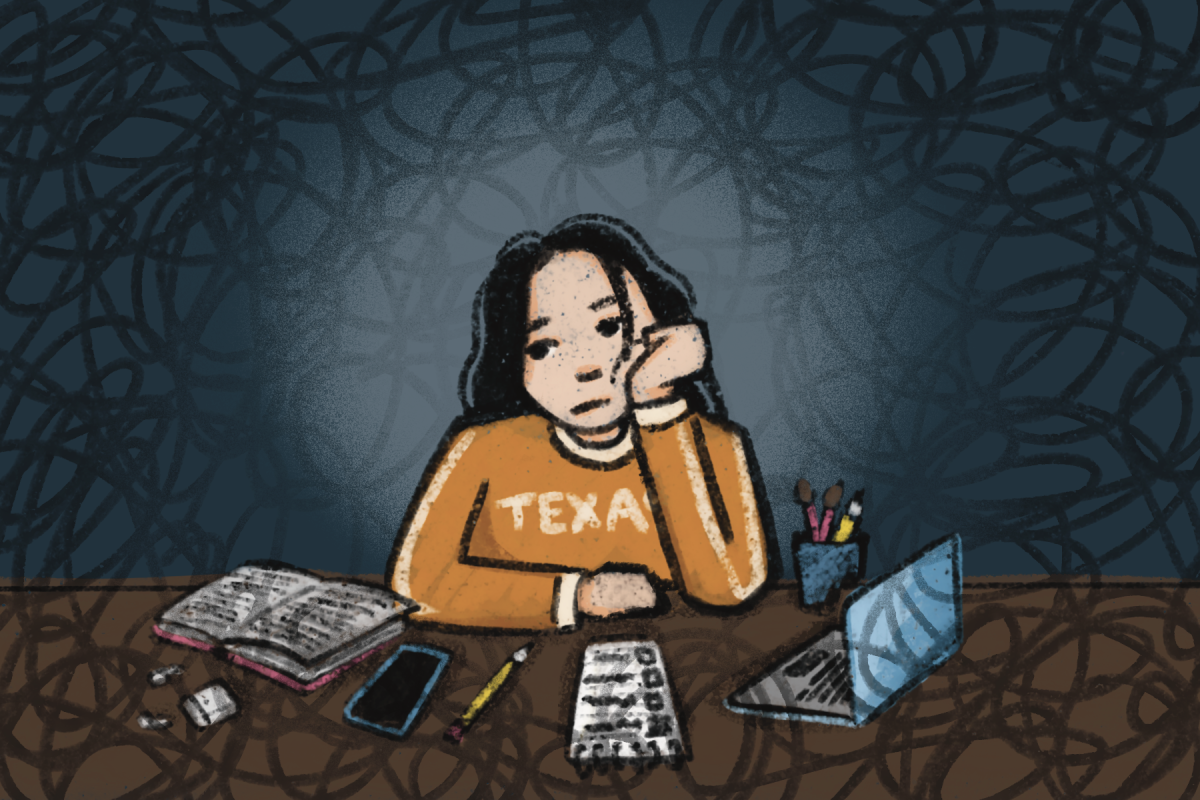
I can’t remember the last time I crossed campus without my headphones on. The walk feels like it needs a soundtrack, a text reply and maybe a quick scroll. It isn’t even that unbearable, but many students treat the silence like something that needs to be solved.
Students should leave routine boredom unresolved before turning to stimulation. Boredom is not always just vacant time. Sometimes, it’s a clue that we need rest, connection, challenge or change.
The issue is that we often answer these needs the same way. A tired student, a lonely student and an understimulated student may all look identical with their head down and screen lit.
Psychology and anthropology junior Rasikapriya Krishna works for Finding Focus, a program developed by UT’s Applied Psychology Lab that focuses on regulating attention, thoughts and emotions. She argues regulating begins with understanding.
“(Self-regulation) has a lot to do with being aware that you’re distracted in the first place,” Krishna said. “Then taking the steps to actually think about, ‘Why is this happening? How am I distracting myself?’ and then taking action to be more mindful and present.”
That awareness gets harder at UT, where ambition shapes the rhythm of campus and every pause can feel like wasted time.
“When you’re sitting there in a moment of boredom, you often feel the need to reach for something, to do something,” Krishna said.
Sound gives the mind something immediate to hold onto. Sarah Dunn, a speech-language pathology master’s student and UT Voice Lab research assistant, said the human voice is especially powerful because of how much the brain has to process when hearing and producing language.
“There’s just so much that goes into speaking and language,” Dunn said. “What you’re hearing, how your brain processes it … and actually creating sound.”
Music intensifies that pull, strengthening connections in the brain that support memory and executive functioning.
The appeal of music is not inherently its ability to distract. Dunn described music as “a form for human connection,” something people use to share parts of themselves.
A song can comfort us, but it can also let us borrow another person’s words before finding our own. A podcast can make loneliness feel social without requiring a phone call. A playlist can make a quiet walk feel easier without helping us understand why the quiet bothered us.
Students should practice just one small pause. Walk from one class to another without headphones. Sit the first two minutes before lecture without pretending to check an email. Then consider what the boredom is pointing toward.
Am I tired? Am I lonely? Am I avoiding something?
When students reach for stimulation at the first sign of quiet, they are not always chasing entertainment. Sometimes, they move mental energy away from a feeling they do not want to name yet.
If students are not always unmotivated but directing energy and effort elsewhere, then quiet moments matter because they reveal where that energy has gone.
That displacement can feel therapeutic. The phone lights up, the song starts, the reel changes and the body gets a small instruction to calm down. The ritual works just enough to prove itself right, even when it never reveals why you felt uneasy to begin with.
This makes boredom worth cherishing. It slows down the human reflex that turns discomfort into consumption and gives students a few seconds to notice whether they need sleep, company or even movement.
Let the silence be awkward for a moment. It might be trying to tell you something.
Khan is an advertising junior from Allen, Texas.