
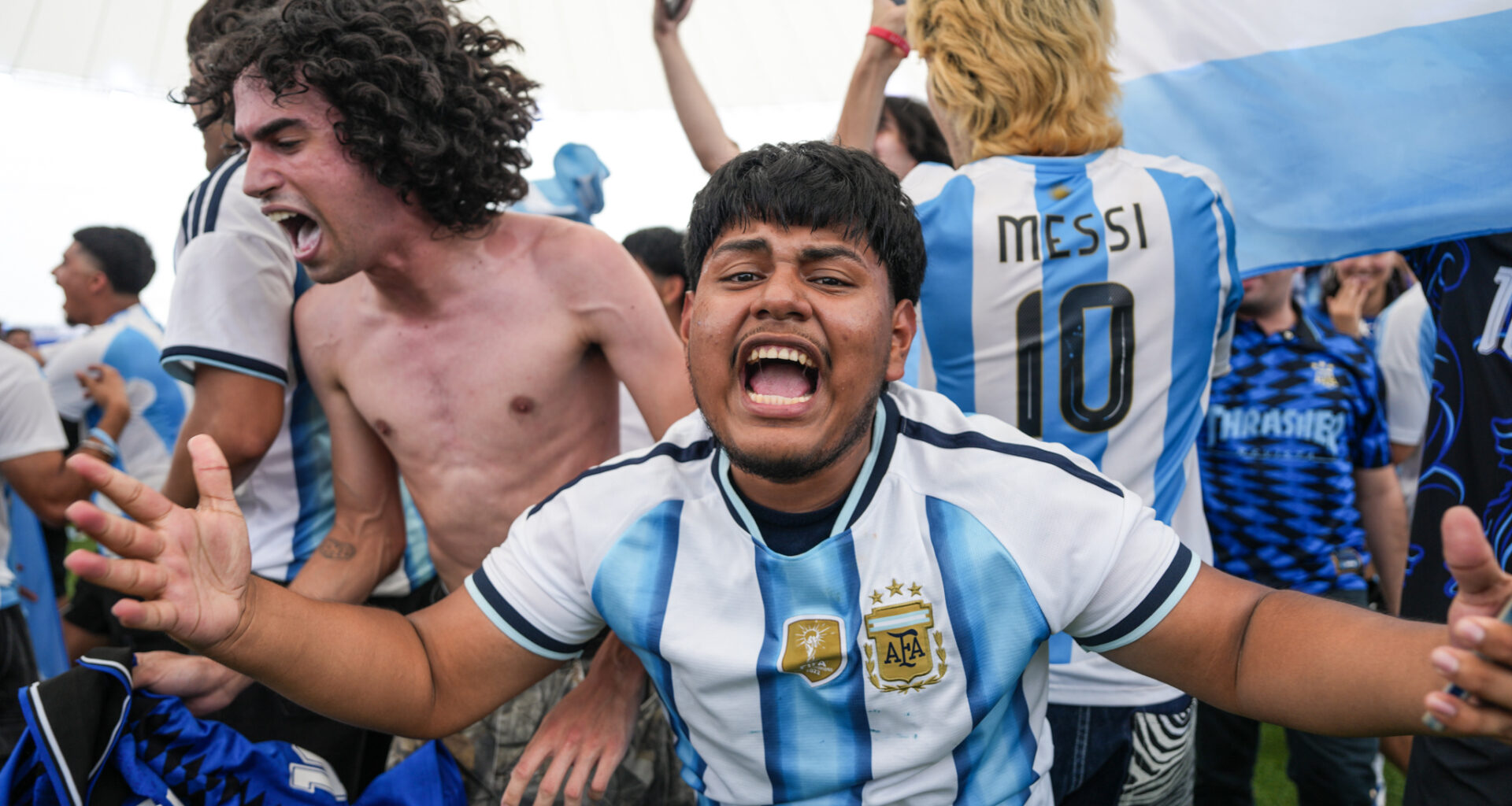
Argentina fans react after Argentina defeated England 2-1 in the Semifinals of the 2026 FIFA World Cup which was streamed to attendees of the Fan Festival in EaDo, Houston, Wednesday, July 15, 2026.
Jacob Lujan/Houston Chronicle
Houston doesn’t always make the best first impression on sports tourists.
It was only a few years ago that Connecticut Gov. Ned Lamont slammed our fair city as “butt ugly” when he was in town for the UConn Huskies’ NCAA national championship game.
Lamont eventually apologized for his mean-spirited observation, but stigmas have a way of sticking. As much as we evangelize about Houston’s virtues, even its most ardent fans would acknowledge the city can be an acquired taste. Would Lamont’s opinion be shared by the hordes of soccer fans from across the globe flocking to Houston for the handful of games hosted at NRG Stadium? Would hosting games be more trouble than it was worth?
Article continues below this ad
It turns out that anxiety was mostly unfounded. While the economic impact of the World Cup was mixed — June job growth in host cities, for instance, mirrored gains in cities that didn’t host games — the tournament itself went off without a hitch, and visitors gave Houston’s glow-up rave reviews.
Hosting the World Cup heralded nearly half a billion dollars’ worth of improvements across Houston. Thousands of new trees were planted. New street lights, sidewalks and pathways were installed — though the area around NRG could’ve used some more work. Roughly 400 lane miles of pockmarked streets were resurfaced and paved. Metro rail, bus and shuttle services ran with increased frequency.
All that infrastructure was put to good use. It turns out many of our foreign visitors like to walk, bike and take public transportation. What better way to visit the dozens of barbecue joints scattered across Houston? The Chronicle’s barbecue columnist J.C. Reid noted that European tourists took a particular liking to the more rich, flavorful beef we produce here in Texas.
Even Houston’s oppressive summer humidity didn’t deter soccer fans. One of the highlights of the tournament was the “Oranje Fanwalk,” when thousands of Dutch and Swedish soccer fans trekked 2.5 miles from Rice University to NRG Stadium — or, to comply with FIFA’s naming rules, Houston Stadium — in blistering heat ahead of their match. These are the moments that help change stubborn narratives that Houston is too car-centric and generally unfriendly to pedestrians. Maybe Texans diehards should try a fanwalk of their own — though the weather will likely be more accommodating come football season.
Article continues below this ad
And about that Metro service. Too often Houston officials — and even many Houstonians — treat our public transit like an unwanted stepchild. But look what happens when we actually put some effort into improving service – people want more of it! While the expanded services ended on July 11, Metro leadership must use the success of the World Cup to advocate for making these changes permanent. Particularly the increased high-frequency service.
The pedestrianization of Main Street in downtown also proved to be a success, and Houstonians should hope to see that design replicated elsewhere along the Red Line.
As for the actual games, NRG Stadium proved to be a big hit with international fans. The positive feedback should put any pleas for a new taxpayer-funded stadium to bed. We do hope the Houston Texans consider heeding the concerns of their players by keeping the natural grass intact. It took a lot of effort to transform the synthetic turf of the gridiron into a verdant, grassy soccer pitch, but it’s an investment the team should consider, especially since fewer injuries happen on grass.
Overall, the city proved we should be at the top of the list to host major events for years to come. As long as the state and federal government are willing to kick in extra money to offset security costs, is it too soon to throw our hat in the ring for the next eligible World Cup in 2038? When are the Olympics up for grabs? We’re already hosting the Republican National Convention in 2028 — can we interest Democrats in 2032? Comic Con? Dragon Con?
Continuing to vie for these events serves several purposes. It bolsters Houston as a business travel and short-term tourism destination — a niche that cities like Nashville and New Orleans have carved out for themselves — and all the plaudits and tax revenue that comes with that distinction. It also incentivizes local officials to continue to invest in making the city more livable and, well, less “butt ugly.”
Article continues below this ad
Perhaps most importantly, these events remind us that the spirit of competition can uplift, inspire and connect us in times of global strife and numerous crises. As one young Houstonian eloquently put it in a letter to the editor, “it was amazing to see how all the players and fans treated each other with respect,” and “this proved that we are not so different after all.”
Thanks for visiting Houston — and the whole United States — World Cup fans. And for reminding us that with a little bit of effort and planning, our city can still rise to the occasion of being a world-class destination.