
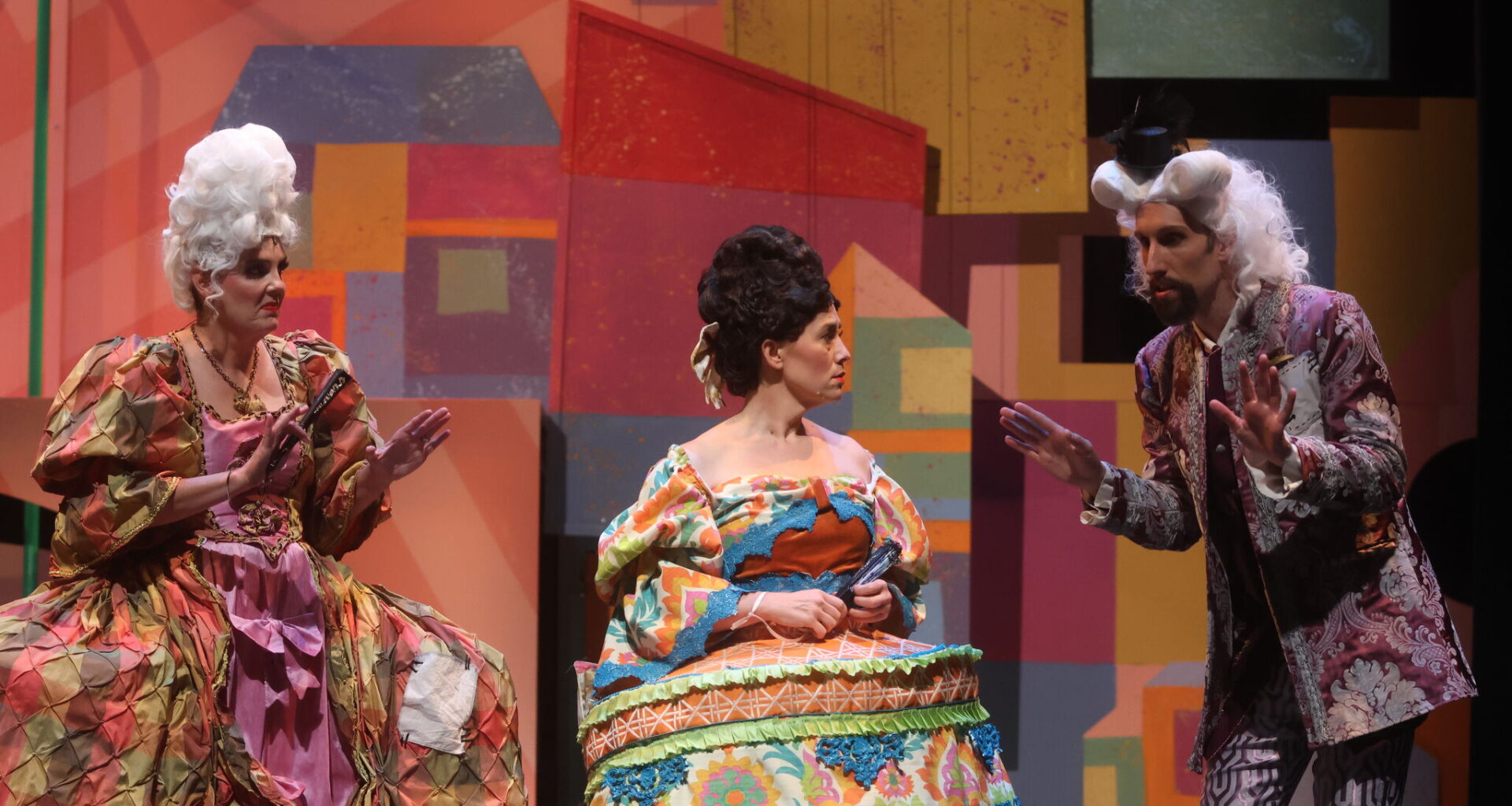
Sarah Lee, Kaitlyn Stavinoha, Dennis Arrowsmith in ‘The Gondoliers’
Pin Lim
The Gilbert & Sullivan Society of Houston performed “The Gondoliers” at the Wortham Center’s Cullen Theater on Saturday night in a show that met all the expectations of operetta devotees for singing, satire and slapstick.
Beyond demonstrating its fruitful experience with G&S operettas, the Society also demonstrated its ongoing creativity with inventive and detailed sets and costumes. As stage director and choreographer, Alyssa Weathersby drew effectively upon the cast’s experiences in opera, musicals, and plays to feature non-stop comic action throughout the plot’s intrigues, entanglements, and mock-tragic eruptions.
When: 7 p.m. Saturday, 2:30 p.m. Sunday
Where: Cullen Theater, Wortham Theater Center, 501 Texas
Details: $25 and up; performingartshouston.org
At the center of the story are two brothers, Marco and Giuseppe Palmieri, who are newly married Venetian gondoliers when they learn that one of them is thought to be the long-lost and already-married King of Barataria. The unknowns of the story – Who is King? Who loves him truly? Who is married to him? – required a comic deftness and agility from the entire cast, and tenor Grant Peck (Marco) and baritone Sean Holshauser (Giuseppe) excelled as nimble numbskulls.
Article continues below this ad
Peck’s smooth tenor voice suited Marco in his ardent but clumsy courtship of his eventual bride and in his befuddled inexperience as supposed King. Holshauser’s sonorous baritone effectively evoked Giuseppe’s attempts at a royal demeanor as the other supposed King, while his comic patter underscored the role’s nerve-wracked confusion.
Laura Coleman (Marco’s bride, Gianetta) and Riley Vagis (Giuseppe’s bride, Tessa) mastered quick shifts of mood between effusive joy and ostentatious pride, first as new brides and then as thought-to-be queens. Later, as possibly (but innocently) bigamist brides and replaced queens, their moods shifted again between disbelief, humiliation, and jealousy. Throughout these twists and turns, Coleman’s bright soprano was bell-like in its beautiful high notes, and Vagis’s mezzo-soprano demonstrated lustrous and moving warmth.
As more pretenders to the throne of Barataria, Dennis Arrowsmith (The Duke of Plaza-Torro), Sarah L. Lee (The Duchess of Plaza-Torro), and Kaitlyn Stavinoha (their daughter Casilda) added intrigue and hilarity to the story. Arrowsmith’s and Lee’s adeptness at caricatures of vain, haughty, but penniless Spanish nobility spilled out in the Duke and Duchess’s garish manners and excessive demands. As their kindly daughter, uninterested in her parents’ royal ambitions, Stavinoha sang with a ringing soprano to express Casilda’s shared but secret love for Luiz, the family servant. Nathan Holmes (Luiz) sang with a sweet tenor voice and demonstrated his comic flair as the hounded family servant, lugging a drum around to announce their presence.
The resonance and crispness of Richard Paul Fink’s baritone in the role of Don Alhambra Del Bolero immediately showed off Alhambra’s swaggering self-importance as Grand Inquisitor, but then revealed his thick-headed dogmatism and undignified lecherousness. Both choruses, gondoliers and contadine (country girls), demonstrated a well-honed discipline in both their singing and their choreographed steps, the effect of which was to grandly introduce the two main settings – the city of Venice and the court of Barataria – and to intensify the different moments of youthful courtships, wedding celebrations, games at court, and the much-anticipated arrival of the King of Barataria’s one-time nurse, Inez (Raquel Bowman), who would reveal his identity.
Article continues below this ad
Musical director Clifton Evans led a solid and sensitive orchestral accompaniment. Sound design by Glenn Wheeler resulted in a good balance between the singers and orchestra, after carefully tweaking the miking early on to eliminate the dead spots on stage. The sets created by Jodi Bobrovksy and the costumes by Shaun Heath, Mary Webber, and Karen Christensen added appreciably to the quality of the show.
In Act I, the simple but colorful exterior of a Venetian palace amounted to a Cubist-cartoonish triumph that established the historical place and, with sliding board and firefighter’s pole included, signaled the chaotic comedy to come. The Baratarian court in Act II visually underscored Marco and Giuseppe’s new status as co-reigning kings by featuring a broad throne cut in half and separated for each king, and two giant chess-piece kings flanking them.
Heath, Webber, and Christensen’s costumes created their own layer of visual comedy with mismatched patterns and profuse colors. Thus, the Duke of Plaza-Toro’s cape, jacket, and breeches came from different outfits, and the costumes for Marco and Giuseppe in Act II showcased their half-king ranks with half-royal and half-aristocratic attire, vertically split down the middle.
In all, the singing, acting, dancing, sets, and costumes generated an uproarious performance, a fitting celebration of the company’s 75th anniversary that earned laughter throughout and a standing ovation at the end.
Article continues below this ad