
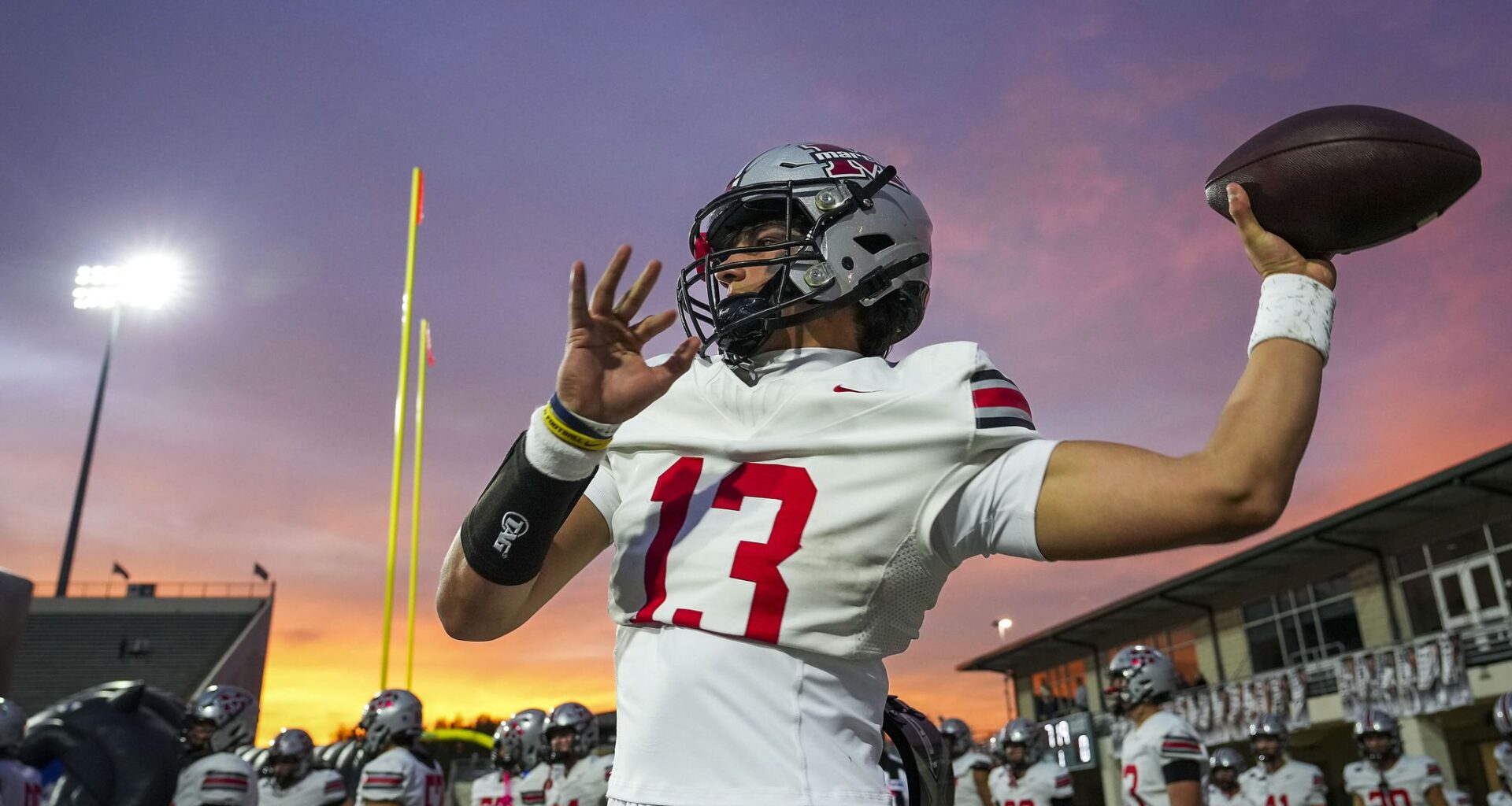
Flower Mound Marcus quarterback Colton Nussmeier (13) warms up before a District 5-6A high school football game against Denton Guyer on Thursday, Oct. 16, 2025, in Denton.
Smiley N. Pool/Staff Photographer
North Crowley cornerback John Meredith III pictured at North Crowley High School, Monday, Feb. 9, 2026, in Dallas. Meredith is the top ranked recruit in the Dallas area for the Class of 2027.
Elías Valverde II/Staff Photographer
The UIL state executive committee denied 11 of 13 eligibility appeals from Houston-area athletes in 2025-26.
Zach Del Bello/San Antonio Express-News
As student-athlete movement becomes more common across Texas and high-profile eligibility cases attract statewide attention, several Houston-area high school football coaches have expressed concern over players transferring for athletic purposes.
According to a survey of Houston-area head football coaches conducted by the Chronicle this summer, 86% of those who participated said they believe students transfer for athletic purposes either “very often” (46.5%) or “often” (39.5%). Also, 51.2% believe that the issue of transfers deserves the most attention from the UIL over the next five years, while another 11.6% pointed to the related illegal recruiting that can occur.
“For a guy who coaches at a place where we do not get transfers, it is hard to go into a season and say we want to compete for championships when the teams you have to play are not playing by the same rules,” Magnolia coach Craig Martin said in the survey. “Transfers are going to destroy the purpose of high school sports.”
Article continues below this ad
The issue has garnered plenty of attention this month as two of the state’s premiere high school football recruits were ruled ineligible for transferring for athletic purposes. Five-star cornerback and Texas commit John Meredith III, the No. 2-ranked player in the country, and four-star quarterback and Georgia commit Colton Nussmeier both lost their appeals to the UIL state executive committee, though not unanimously.
Speaking at the Texas High School Coaches Association convention on Sunday, UIL executive director Jamey Harrison said his organization is confident in the system it has in place when it comes to addressing athletic-driven transfers across the state.
“I believe we have a very, very good system, especially when I look at our peers across the country, because ours is a local-based, grass grassroots-based process,” Harrison said. “The school leaders and administrators who are closest to a situation are those who make original decisions. There’s an appeal to any decision that those local committees make. When we compare that to our peers across the country, it’s their state offices making those decisions.
“With a state that is 265,000 square miles, a state that has a wide-ranging population of schools, from very, very small to very, very large, from as rural as it gets to as urban as it gets and everywhere in between, us trying to make all of those decisions from 1701 Manor Road in Austin (UIL headquarters) just doesn’t seem to be the best approach. So we have a very, very good system. We have a very good approach, but it’s not perfect. I say that all the time. It is a human-based system, like any system — a football team, basketball team or a company. Your output is only going to be as good as the input that is put into it, and so that’s what we really try to lean into.”
Article continues below this ad
The UIL’s Previous Athletic Participation Form (PAPF) — first implemented by the organization in 1981 — must be completed for every athlete who changes schools before they can compete at the varsity level. The form includes questions pertaining to the student’s residence, family situation and experience at the previous school. The new school’s coach or administrator initiates the process through an online UIL portal after the student enrolls in the school. The student’s parents or guardians are then required to answer questions about the transfer before it’s passed along to the previous school.
An administrator or coach at the previous school reviews the form and certifies whether they believe the student transferred for athletics or not. This part of the process is where red flags can be raised, often spurring hearings by the district executive committees to make official rulings. Those decisions can then be sent to the UIL state executive committee for appeal. According to the Dallas Morning News, the organization’s highest-governing committee denied 61 of 71 of student eligibility appeals during the 2025-26 school year.
When it comes to the Houston area specifically, Chronicle research showed that 11 of 13 athletes who appealed to the state executive committee were denied eligibility. The other two who appealed won their cases after the committee determined they did not move for athletic purposes.
According to the Chronicle’s survey, 46.5% of participants said PAPFs are “somewhat effective” at discouraging athletic-driven transfers. But 25.6% disagreed, saying they were “very ineffective,” and another 23.3% said they were only “somewhat effective.”
“I think it’s important to remember, and this gets lost, that our rules are not made by any UIL staff members,” UIL athletic director Ray Zepeda said. “They’re made by our member schools for our member schools, and I’m reminded every day in the execution of my job that my personal opinion about those rules really doesn’t matter. It doesn’t matter at all. And I think sometimes when we start to utilize our personal opinions in the adjudication of the rules, that’s when we start having inconsistency of process.
Article continues below this ad
“Right now, our member schools have a two-way go when it comes to eligibility, and that’s residency, and then also the measure of changing schools for athletic purposes. Whether it’s a UIL official or a coach who maybe might not believe in those standards is really immaterial because those are the rules that our member schools have set. If they’re not serving us well, then the right thing to do is to change the rules through official action in the legislative council process, and I think that’s important to remember in all these conversations.”
Harrison said between 17,000 and 18,000 PAPFs were processed through the UIL’s system during the 2025-26 school year, a statistic he described as “staggering.” He noted that while less than 1% of those cases advanced to the state executive committee appeal process, those are the ones that make the most headlines because of the public nature of the hearings and, oftentimes, the notoriety of the athletes involved, such as Meredith or Nussmeier.
“We want to demand that coaches and schools stay true to the rules, adjudicate the rules as they’re written,” Harrison said. “That when they’re completing any form — the Previous Athletic Participation form or PAPF has talked about quite a bit in the media. When that form is being completed, it needs to be completed with great fidelity and great honesty, and if it’s not, then we have an input that is flawed. And when you have flawed inputs, you may end up with flawed outputs. So we in no way suggest that our system is perfect because it’s not. It’s a human-based system, and any human system is not going to be perfect. But we think it’s a very, very good system that is working very well for the vast majority of cases. When you have a case or two or five that gets some attention, people lose sight of the forest for the trees.”
When it comes to flagging transfers on the PAPFs, several Houston-area coaches say it’s easier said than done. Many athletes transfer for legitimate reasons — including family relocations, custody changes, academic opportunities and other personal circumstances — and identifying sufficient evidence of an athletic-drive move can be challenging.
For other coaches, the idea of holding a player “hostage” who no longer wants to be part of their program is not something they want to get involved with, so they’ll sign off on the PAPF for that reason. Several coaches expressed frustration that some athletes and parents seek “the path of least resistance,” transferring when faced with competition or adversity instead of earning playing time or helping build their home programs. Nearly 41.9% of survey participants said transfers do not make it difficult to maintain their culture, but that’s certainly not the case for all. Many coaches worry about the disruption of competitive balance within their districts and across the state.
Article continues below this ad
“Transfers are destroying community-based athletics and team culture for a lot of average to struggling teams,” one Class 6A Houston-area coach said in the survey. “Athletics is about all student-athletes and the character, morals and life lessons that come from that. If we keep creating all-star teams, what happens to all those average to bad teams and their culture and morale? Some will move on, but kids and teams are fragile. We don’t need to widen the gap between the haves and have nots.”
According to the National Federation of State High School Associations, at least 10 states are now allowing athletic-driven transfers with immediate eligibility. During the 2025 Texas legislative session, House Bill 619 proposed allowing high school students to have a one-time penalty-free transfer for athletic purposes. The bill, which had been proposed twice before, was authored by Rep. Barbara Gervin-Hawkins of San Antonio and drew stark opposition from the Texas High School Coaches Association and the Texas High School Athletic Directors Association. Their stance has been that any type of relaxation of the transfer rules would fundamentally alter the community-based model of Texas high school athletics. The bill ultimately failed for a third time, however.
When asked about a one-time penalty-free transfer rule, 65.1% of participants in the Chronicle’s survey said they would be opposed. But another 32.6% said they would be in favor, while one coach said he would need to see the proposal in writing to decide.
For now, the UIL rules remain the same, but several Houston-area coaches said cracking down on athletic-driven transfers is an uphill battle. They noted that players are connecting with each other more and more through social media, shared trainers, 7-on-7 club teams and other avenues, which is helping to fuel the rise in transfers. Some also pointed to open-enrollment school districts, which allow students to transfer to schools outside their attendance zones, either within the same district or from neighboring districts.
Article continues below this ad
While some coaches advocated for stricter enforcement or changes to transfer rules, others argued the issue is bigger than any policy. As transfers have become more common, several said schools also have to look inward at why those decisions are made.
“You cannot control what people want to do,” Mayde Creek coach Mike Arogbonlo said. “They will find a way around the rules. The pressure should be put on coaches to provide an environment where kids and parents don’t want to leave.”