
In an announcement, USAA said the Alamo’s history is intertwined with the U.S. military. The Army used the Alamo Church and its grounds as a quartermaster depot from 1845 through 1877, and installed a roof with what became the site’s iconic parapet arch, the company said.
USAA was founded in 1922 by Army officers, who met at the Gunter Hotel a half-mile west of the Alamo to discuss how they could secure affordable automobile insurance at a time when many insurers were reluctant to cover families that had to relocate frequently.
“San Antonio is our hometown, and we owe so much of our history to the military community that built this city,” USAA president and CEO Juan Andrade said in a statement. “This partnership is about more than protecting a historic site. It’s about telling the story of the men and women who have served and ensuring this city remains a vibrant, thriving place for future generations to connect with that legacy.”
The Paseo del Alamo, linking the plaza to the River Walk is the newest component of the plaza’s public-private redevelopment, which is expected to nearly double visitation to the Alamo from 1.6 million to 2.5 million visitors annually.
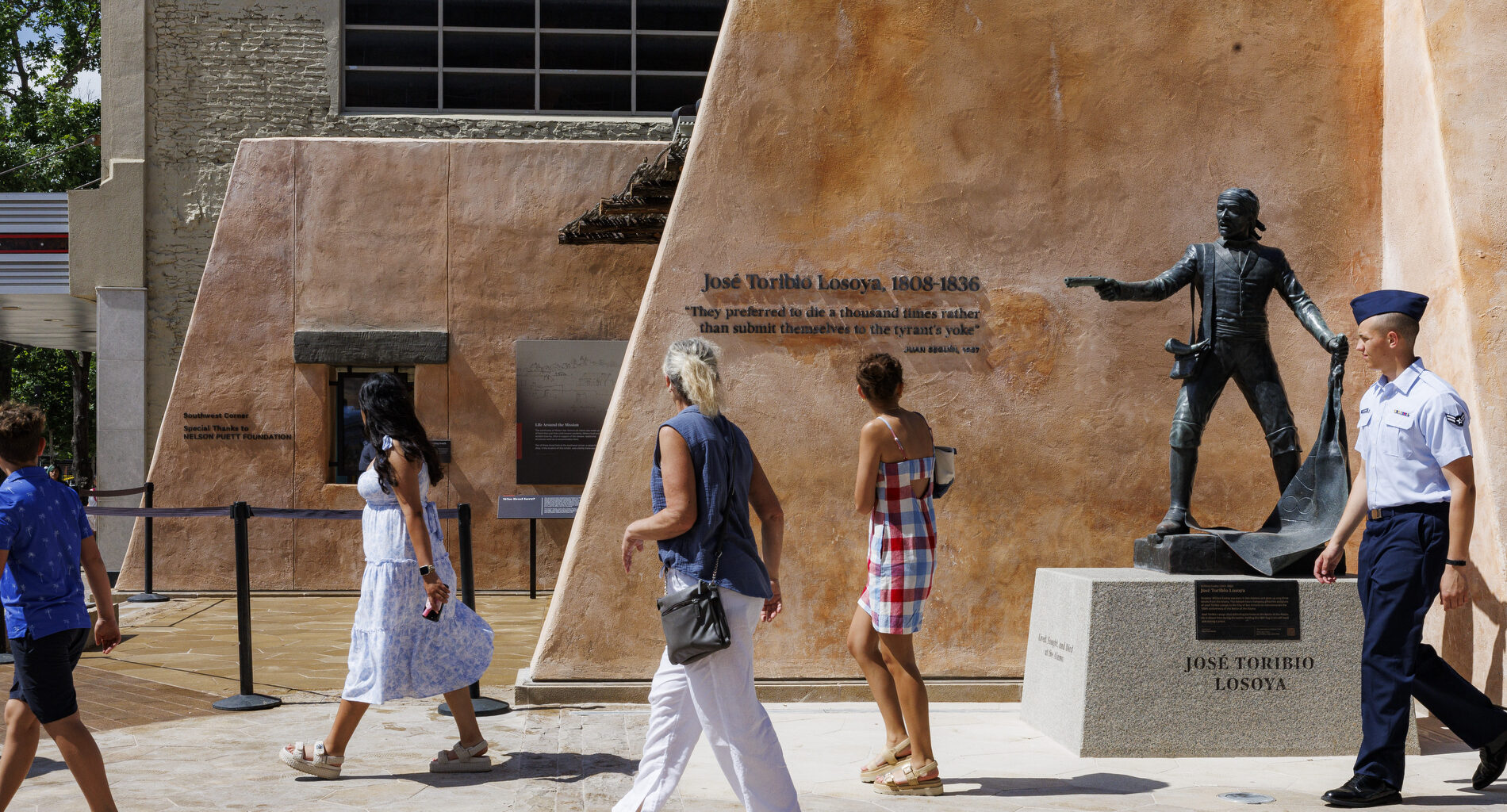
The paseo now has an outdoor elevator, new landscaping and benches, repaired water features, wheelchair-accessible paths, a welcome center and an exhibit honoring those who died defending the Alamo during the famous battle in 1836.
Outdoor exhibits, renovations to Plaza de Valero next to the Menger Hotel and the Texas Cavaliers Education Center, a building with classrooms, workshops and a theater for visiting students, have also been completed.
Construction is underway on the Alamo Visitor Center and Museum, which will occupy the Crockett, Woolworth and Palace buildings adjacent to the paseo and Alamo Cenotaph.
Another crucial undertaking, replacing the roof of the church, is expected to begin in spring 2027. The Alamo’s caretakers plan to place a temporary structure over the church, remove its concrete roof in sections and replace it with a modern composite masonry roof. The work is expected to take up to two years, and the church will remain closed to the public during that period.
The majority of the funding for the project is coming from the state of Texas, which is contributing more than $400 million. The city of San Antonio and Bexar County are contributing $63 million combined.
The Alamo Trust and its affiliate, the Remember the Alamo Foundation, have raised $96.5 million toward their goal of securing $150 million from private sources. That includes $11.4 million from Angel Staffing Inc. and philanthropist Shannon Ralston, $5 million from the Texas Cavaliers, $5 million from Valero Energy Corp. and $5 million from the Kate Marmion Charitable Foundation, among other donors.