
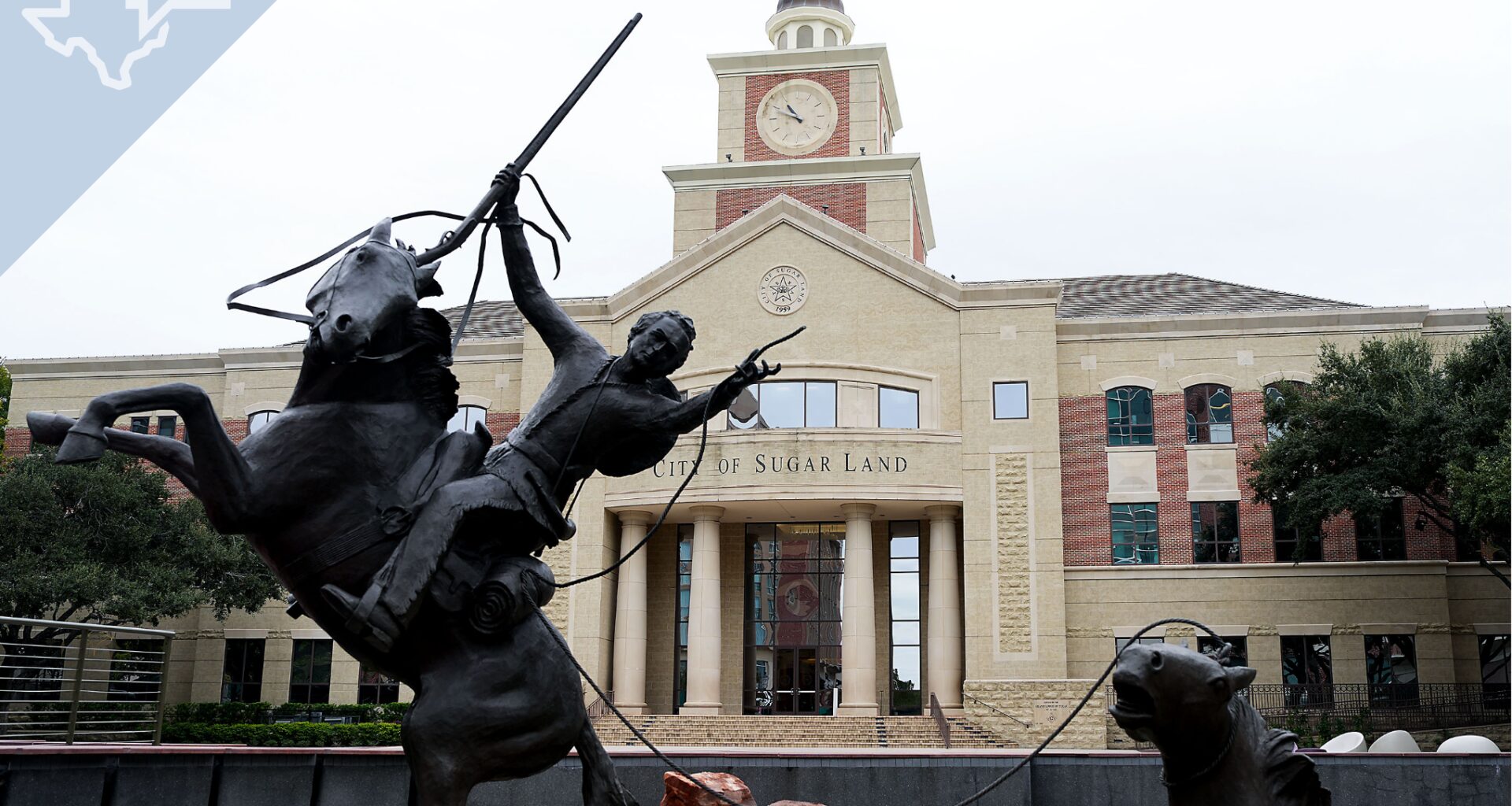
A statue of Stephen F. Austin in front of the Sugar Land City Hall on Tuesday, Oct. 31, 2023 in Sugar Land.
Elizabeth Conley/Houston Chronicle
Join us on a journey to better understand Houston, one question at a time. Sign up to get the Houston Explained newsletter in your inbox every Tuesday and Friday.
Drive through the Sugar Land of today, and you’ll find one of the most diverse and affluent suburbs in America, a landscape of master-planned neighborhoods and top-ranked schools laid out around man-made lakes that make up the good life in Houston’s ever-expanding suburbia.
But none of that modern comfort along this bend of the Brazos gives away that it was once one of the most punishing places in Texas, where men and women were worked to death by plantation owners and, later, a state prison that leased their labor and called it justice.
Article continues below this ad
The story of how such a brutal place became one of Houston’s largest suburbs, of course, begins with the sugar.
How Sugar Land got its name
The land that became Sugar Land was granted in 1828 to Samuel M. Williams, Stephen F. Austin’s secretary, who named it Oakland Plantation for the oaks crowding along the Brazos.
Williams sold it to his brother, Nathaniel, in 1838, and the Williams brothers worked the land together, raising cotton, corn and sugar cane. By the 1840s, the brothers were milling raw sugar there, the cane planted, cut and hauled by enslaved people.
Article continues below this ad
The name we know today came about in 1853, when two Brazoria County planters and slaveowners, Benjamin Franklin Terry and William Jefferson Kyle, bought the place and dubbed it Sugar Land. The two are also credited with extending the Buffalo Bayou, Brazos and Colorado Railway to Sugar Land, but their prosperity didn’t last: Terry would go on to raise a Confederate regiment during the Civil War and die in the outfit’s first battle in 1861, and Kyle followed in 1864 after falling ill with a so-called congestive fever.
After the war, Confederate Col. Edward H. Cunningham bought the property, built a sugar refinery and laid out a town around it. Emancipation had ended slavery, but not the hunger for cheap labor. Cunningham began working his cane fields and refinery with convicts leased from Texas prisons, most of them Black.
Sugar Land went on to become one of the most brutal places to work in the state.
Why Sugar Land was known as the ‘Hell hole on the Brazos’
The 13th Amendment had abolished slavery except as punishment for a conviction, and Texas, like much of the South, treated that caveat as an opening to arrest Black men for vagrancy or for spitting on a sidewalk, handing down harsh sentences and leasing the convicted to anyone who would pay for their labor.
Article continues below this ad
Cunningham and his partner, Littleberry Ellis, contracted with the state, especially the nearby Central Unit, to form a workforce of convicted men. What the leased men found along the Brazos was a mosquito-ridden swamp where they cut cane barelegged in flooded fields and died in the fevers that swept through the camps. More than 3,500 Texas prisoners died under the leasing system before the state outlawed it in 1910, and enough of them died in Sugar Land that it became known as the “Hell hole on the Brazos.”
Those who died were buried in pine boxes in unmarked ground and then forgotten. But in 2018, when a Fort Bend ISD crew broke ground on a new career center, the graves of 94 men and one woman were uncovered, whose bones still carried the marks of overwork and abuse.
The discovery proved what a former prison guard named Reginald Moore, who died in 2020, had insisted for years: the dead of the convict-leasing camps were still beneath the suburb that thrived over them. The 95 were reburied at the site in 2019, and researchers are still working to match their remains to living descendants.
From plantation to suburb
In 1907, the Kempner family of Galveston, along with a developer named William Eldridge, bought up the land and the mill and renamed the operation the Imperial Sugar Company. For the next half century, the Kempners ran Sugar Land as a company town, owning the houses and the store and the school, until 1959, when they began selling off their holdings and the town incorporated as a city.
Article continues below this ad
Developers eventually paved over the old cane fields and created a string of master-planned communities, like First Colony. They were outfitted with schools, golf courses and lakes that were in stark contrast to the former hell hole on the Brazos.
The sugar itself left in the early 2000s, when the Imperial refinery finally shut down. Central Unit, the first state prison in Texas history to close for good, followed in 2011, and the land was remade into a master-planned community called Telfair.
The massive suburb that has flourished over all of it is now not only one of Houston’s largest, but considered one of the best places to live in the whole country. But only in the last few years, with the wider recognition of this dark history, has it begun to reckon with the ground it was built on.

What is your Houston question?