
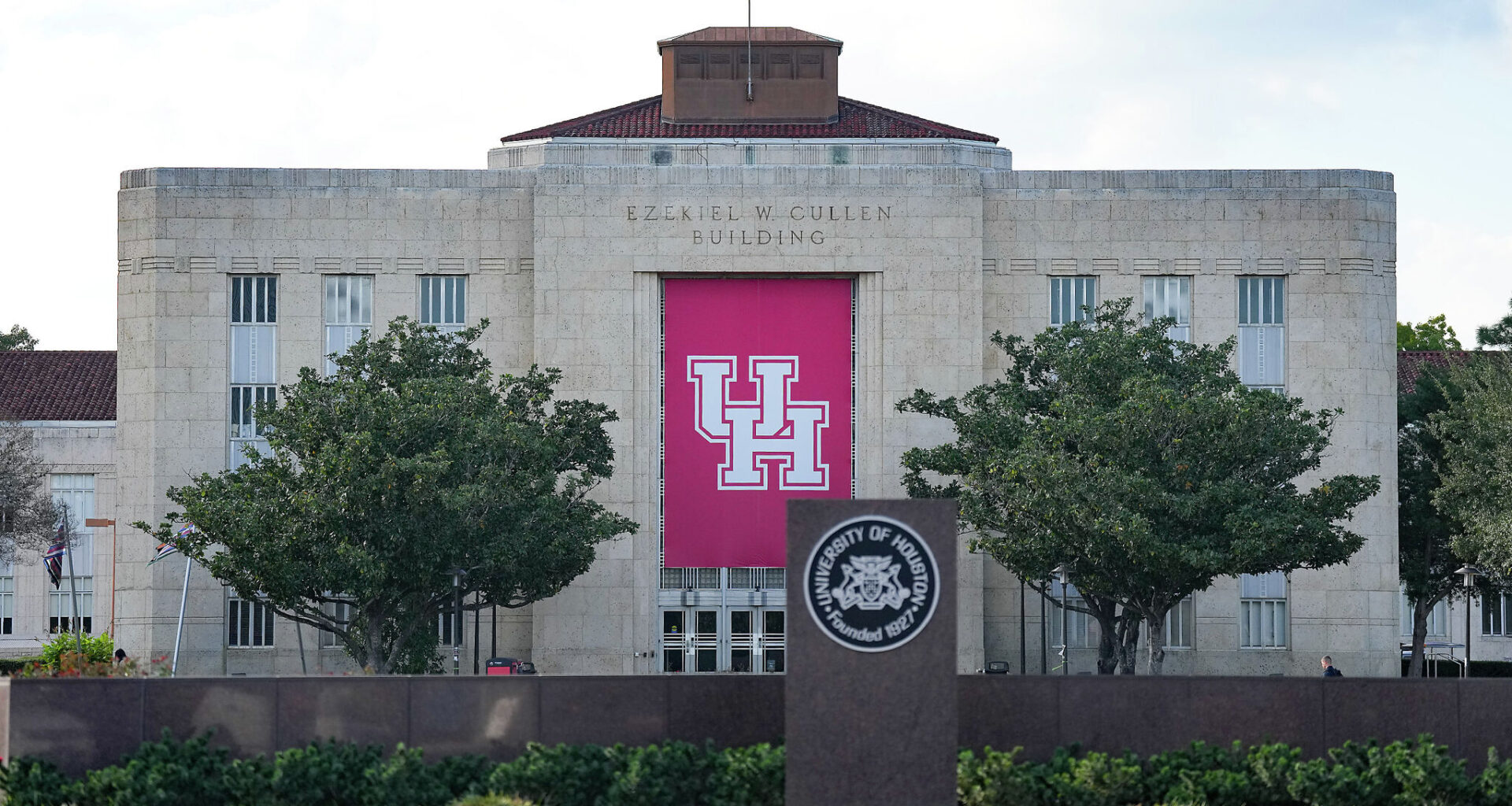
The Ezekiel W. Cullen Building on the campus of University of Houston on Thursday, Nov. 10, 2022.
Elizabeth Conley/Staff photographer
University of Houston administrators could slash almost 40% of the courses offered in the school’s core curriculum to comply with a new state law — including “Intro to Global Climate Change,” “Black Liberation Theology,” “Introduction to Women’s Studies” and “Introduction to LGBT Studies,” according to a list obtained by the Houston Chronicle.
If implemented, the changes would drastically reduce the general education options that undergraduates choose from as they work toward their degrees. The cuts would affect liberal arts departments the most, including professors who teach topics that high-ranking conservative lawmakers view as biased or “woke.”
Any courses that are removed from the core can still be taught, but they’re likely to be taken by a smaller number of students — meanwhile, some faculty fear that the remaining classes won’t have enough seats. Professors have criticized the process and say they were not meaningfully involved in these decisions until now as administrators seek their feedback for a final proposal that will go to the UH System Board of Regents in August.
Article continues below this ad
“This is basically DOGE-ing the core curriculum over the summer while nobody’s looking,” said Richard Armstrong, an associate professor of classical studies. “When you think about something that’s been that carefully managed and curated, you wonder, why are we being reckless in cutting the offerings?”
READ MORE: A battle over workforce, ‘indoctrination’ is reshaping core curricula at Texas colleges
UH is among the dozens of institutions across the state assessing their core classes against the backdrop of a broader GOP push for more oversight on Texas’ public college campuses.
While every institution’s “core” looks different, they each include subject requirements and learning objectives set by the state, making up 42 credit hours, or 14 classes. The core has become hotly contested in recent years, as it indicates what every college graduate should know.
Article continues below this ad
Lawmakers wrote Senate Bill 37 in 2025 to unravel what they view as left-leaning indoctrination in college classrooms. The new law didn’t explicitly ban topics but instead enacted four broad guidelines for core classes — such as being “foundational” for a sound education and “necessary” to prepare students for the workforce and civic life.
“The legislation demands real accountability from our institutions,” the bill’s author, former state Sen. Brandon Creighton, R-Conroe, said in a statement as lawmakers sent it to Gov. Greg Abbott to sign. “Texas isn’t just leading the conversation — we’re setting the national standard for restoring academic integrity and accountability on college campuses.”
So far, the responses of universities and colleges to the law have been varied. While UH has not issued any policies restricting topics — as the Texas A&M and Texas Tech university systems have done — some UH faculty have been wary.
ACROSS TEXAS: A&M alumni warn politics is changing campus leadership
In a move that some UH professors viewed as a threat to academic freedom and a precursor to further changes, College of Liberal Arts and Social Sciences Dean Dan O’Connor asked faculty early this spring to sign a memo affirming that they don’t “indoctrinate” while teaching.
Article continues below this ad
The official SB37 review began later, when a working group of nine professors across UH’s academic colleges drafted the recommendations over five “extended” meetings, according to university documents. This month, Provost Diane Z. Chase shared the findings with faculty and opened a feedback form, which closes Tuesday.
Otherwise, the university has disclosed little about the group’s process, beyond sharing the results and giving faculty copies of the guiding questions used to judge courses against the state’s criteria.
UH’s chapter of the American Association of University Professors, a group that advocates for academic freedom, said that the committee was sworn to secrecy, and that UH general counsel Dona Cornell attended all of the meetings.
When reached by the Houston Chronicle for comment, UH officials said the SB37 review is ongoing and declined to answer a series of questions about the process.
“As part of this process, the UH Core Curriculum Working Group evaluated all core courses using a consistent evaluation framework,” said a statement released by the university. “Based on that framework, the working group prepared draft recommendations, which have been provided to faculty for feedback. These recommendations are just one step in a broader review process and do not represent final decisions. The university leadership will evaluate the recommendations, which must ultimately be approved by UH System Board of Regents.”
Article continues below this ad
What could go
The working group suggested taking about 100 courses out of the core and keeping almost 160 others, according to a document summarizing the proposed changes.
While some courses involving politically divisive issues were on the list — like LGBT Studies and climate change — the cuts don’t appear to target race studies as a whole, as “African American Studies” and “Introduction to Latino Cultural Studies” would remain in the core while “Black Liberation Studies” and “Mexican American Urban Communities” were recommended to be removed.
Some courses on the chopping block involve topics exploring political differences, like “Left, Right and Center.” Others concern movements and social change, like “Latino Leadership Activism and Organizing,” “Sexuality and Society,” “Social Class and Mobility in America” and “Voices from Exile and Diaspora.”
Article continues below this ad
But no history or government classes were flagged, sparing courses that focus on histories for specific demographics, including Chicanos, women, Latinos and African Americans.
UH’s members of the AAUP, the faculty union, said the university violated “basic principles of transparency, faculty participation, and fairness” in the review, according to a letter sent to UH President Renu Khator and other administrators on Monday.
They have urged the university to halt the review process.
“This lack of transparency and the exclusion of the vast majority of faculty from the process, should these cuts to the curriculum be upheld, undermines the education UH students will receive,” according to the group’s letter. “A wider range of foundational courses opens up more opportunities for our students to pursue a meaningful and effective college education, setting them up for greater success in graduate work, professional schools, and the workforce.”
They also say that UH overcomplied in following SB37. The group interprets the law as requiring the university’s core in its entirety to meet the state’s four criteria, while UH tasked the working group with ensuring that each individual course meets all four criteria.
The courses on the list also include several that don’t touch on political, cultural or social topics.
Rebecca Forrest, an instructional professor in the department of physics, said she was shocked to open the recommendations and see her “Advanced Laboratory 1” course on the list. She has offered it since she created the class 20 years ago, helping physics students learn to convey complicated material and satisfy a core requirement called “Writing in the Disciplines.”
She deems the course essential for the workforce, and believes it meets the criteria of SB 37. To reach more physics students in the future, her department will need to alter its degree plan to require it outside of the core, she said.
“This is doing a disservice to students,” Forrest said. “They won’t be well prepared to enter the workplace or graduate school.”
Largely, faculty members critical of the process argue that they have the pedagogical expertise and knowledge of learning objectives to back up their curricular decisions, and they say they’ve previously gone through rigorous processes to ensure that their core courses met state standards. Those processes were upended after SB37 disbanded faculty senates – which led prior curricular reviews – and allowed colleges to replace them with smaller advisory councils that are more limited in function.
INSTRUCTION: AI use at colleges has become a ‘minefield’ of rules, confusion
“We are the closest to the students,” Armstrong said. “We are interacting with them all the time, far more than the administration, and we have to create material that really works, that does achieve the goals that we’re setting out – pedagogically but also connects to their interests, energizes them.”
Effects on students
People walk across the University of Houston campus near the UH Student Center in Houston, Monday, Oct. 27, 2025.
Brett Coomer/Houston Chronicle
By forcing students at a growing university to compete for a more limited number of courses, Forrest, Armstrong and others worry that students will experience a bottleneck at registration and face delayed graduation times.
Other ripple effects are possible. The core is known to draw students to departments – even helping them minor in areas that are known to have smaller numbers of majors.
If their courses are available to fewer students, some professors fear class enrollments will drop further.
UH: Board drops religious studies as major due to low enrollment
Five of the six core courses offered by the classical studies department were recommended for removal, according to the working group’s list. The creative writing department’s only offering in the core was “Creation and the Performance of Literature,” which could now be cut.
“Students find core courses that interest them, that broaden their experience and their education in society,” Forrest said. “All of that makes for more well-rounded students that are better prepared for whatever profession they choose to go into.”