
AUSTIN, Texas — Austin just hit its second triple-digit day of 2026 so far, but data suggests that days in the city are reaching hotter temperatures more frequently over time.
Data from the National Weather Service has tracked the number of triple-digit temperature days in Austin since 1897.
While numbers from ten of those years—all from 1925 and earlier—are missing, the data show that the average number of days 100 degrees or hotter has risen significantly over the decades.
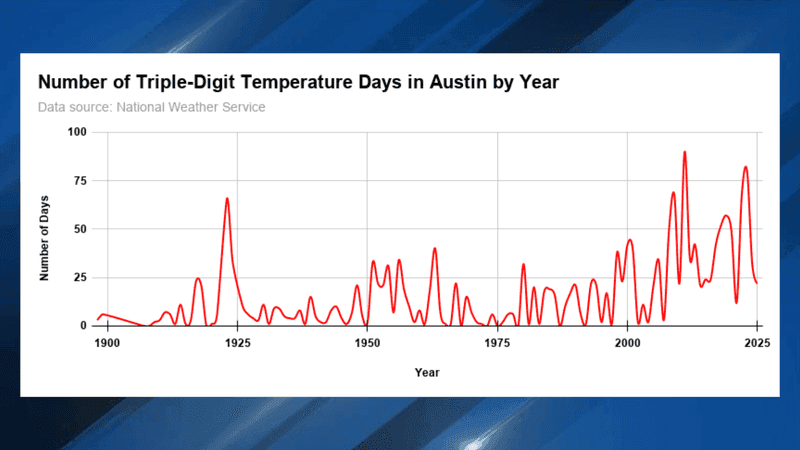
Number of triple-digit temperature days in Austin, 1897-2026 (Data source: National Weather Service)
A snapshot of the past few decades reveals that the city recorded an average of approximately 15 triple-digit days per year in the 1990s.
That has increased every decade. Austin has experienced an average of around 44 triple-digit days per year since 2020.
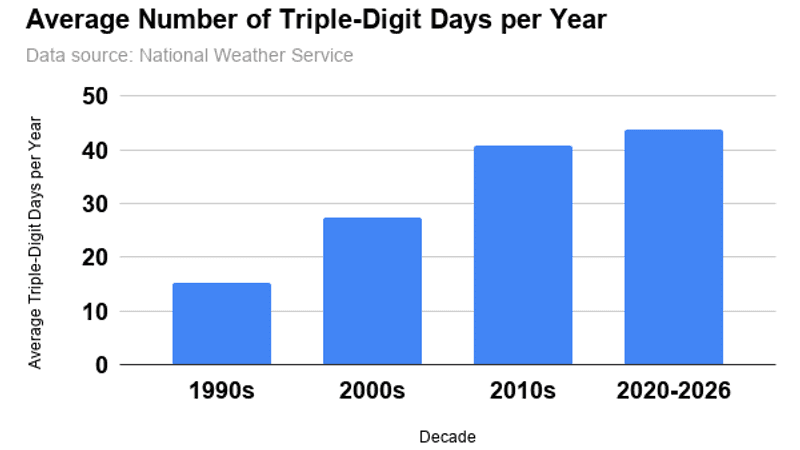
Average Number of triple-digit days per year, by decade (Data source: National Weather Service)
What are the implications of extreme heat for me?
Dr. Kevin Lanza is an Associate Professor at UTHealth Houston’s School of Public Health. He warns that extreme heat can take physiological tolls on anyone, but especially vulnerable populations such as children, older adults, outdoor workers, and even the socially isolated.
Dr. Lanza said heat becomes a problem when a person’s core body temperature becomes elevated, and the body cannot cool down to its stable temperature fast enough.
“When it starts going up to 101 or 103 degrees inside your body, that’s what we call heat exhaustion. And that could be dizziness, headaches, some skin rashes, muscle cramps, could even lead to some nausea and vomiting,” he said. “But then if your core body temperature reaches 104 degrees or higher, that’s what we call heat stroke. That’s a medical emergency.”
ALSO | “Please don’t”: Austin officials urge residents to stay off waterways due to flooding
KEYE
Along with heat illnesses, Dr. Lanza is also concerned with how extreme heat can affect the everyday lives of individuals.
“Folks spend a lot of time thinking about heat and the health issue of injuries from heat and heat-related mortality… What we don’t talk enough about is how heat impacts people’s everyday lives—how it impacts what they do during their day, how it impacts their mood, their activity levels, their sleep quality, and how much they sleep,” he said.
What can I do to beat the heat?
With the ability of heat to impact individuals’ everyday needs and schedules, Dr. Lanza wants to raise awareness about the resources available to help people adjust to hotter temperatures.
“Cities, including Austin, have public cooling centers. So that means our recreation centers, which are free to access as well as our park spaces and our public libraries,” he said. “Our transportation authority, CapMetro–buses, trains–if you tell the operator that you’re using that transportation to go to a cooling center, your fare is free.”
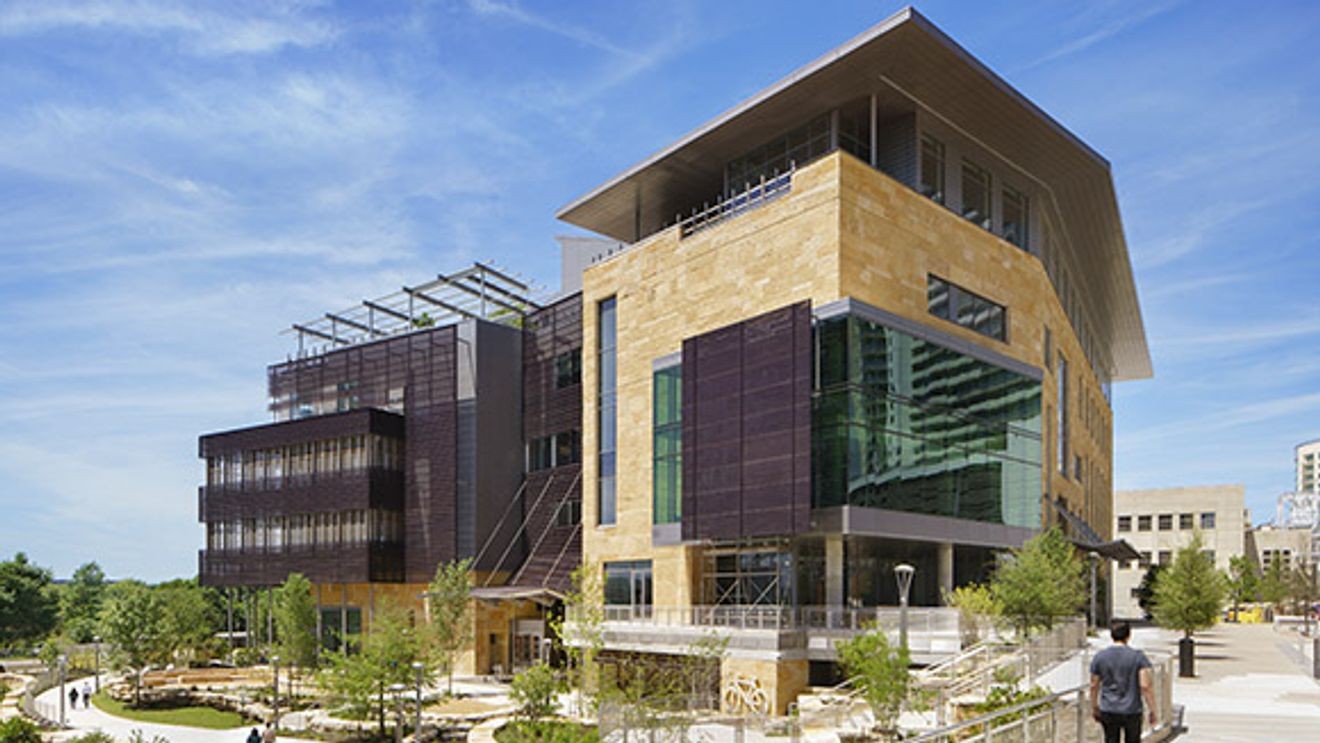
Cooling centers are being opened at libraries, recreation centers, and senior activity centers across Austin. The Central Public Library in Downtown Austin is one of the sites. (Photo: City of Austin)
Austin’s Ending Community Homelessness Coalition (ECHO) provides a map of every cooling center run by the City of Austin and Travis County Office of Emergency Management. You can find a cooling center near you and other heat resources here.
“What can we do at kind of a systems level, and municipally as well as within our different private and public sectors, is we already have the ingredients,” Lanza said. “Now it’s just activating them and providing access for our community to receive those things.”