
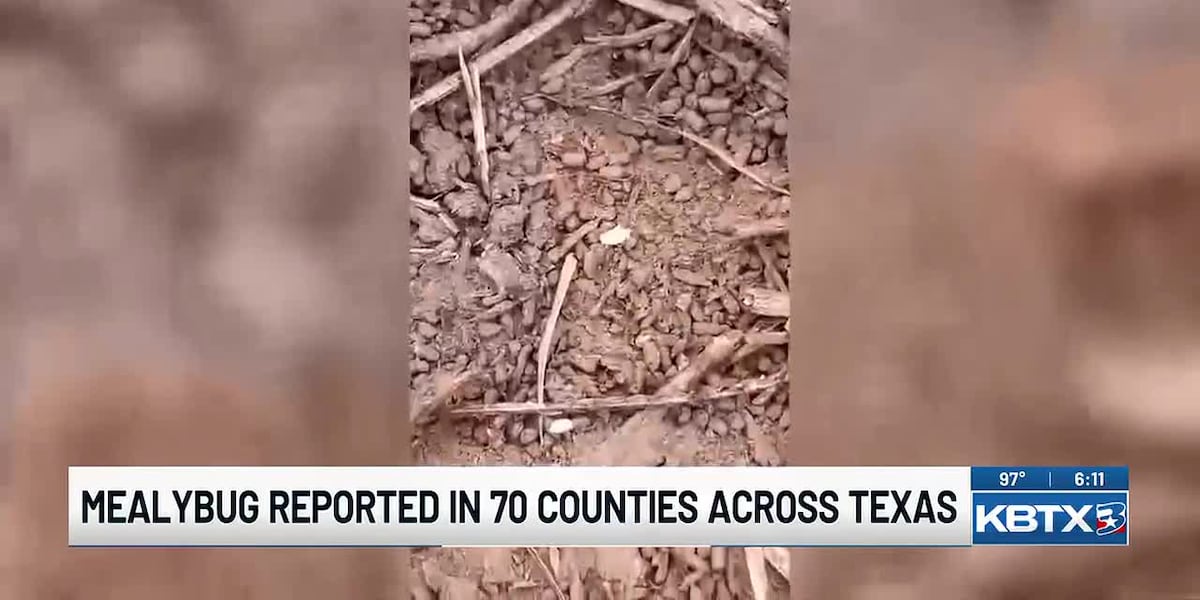
BRYAN, Texas (KBTX) – A pest that can hide at the soil line is spreading across Texas and leaving some hay fields looking like they were scorched in a matter of weeks.
Texas A&M AgriLife Extension says the pasture mealybug —Heliococcus summervillei— is a new invasive insect now linked to pasture and hayfield dieback, with producers reporting widespread problems since April 2025. The Texas Department of Agriculture says infestations have been confirmed in 70 counties, with dozens more on watch.
The damage often starts where producers don’t typically look. Texas A&M says the immature stage of the insect does the harm, feeding by sucking plant sap and injecting toxins that stress and weaken grasses. Under the right conditions, Texas A&M says visible symptoms can show up in about a week, starting with yellowing and discoloration and progressing to purpling or reddening leaves, stunting and poor root development. Researchers say infested grasses can look drought-struck even after rain and may become more vulnerable to secondary plant diseases.
Daniel Trampota, an operations manager with Producers Cooperative Association and a producer in Robertson County, said he first noticed the problem in April 2025 when his field turned patchy and uneven.
“Some of the grass was 24 inches tall and then right next to it, three to four inches tall and just yellow and chlorotic looking,” Trampota said.
He said the damage didn’t just change the look of the field; it hit his bottom line.
“When you’re talking about losing half of your production, that’s pretty serious numbers and dollars,” Trampota said.
Texas A&M says pasture mealybugs can be found on grass blades, at the base of plants, in leaf litter and thatch, and even below the soil surface or under dried cow patties. The insect is mobile in all life stages, and researchers say outbreaks can intensify with high humidity, high temperatures, and rain events, along with pasture management conditions that allow grass to grow thick.
Trampota said he has seen the issue hit hardest where the grass is tall and dense, especially in hay fields.“They prefer the real dense cover,” he said, explaining why hay meadows can take the brunt compared to more closely grazed pasture.
State agriculture leaders say the pest is spreading quickly, and Texas Agriculture Commissioner Sid Miller urged producers to scout frequently.
“If you don’t go check your hay meadow for four or five days, you could lose 50, 100 acres almost overnight,” Miller said. “This thing spreads real, real rapidly.”
Officials and researchers believe the insect can spread by hitchhiking on equipment, vehicles and even clothing. Miller also warned that moving hay can carry the problem into new areas.
“He sells that hay and hauls it to another county. Well, he just infested that county. So please don’t do that,” Miller said.
Texas A&M says there is no standardized scouting protocol yet, but producers should closely inspect areas where grass is yellowed or reddened, including thick, unmanaged patches along fence lines or roadsides. The Texas Department of Agriculture and Texas A&M AgriLife Extension are urging producers to scout pastures and hayfields regularly, clean equipment before moving between fields and report suspected infestations.
Suspected cases can be reported to the Texas Department of Agriculture at 800-TELL-TDA. Producers can also contact their local Texas A&M AgriLife Extension office for identification assistance and management recommendations.
Researchers say more work is needed to pin down Texas-specific management strategies. Texas A&M notes that broad-spectrum insecticides, including pyrethroids, may be ineffective and can worsen outbreaks by killing beneficial insects that would otherwise help keep mealybugs in check.
Scientists and state agencies are continuing trials and working to identify effective options and expand labels for promising products.
Copyright 2026 KBTX. All rights reserved.