
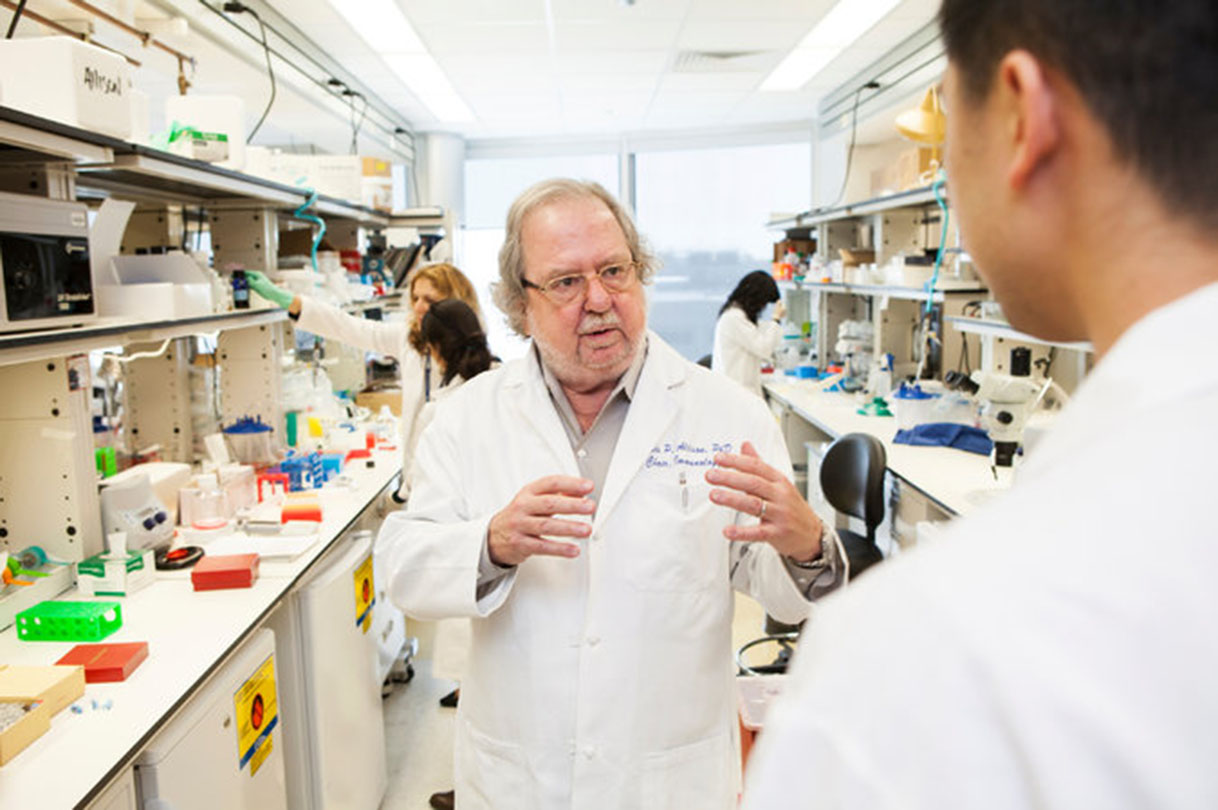
Research by Nobel-Prize winner Jim Allison, chairman of the Department of Immunology at M.D. Anderson Cancer Center, has led to promising results.
MD Anderson Cancer Center
Dr. Daniela Matei, of Houston Methodist’s Neal Cancer Center, specializes in gynecological cancers, including ovarian and endometrial cancers.
Houston Methodist
Dr. Mothaffar Rimawi is executive medical director of the Dan L. Duncan Comprehensive Cancer Center at Baylor St. Luke’s Medical Center.
Baylor St. Luke’s Medical Center
Dr. Jeffrey Lee, of M.D. Anderson, has focused on abdominal cancers, such as pancreatic, with a secondary specialty in melanoma,
M.D. Anderson/Photo Courtesy of MD Anderson Ca
M.D. Anderson researcher and Nobel-Prize winner Jim Allison’s ground-breaking research enabled doctors to enlist the immune system to fight cancer.
Craig Hartley/For the Chronicle
The auditorium was packed at the American Society of Clinical Oncology’s annual meeting in June, as doctors and researchers gathered to hear what was likely the most consequential news in decades: New drugs and therapies are changing outcomes for some of the most difficult cancers, including pancreatic, breast and even prostate cancers.
When researchers announced their findings on pancreatic cancer alone, they received a five-minute standing ovation, with usually stoic doctors high-fiving and clapping. Many were moved to tears, said Dr. Mothaffar Rimawi, executive medical director of the Dan L. Duncan Comprehensive Cancer Center at Baylor St. Luke’s Medical Center.
“Some 20,000 people were in tears and on their feet because we finally could target the pathway that causes pancreatic cancer. People were hugging each other because we’re finally making progress. You could see new hope,” said Rimawi, a breast oncologist, noting that Baylor St. Luke’s was part of the first phase of the study that lead to the development of daraxonrasib, an oral pill that reduced the risk of death by 60 percent in metastatic pancreatic ductal adenocarcinoma patients.
Article continues below this ad
Between Baylor St. Luke’s, Houston Methodist, Memorial Hermann and the University of Texas MD Anderson Cancer Center, research on new drugs and ways to treat cancer are not only changing survival rates for some of the most difficult to treat cancers, but it’s also improving the quality of life during and after treatment for many patients.
Dr. Jim Allison, of MD Anderson, earned the 2018 Nobel Price in Physiology or Medicine for discoveries in immunotherapy, changing survival rates by finding a way to harness a patient’s immune system to attack cancer cells for a variety of cancers. Allison shared that Nobel Prize with Tasuku Honjo of Japan.
Immunotherapy has been transformative in cancer care, but that isn’t all that’s happening.
Ongoing news from the human genome project — a longtime project that Baylor participates in — allows scientists to identify genetic mutations, and the development of artificial intelligence helps physicians analyze mountains of data to provide better and more personalized care.
Article continues below this ad
“I don’t think there’s any other field of medicine that’s as exciting as oncology right now. There have been amazing changes in the last 10 years even for cancers that were considered killers,” Dr. Daniela Matei of Houston Methodist’s Neal Cancer Center. Matei’s own area of specialty is gynecological cancers, including ovarian and endometrial cancers.
Dr. Jeffrey Lee came to MD Anderson after his residency training and has focused on abdominal cancers, such as pancreatic, with a secondary specialty in melanoma, two deadly forms of cancer. With so many years focused on cancers with low survival rates, Lee is excited about the news he can now give patients: There is hope.
“At MD Anderson, we are tremendously energized by the possibilities. The huge advances in using immunotherapy could transform the outcomes of advanced melanoma from a diagnosis that gave patients an average lifespan of just 7 months — just 3 percent of patients could live five years. Now, more than 60 percent of patients can live for five years,” Lee said.
Lee talked about one pancreatic cancer patient who has lived nine years since his diagnosis. In that time, he has been able to greet seven new grandchildren.
Dr. Julie Rowe, the research director of oncology at the UT Medical School and operations director for the Memorial Hermann Cancer Center, specializes in gastrointestinal cancers, including pancreatic, said that Memorial Hermann is involved in two promising Phase 2 clinical trials right now.
Article continues below this ad
They are a three-prong attack, combining chemotherapy and immunotherapy with radio frequency ablation prompting a whole body response, Rowe said.
Pancreatic cancer isn’t the only one making headlines.
Breast cancer, the most-diagnosed cancer, is now much more survivable. Dr. Jenny Chang, now the CEO of the Houston Methodist Academic Institute, has done groundbreaking work on chemotherapy-resistant tumor-initiating cells in triple-negative breast cancer patients, testing treatments with less toxicity and better results.
Hundreds of clinical trials for new drugs and treatment programs for a variety of cancers are underway throughout the Texas Medical Center, and Lee said that MD Anderson has the largest clinical trial program in the world. Last year alone, the cancer center enrolled 10,000 patients in more than 1,500 clinical trials. Also, more than 70 percent of the drugs approved by the FDA have been tested at MD Anderson.
Rimawi, whose specialty is treating breast cancer, is the local principal researcher working on a vaccine that can prevent HER-2 breast cancer from recurring. (Up to 25 percent of early-stage HER-2 patients have a recurrence of the cancer within 10 years.)
Article continues below this ad
Lung cancer, still the number one cancer killer that once came with a six-month prognosis, now finds patients still alive seven or more years after treatment, Rimawi said.
Metastatic melanoma, known as a deadly form of cancer that treatment could barely touch, finds patients living several years after treatment and some can be cured.
High-risk prostate cancer patients got good news this year with results from a huge clinical trial that tested the drug apalutamide with standard hormone therapy before and after radical prostatectomy. Ultimately, the new treatment reduced the risk of metastasis or death by 20 percent.
Clinicians are using the term “personalized care” as the new standard for cancer treatment. What it means is that the new drugs, treatment programs and other therapies can zero in on a patient’s individual genetic makeup and tumors or cancer cells for the best care for each person, instead of broad treatment programs that treat everyone as if they’re the same.
In many cases, less toxic drugs — for example, less chemotherapy — can improve the quality of life for patients, lessening or removing side effects that can lead to other health problems. It can also make staying alive more affordable, as there could be fewer drugs or rounds of chemotherapy to pay for, Lee said.
Article continues below this ad
Lee and his staff continues to search for ways to optimize immunotherapy and test new drugs, he said, and one of the more promising areas of work underway is microbiome research, which looks at how our intestinal bacteria helps shape how patients respond to a variety of treatments. He noted it includes transplanting more favorable microbiomes and using probiotics and dietary interventions.
Artificial intelligence will only become more important in analyzing data from every stage of research and treatment, Lee said.
“I moved to Houston for medical school and was in awe of the Texas Medical Center, the largest medical center in the world. When I think of the Texas Medical Center, I think that the success of one is the success of all,” Rimawi said. “There is so much collaboration across TMC, getting grants together and leveraging strengths together. So many health systems are trying to do what’s right.”