
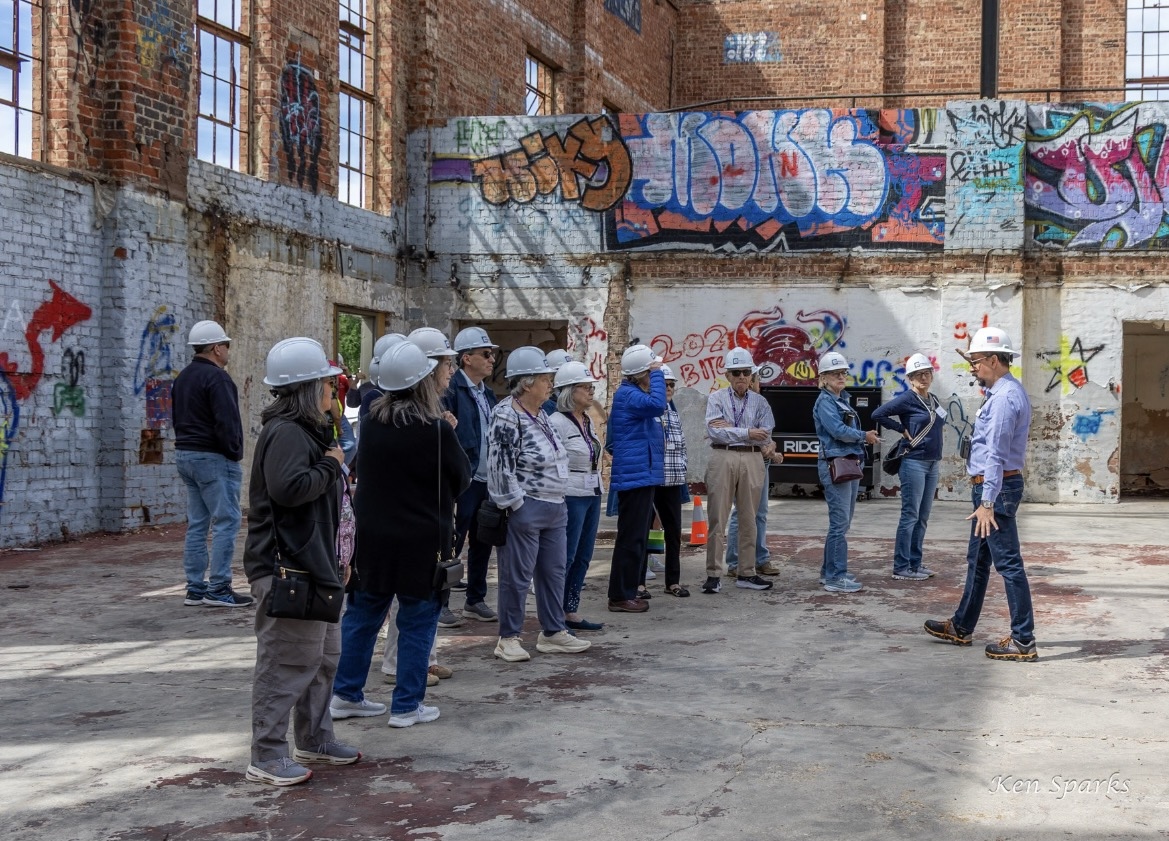
FORT WORTH, Texas — Blue and orange graffiti decorate the faded brick and the concrete. Ants crawl across the nail-covered floor. There’s no roof, leaving the second floor of the auditorium open to the scattered rain drops that fall on a drizzly Saturday morning in April. A group of visitors who signed up for a hard-hat tour walk across the building and tread on narrow steps, leaving behind a trail of dust and glass shards.
A slim metal bar serves as the only barrier to the empty space below them. Looking at thedecaying building, Greg Robertson begins to choke up, placing a hand over his chest as he surveys the second floor.
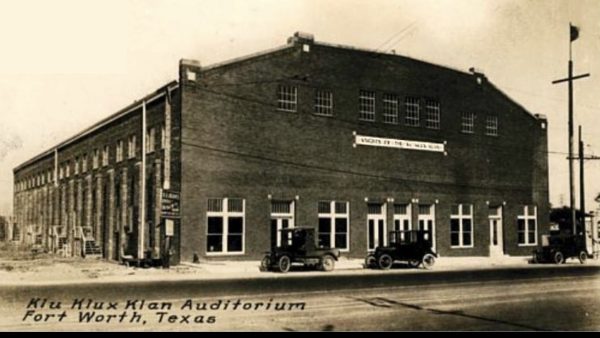 The auditorium becomes a meeting place for the KKK. It also served as a performing arts center for the Klansmen and their families. Photo courtesy of Transform 1012
“It always just tugs at me,” says Robertson, the development director of a nonprofit that owns the site on Fort Worth’s north side. “I stand here, and I can see the city and I can see where people lived, and they were forced to walk past this massive building.”
More than 100 years ago, this empty, abandoned hall was a meeting place for racial violence. Built in 1924, it served as the public headquarters of Fort Worth’s local chapter of the Ku Klux Klan.
Nearly a century later, in 2021, a group of civil rights activists purchased the building at 1012 N. Main Street to turn it into a center for performing arts and community healing. Carlos Gonzalez-Jaime, executive director of Transform 1012, says the nonprofit is passionate about making the center into a place where all individuals of different backgrounds can come together.
“It’s a place to teach people to love others, to love other religions, and to love other people,” Gonzalez-Jamie says. “We’re transforming a place that was used for hate into a place for love.”
* * *
When the hall was built, the klan was a major political force in Texas. The Fort Worth chapter, Klavern 101, was heralded as one of the strongest in the nation throughout the early-to-mid 1920s, boasting a multitude of civic leaders, teachers and police officers.
Their white supremacist ideals, along with their partnerships with local churches, garnered themadmiration from many Tarrant County residents.
But on Dec. 11, 1921, the klan was scrutinized after Fred D. Rouse, a Black laborer who was hospitalized after being beaten, was forcibly removed from his hospital bed and hanged. Rouse’s murder was the only record case of a Black man lynched in Fort Worth. No one was ever charged for his murder.
In 1924, the klan built an auditorium for its 7,000 members, becoming the second-largest building in the city. The group expanded the hall the following spring, and for decades, the hall became a place for Klansmen to strategize and spread their white supremacist propaganda.
However, the klan eventually disbanded after losing popularity in the 1930s. The building was sold to and later abandoned by different department stores and theaters over the next century.
* * *
In 2019, the building’s owner planned to demolish it. That’s when Transform 1012 stepped in.
Inside, organizers say, the center will serve multiple functions combining performance, education and community programming under one roof.
“We’re going to have different spaces for different purposes,” says Gonzalez-Jaime. “For example, we’re planning a community garden where people can come and learn how to grow their own food at home.” Organizers say the project is centered around communities that were historically excluded or targeted — both in the past and in the present.
“This project is about working with communities that were historically targeted,” Gonzalez-Jaime says. “The LGBTQ community, Black and Hispanic communities, Jewish and Catholic communities, and immigrants.”
The center plans to host resident organizations, allowing them to operate out of the space and offer programming year-round.
“All these organizations already have their own programs, and this is going to be their permanent home,” Gonzalez-Jaime says.
The redesign also extends beyond the walls of the structure itself. Plans include integrating the site with surrounding outdoor spaces, including walking and biking trails along the Trinity River levee nearby.
“We have one of the most beautiful views of the city,” Gonzalez-Jaime says. “You can see the trails, the water, and how everything connects.”
* * *
Gonzalez-Jaime says they also wanted this project to bring healing to the community that was once plagued by racial violence. He and the nonprofit’s board began hosting workshops, which provide opportunities for the descendants of the Klansmen to reckon with their familial history and empower them to move forward.
Among the members of the nonprofit spearheading these workshops is Fred Rouse III, the descendant of lynching victim Fred D. Rouse. He says that although learning about his ancestor’s death was painful, it motivated him to spread awareness about Fort Worth’s complicated history.
“We have to first recognize what happened, then once you recognize what happened, then you have to put in process the steps to heal the pain of what happened,” Rouse III told the Fort Worth Report in 2024.
The project is still in its early stages of development. While initial demolition work began in August 2025, full construction is dependent on both final design plans and funding.
“We started what we call pre-construction last year,” Gonzalez-Jaime says. “Now the architects are moving into more detailed phases of the design.
If those phases stay on track, organizers say construction could begin as early as mid-2027, with an estimated opening in late 2028.
So far, the organization has raised approximately $13 million, including support from grants and early partners. However, organizers are trying to raise $77 million before construction can begin.
“We’re in a good position, but we still have a large amount left to raise,” says Robertson, the group’s director of development.
However, in 2025, the organization lost nearly $110,000 in grants after President Trump mandated that federal agencies eliminate funding for programs that promote diversity, equity and inclusion, according to the email obtained by the Fort Worth Report.
Transform 1012 has also been particularly cautious about how the project is portrayed in the Fort Worth community. The organization only allows certain visitors to access the property, and only through strictly-controlled tours that include both safety waivers and agreements that no photos or videos may be captured on the premises.
Representatives of Transform 1012 declined to answer Venture magazine’s questions about these restrictions on-the-record.
* * *
On the drizzly Saturday morning, Robertson silently walks back down the narrow steps with Gonzales- Jaime. The visitors follow behind them, whispering to one another and surveying the faded infrastructure that once served as a refuge for the klan.
For visitors like Jessica Adame, who’s hoping to be a volunteer when the center opens, the vision for the space is already having an impact on the communities.
“I knew the history in general, but seeing how intentional they were with every detail gave me chills,” Adame says. “It just moved me more than I expected.”
Adame says the project feels larger than just a building or a performance venue.
“I feel like I’m walking away with a deeper understanding of what it’s supposed to represent,” Adame says. “It’s so much more beautiful than I thought it would be.”