
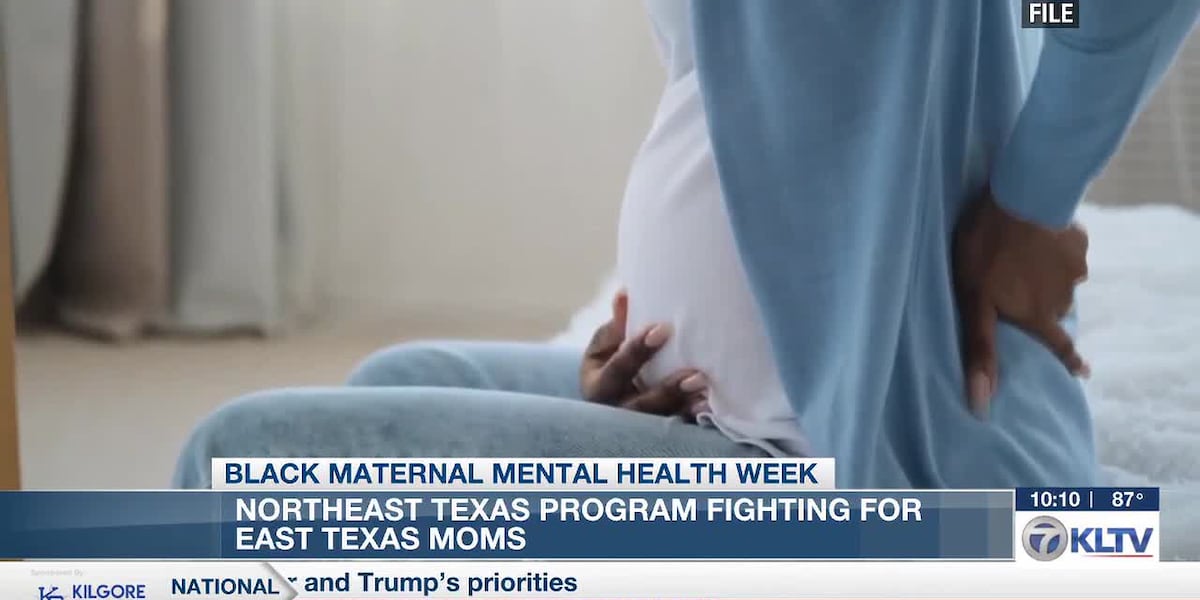
TYLER, Texas (KLTV) – One in five new mothers will experience a maternal mental health condition during or after pregnancy. For Black mothers, that number rises to nearly 40% — nearly twice the rate of all women, according to March of Dimes.
Black Maternal Mental Health Week, recognized July 19–25, draws attention to those disparities and calls for expanded access to screening, support, and treatment, March of Dimes says.
‘One of the leading causes of pregnancy-related deaths is mental health’
The CDC reports Black women are three times more likely to die from a pregnancy-related cause than white women, and more than 80% of pregnancy-related deaths in the U.S. are preventable. Multiple factors contribute to these disparities, according to the CDC:
Variation in quality of healthcareUnderlying chronic conditionsSocial determinants of health, including limited fair opportunities for economic, physical, and emotional health
Mental health conditions — including depression, anxiety, death by suicide, and substance use disorders — are the leading cause of maternal mortality, according to March of Dimes. Up to half of women experiencing maternal mental health symptoms do not receive any support or treatment, March of Dimes says.
Tiffany Murray, a maternal health program specialist with Net Health, said East Texas lacks adequate mental health resources that specialize in perinatal care.
“One of the leading causes of pregnancy-related deaths is mental health,” Murray said. “And so that is something that we somewhat lack here in East Texas.”
Murray said the barriers Black women face in seeking care go beyond access. She said many women feel unseen by providers and are reluctant to seek help due to a cultural expectation of strength.
“As a Black woman, there is that sense or that feeling of always having to be strong, always having to be other people’s support system,” Murray said. “But at the same time, you have to be able to receive some support as well as some self-care.”
A personal experience with being unheard
Murray, who experienced postpartum depression after the birth of her son, said her own labor and delivery illustrated the problem firsthand. During labor, medical staff rushed into her room and instructed her to change positions without explanation.
“All of a sudden, I just started seeing a whole bunch of people rushing to my room,” Murray said. “And telling me to switch from side to side while I’m laying in my bed. And then they told me to get on all fours on my bed. And I’m like, hold up, wait a minute, pause. What is going on? You can’t just tell me to do all of this and not tell me what’s going on with me or my baby.”
Doctors told her the baby’s heart rate had dropped and they were repositioning her to bring it back up — but only after she demanded answers. Murray said the experience reinforced why self-advocacy matters.
She said the midwife practice she used during her pregnancy offered a different standard of care.
“That was one of the things that I loved about the midwife practice that I went to — they took the time to hear me, to see me not as just a patient with a random patient number,” Murray said.
The DREAM program
Through Net Health’s DREAM program — Delivering Resources, Empowering All Mothers — Murray and a team of two maternal health community health workers and a peer dad specialist connect all expecting and postpartum mothers and fathers in Smith and Cherokee counties to care and community resources.
Murray said the program partners with Healthy Start Tyler through BCFS and UT Tyler’s Nurse Family Partnership, among other organizations. She said the program also serves as an extended support system for families who relocate to East Texas without an existing support network.
Murray said postpartum depression can persist well beyond the standard six-to-eight-week recovery window — in some cases up to a year or longer. She said 85% of maternal deaths in Texas occur between 43 days and one year postpartum.
“Postpartum can go all the way up to one year,” Murray said. “Don’t feel like you’re alone.”
Resources
Families in Smith and Cherokee counties can contact the DREAM program here.
Additional local resources include:
Healthy Start Tyler through BCFSUT Tyler’s Nurse Family PartnershipThe Andrews CenterMaternal Mental Health of East Texas
The National Maternal Mental Health Hotline is available here.
Copyright 2026 KLTV. All rights reserved.