
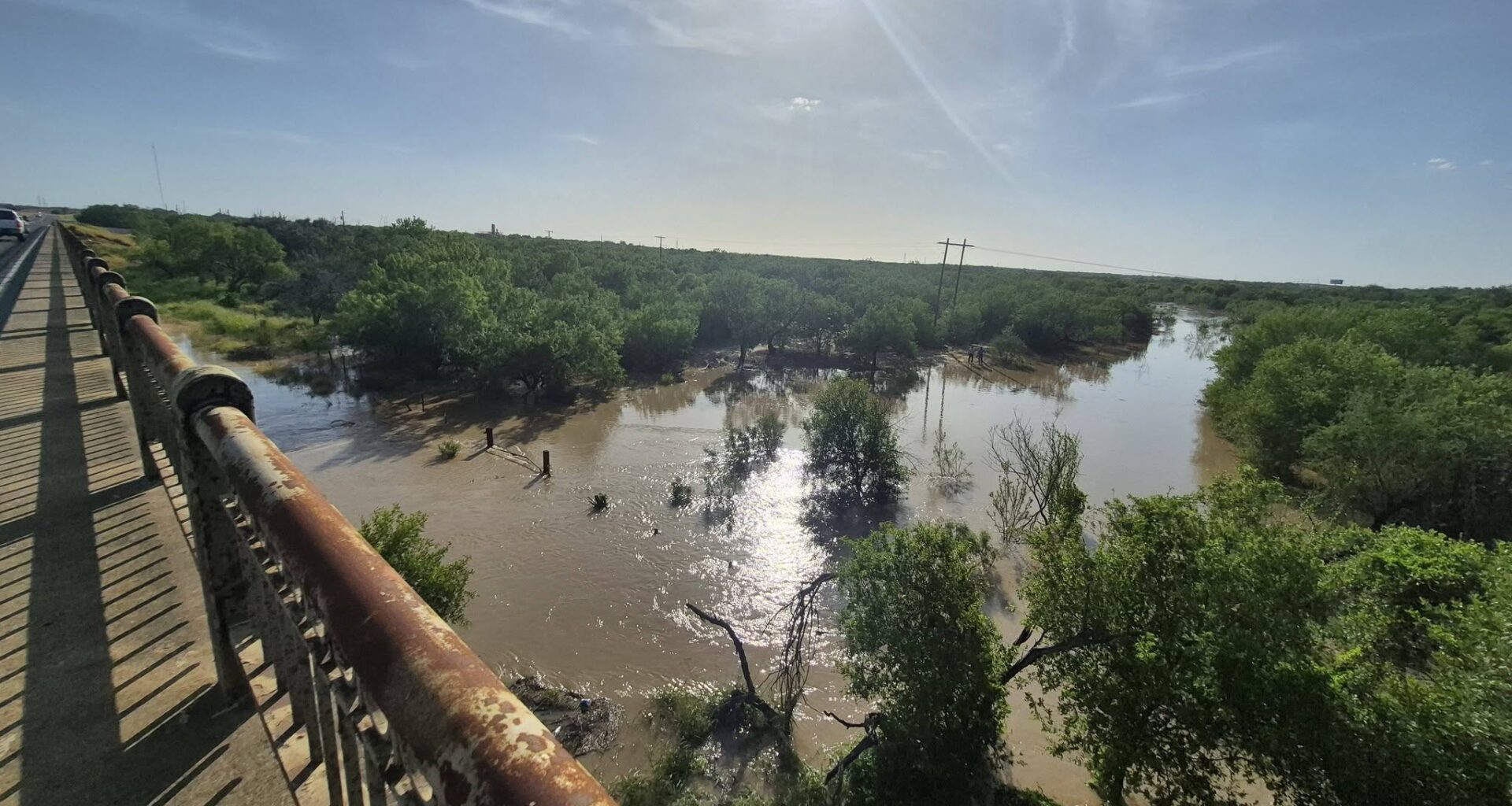
The La Salle County city of Cotulla, located about 90 miles southwest of San Antonio, has been among those hardest hit. Late Tuesday night, July 21, La Salle County officials urged residents to consider voluntarily evacuating “due to the rapid rise of the Nueces River,” La Salle County Fire Department officials said in a Facebook post at 11:47 p.m. According to the National Oceanic and Atmospheric Administration (NOAA), the Nueces River reached major flood stage at Cotulla at about 10:15 p.m. Tuesday night. During a news conference on Wednesday morning, county officials announced that the Nueces River had risen to 28.96 feet — the highest rise in more than a decade.
“It’s a very serious time. We’re still not out of the danger,” La Salle County Judge Leodoro Martinez III said.
Though water levels in the Nueces River are expected to begin subsiding by Tuesday night, the county judge said he expects Cotulla and the rest of La Salle County to remain under “emergency situations for the next four to five days.”
More than 300 first responders have responded from across the state, including Texas A&M Task Force 1 and the Texas Department of Emergency Management, La Salle County Fire Chief Daniel Mendez said. Over the last several days, first responders have gone to homes and buildings “door by door” to urge residents to consider voluntarily evacuating or to check on those sheltering in place.
“Currently, we have approximately 599 residents that have decided to shelter in place, two voluntary evacuations, 122 self-evacuations and three water rescues,” Mendez said. “I cannot stress enough: please stay off the flooded roadways. If you see barricades, they are there for a reason.”
The fire chief added that floodwaters have intruded into some homes and buildings in Cotulla, but officials won’t know how many until the river recedes. This week’s flooding has also brought something new — floodwaters that “flowed in a different direction that we’ve never seen,” as the rising Nueces River backflowed into Mustang Creek on the east side of Cotulla, Mendez said.
Meanwhile, about 45 miles to the east, the Frio River has also been rising, causing flooding in Tilden. NOAA data show that the Frio reached major flood stage at 17 feet sometime after 9 p.m. on Tuesday night. However, a few hours later, McMullen County officials announced that readings were no longer accurate because the flood gauge had “broken or malfunctioned.”
According to the National Weather Service in Corpus Christi, both McMullen and Live Oak counties remain under a flood warning due to a continued flood threat from both the Frio and Nueces rivers.
“The local forecast now shows the Frio River at Tilden cresting in major flood stage near 28 ft Thursday Afternoon (sic) with a gradual decrease through early next week,” NWS officials said.
Meanwhile, the high waters that Cotulla is seeing will soon continue downstream toward Tilden, where the Nueces River is “forecast to rapidly rise on Saturday into major flood stage,” NWS officials said. The two rivers have risen so quickly that their swelling has become visible from space.