
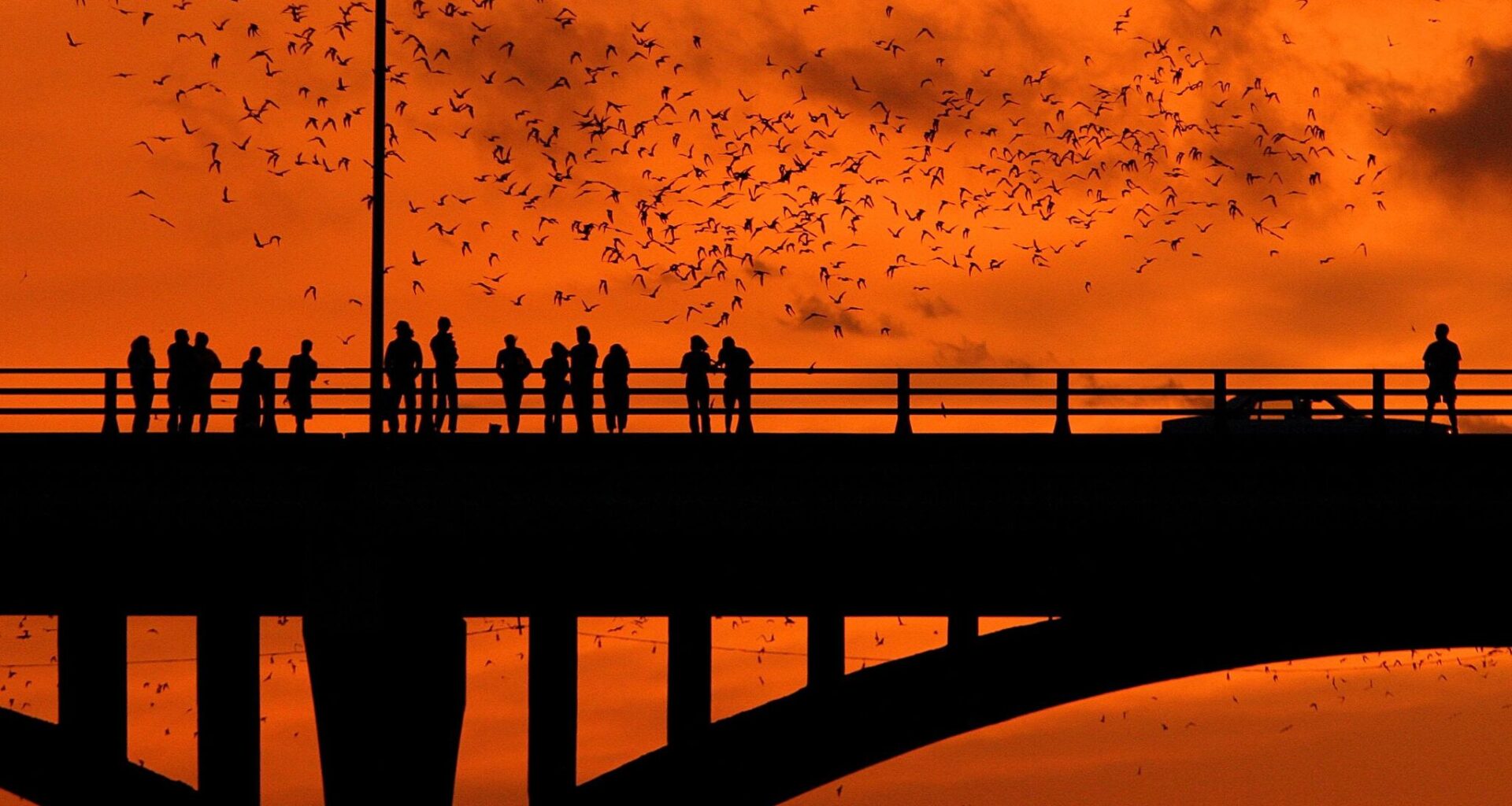
People watch the bats emerge from the Ann Richards Congress Avenue Bridge.
Jay Janner/American-Statesman
Bat watching is one of Austin’s rites of passage. When a friend comes to town, chances are they’ll end up standing on the Congress Avenue Bridge at sunset, shoulder to shoulder with families, couples on date night and tourists clutching their phones, waiting for the sky to erupt with bats — and hoping they don’t suffer collateral damage from above.

The nightly emergence of roughly 1.5 million Mexican free-tailed bats has become one of the city’s most recognizable traditions, drawing thousands of people every year. But while visitors know to look up when the bats begin their evening flight, many leave without knowing much about the animals themselves or why they call the bridge home in the first place.
Article continues below this ad
That’s something a new project hopes to change.
The bat watching experience in Austin is getting a revamp
More than 1.5 million Mexican free-tailed bats live under Austin’s Ann W. Richards Congress Avenue Bridge.
ELI IMADALI/AMERICAN-STATESMAN
Beginning Aug. 26, the south viewing area at the Ann Richards Congress Avenue Bridge will feature new educational signs and interactive exhibits designed to give visitors a little more context while they wait for the main event.
Article continues below this ad
The upgrades include bilingual signs with QR codes that lead to videos, bat facts and interactive activities. At the center of the experience is “Bootsy the Bat,” a handmade puppet voiced in English and Spanish by Austin musician Carrie Rodriguez.
The project was developed by Austin filmmaker Skip Hobbie in partnership with several local conservation organizations, including Merlin Tuttle’s Bat Conservation, Austin Bat Refuge, Bat Conservation International, the Trail Conservancy and Texas Parks and Wildlife Foundation.
“Bats are secretive, nocturnal animals that don’t always get the attention they deserve, yet in the heart of downtown Austin we have one of the most extraordinary wildlife spectacles in North America,” Hobbie said in a statement. “This project brings that work home and helps people better understand these incredible animals in my own city.”
The bridge has long been more than a place to catch the evening commute.
Article continues below this ad
After a 1980 renovation created narrow expansion joints beneath the bridge, the structure unintentionally became the perfect home for Mexican free-tailed bats. Today the bridge is home to what is widely considered the world’s largest urban bat maternity colony, with pregnant females arriving each spring and the population swelling into the summer before the nightly exodus.
How to see the Congress Avenue bats take off
Elizabeth Annis and Monica Kelty, center with masks, wait on the Ann W. Richards Congress Avenue Bridge for bats to come out at the 15th annual Bat Fest on Aug. 24. [ELI IMADALI/AMERICAN-STATESMAN]
Austin American-Statesman
How can you tell what time of day the bat colony will head east toward open fields swarming with insects? Austin Bat Refuge, a nonprofit dedicated to the rescue, healing and release of injured or orphaned bats, posts updates at austinbatrefuge.org.
Article continues below this ad
“We look at over 100 data points per night to give you the most accurate flight predictions out there,” reads a page dedicated to the Congress Avenue Bridge colony. Experts factor in wind, rain, sunshine, temperature and other conditions that might contribute to flight time.
“Some bats fly nearly every night, but the best times of year to view are March-early May and late July-mid September,” reads the website. “Best viewing is under the south side, backlighting the bats with light left in the sky or lights from buildings. Streetlights allow some viewing long after dark.”