
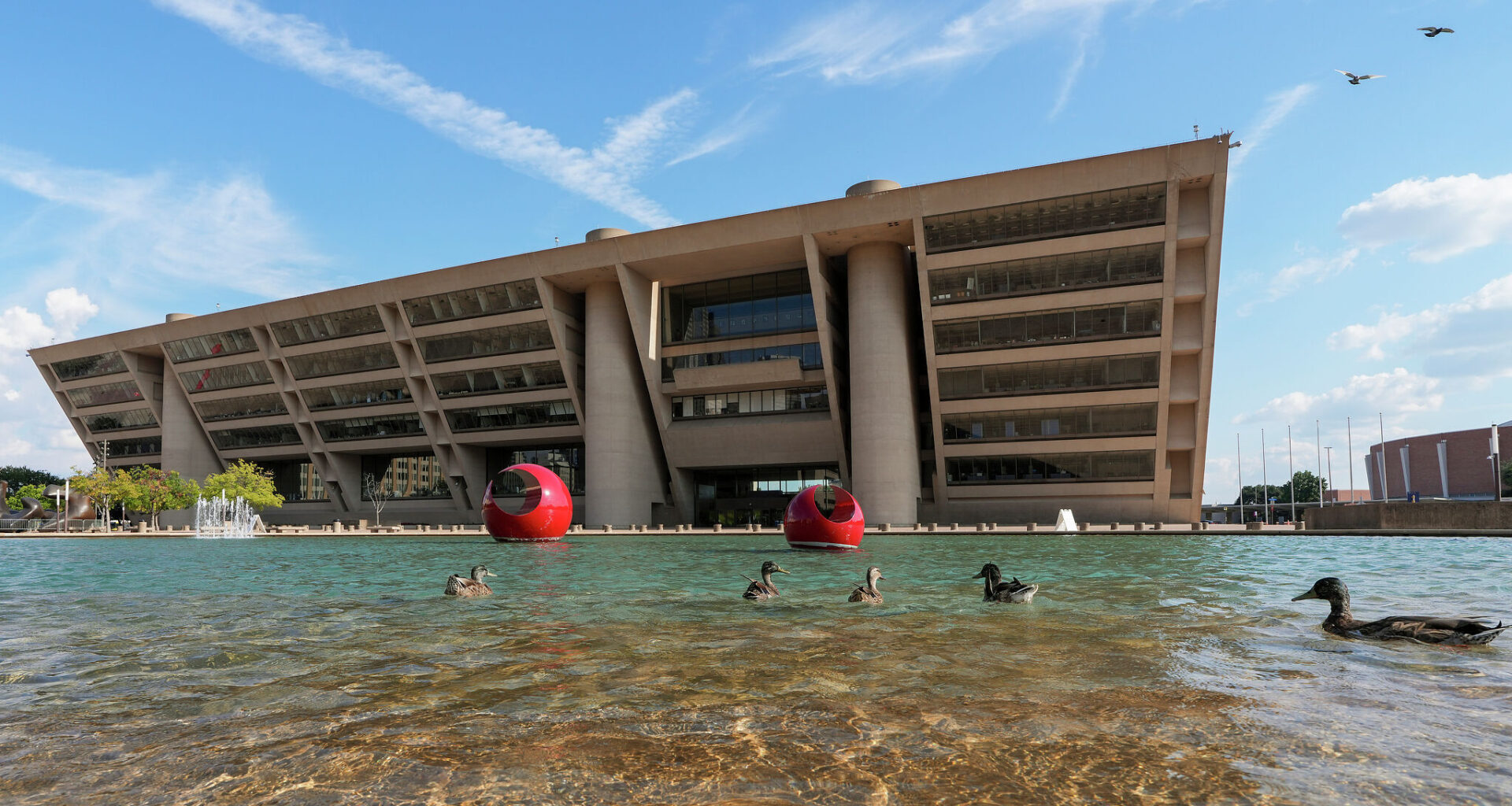
Ducks enjoy the reflecting pool in front of Dallas City Hall. John Lewis, former director of the Goals for Dallas program, writes that the city should save the historic building.
File photo/Dallas Morning News
Mayor J. Erik Jonsson launched the Goals for Dallas program in 1964 to help revitalize the city following President John F. Kennedy’s assassination. According to Jonsson, the program sought to “bring the people of Dallas together in an effort to reach mutual aims of some greatness and magnitude that will enable us to leave behind a city that will be remembered by men for eons to come.”
Among the Goals program’s most visible achievements were a new City Hall, completed in 1978, and the downtown central library, completed in 1982 and named for Mayor Jonsson. The forward-looking modernist architecture of those buildings symbolized optimism and renewal as Dallas sought to redefine itself and restore civic pride.
It is striking, therefore, that today there are proposals to demolish City Hall and replace it with an arena, housing, a casino, a mixed-use tower or even pickleball courts. City Hall is less than 50 years old — hardly an eon.
Article continues below this ad
I believe Dallas should reconceptualize City Hall in its current location rather than relocate it. At a Goals for Dallas conference in 1983, Megatrends author John Naisbitt observed, “The Goals program is a very uplifting enterprise … One of the things that impresses me so much is your constant process of reconceptualizing.”
That observation remains relevant. Rather than abandoning City Hall, Dallas has an opportunity to reimagine this civic landmark while preserving its historic and symbolic significance.
Reconceptualizing begins by doing what we should have been doing all along: maintaining and renovating the building. City Hall today reflects decades of deferred maintenance.
Many major cities have avoided this problem. Houston’s 87-year-old City Hall has been continually maintained. A plaque in its rotunda reads, “As we build our city let us think that we are building forever.” Dallas should embrace that same philosophy.
Within this framework, I offer a few ideas.
Article continues below this ad
Preserve the civic center
City Hall is more than a government building. It is the centerpiece of a civic center that includes City Hall Plaza and the J. Erik Jonsson Central Library. The buildings were intentionally designed as architectural counterparts, with the plaza uniting them. Moving City Hall to a downtown office tower would dismantle this civic center and weaken an important symbol of Dallas’ identity. In most major cities, a well-defined civic center strengthens downtown and provides a focal point for civic life.
Have a plan
Dallas appears to lack a comprehensive, long-term master plan for City Hall’s upkeep and renovation. The central library and the Dallas Museum of Art have benefited from ongoing capital improvements, while City Hall accumulated a substantial maintenance backlog. We need a long-term strategy to preserve both City Hall and the civic center.
Reconceptualize City Hall Plaza
Replace much of the plaza’s concrete and reflecting pool with landscaped green space, an amphitheater, a children’s playground, an interactive water feature and an outdoor café and food service. Successful examples include Boston City Hall Plaza and the amphitheater at Corpus Christi’s Cole Park. The result would be a greener, more welcoming civic space that encourages everyday use and community events.
Article continues below this ad
Put public interests first
Should Dallas preserve an internationally recognized civic center or use city government to help fill vacant downtown office space? If developers in Plano can successfully repurpose the former JCPenney headquarters, developers in Dallas can repurpose downtown office buildings, without rent checks from taxpayers.
Make a payment plan
The old saying, “You can pay me now or pay me more later,” applies here. A modest property tax increase could help eliminate the current budget shortfall while generating millions annually for City Hall repairs. Including civic center improvements in the November bond package could provide additional funding, and Dallas voters have historically supported infrastructure bonds.
A public-private partnership, like Klyde Warren Park, could attract private investment and philanthropy. Dallas also could issue certificates of obligation to begin needed repairs. Resources exist. Where there is a will, there is a way.
Article continues below this ad
Please listen to the words of the poet Edwin Markham, or Dallas may one day cease to be the Dallas we know. In “Man-Making,” Markham wrote: “Why build these cities glorious if man unbuilded goes? In vain we build the world unless the builder also grows.” Those words remind us that a city’s greatest achievement is not simply the buildings it erects, but the values and vision it sustains.
Now listen to Erik Jonsson, whose leadership helped shape modern Dallas: “We can do it, if we care enough.”
Those two messages, though separated by time, express the same enduring truth: Great cities are built not only with concrete and steel, but with vision, commitment and the collective will to do what is right.
John Lewis was executive director of the Goals for Dallas program from 1981 to 1993.
Article continues below this ad
Have thoughts about this? Send a letter to the editor using our letters form or email letters@dallasnews.com. Letters should be no more than 200 words and include the first and last name of the writer and city of residence.