
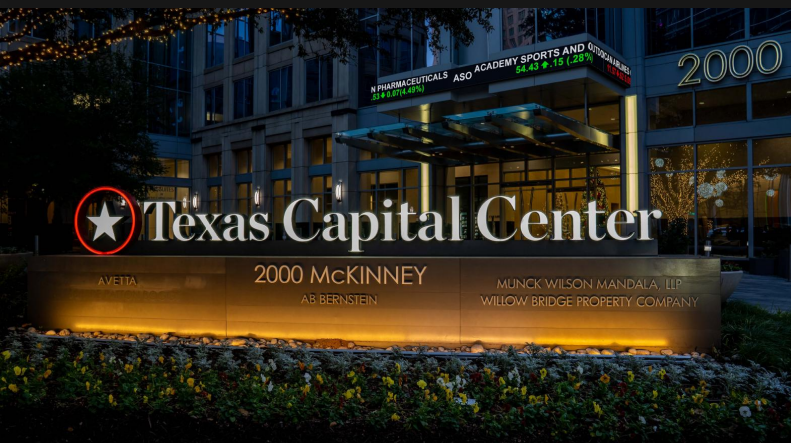
These renderings show a proposed stock ticker outside the Texas Capital Center tower at 2000 McKinney Ave.
Courtesy of Oak Lawn Committee files
Wall Street analysts’ crystal balls must have been polished recently, with Texas Capital Bancshares’ second-quarter financials coming in right around expectations.

The Dallas-based firm, whose subsidiary Texas Capital Bank is one of the state’s largest banks, reported earnings Wednesday, and headline measures were clustered around consensus estimates. Adjusted earnings per share for the second quarter were $1.88 compared with an estimate of $1.86, per Yahoo Finance. Revenue similarly nudged past estimates at $335.5 million compared with $333.2 million. Both were quarter-to-quarter and year-over-year improvements, as Texas Capital continued revenue-driving trends from its better-than-expected first quarter like growth in fee income and book value per share, which each hit records this quarter.
“Double-digit year-over-year growth in earnings per share and book value per share, combined with strong capital ratios and operational
efficiency, reflect another quarter of consistently improving financial performance earned through continued focus on delivering for our
clients,” said Rob Holmes, chairman, president and CEO, in the release. “The durability of our platform, diversity of our solution set, and dedication of our teams, position us to sustain momentum through the remainder of the year.”
Article continues below this ad
Texas Capital’s board of directors also approved another round of dividends, including a dividend on preferred stock and a 20-cent dividend per share of common stock, after delivering the first quarterly common stock dividend in the company’s history last quarter. The company’s stock price fell by about 1% from open to close on Wednesday but is up about 13% year-to-date, outperforming the Nasdaq Composite.
The financial performance comes after Texas Capital completed its transformation into a full-service financial institution, marked by hitting in late 2025 a series of quantitative and qualitative goals it set in 2021. The resultant diversification in revenue is evidenced in a year-over-year increase in non-interest income of $21 million, including a record $60.5 million in fee income from areas of focus like wealth management, treasury products and investment banking and trading, “as strengthened client partnerships continue translating into broad engagement across the Firm.”
Related story: Texas Capital needed to transform, and it did. How is simpler than it seems
“I think that 33% of the investment banking fees that didn’t come from trading came from new relationships, either from the commercial or the corporate bank, just as intended,” Holmes said on a call with investors. “A fun fact is, all of our closed [mergers and acquisitions] transactions year-to-date have been us selling middle-market, privately held, Texas-based, family-owned companies.”
“Only thing I’d add is that a third of those also resulted in new wealth opportunities, which … we think that’s a really large opportunity for us in the back part of this year, but certainly moving into 2027,” said chief financial officer Matt Scurlock. “So you’re effectively banking these clients, providing investment banking products and services, and then high quality private wealth service in return.”
Article continues below this ad
The softening in the bank’s credit quality that showed up in the first quarter abated some in the second, as nonperforming assets returned to fourth-quarter 2025 levels. In the first-quarter, Texas Capital reported total nonperforming assets of $166 million, up from $121 million in the previous quarter; this quarter, nonperforming assets came in at around $124 million. Meanwhile, adjusted return on average assets, a key measure of bank profitability, has been slightly below the target of 1.1% set in 2021 each quarter this year, but Holmes noted Texas Capital hasn’t provided guidance on profitability expectations moving forward.
“I would just tell you that stacking annual book value quarter after quarter is very, very important and something we’ll continue to do, and something we’ve done as well or better than anybody in the country these past five years. … And as the platform continues to mature, you’ve seen over time we’ve certainly made the place more efficient,” Holmes said on the call. “That journey continues. … I would just look at positive operating leverage as a goal of the firm over time, and the rest will take care of itself.”