
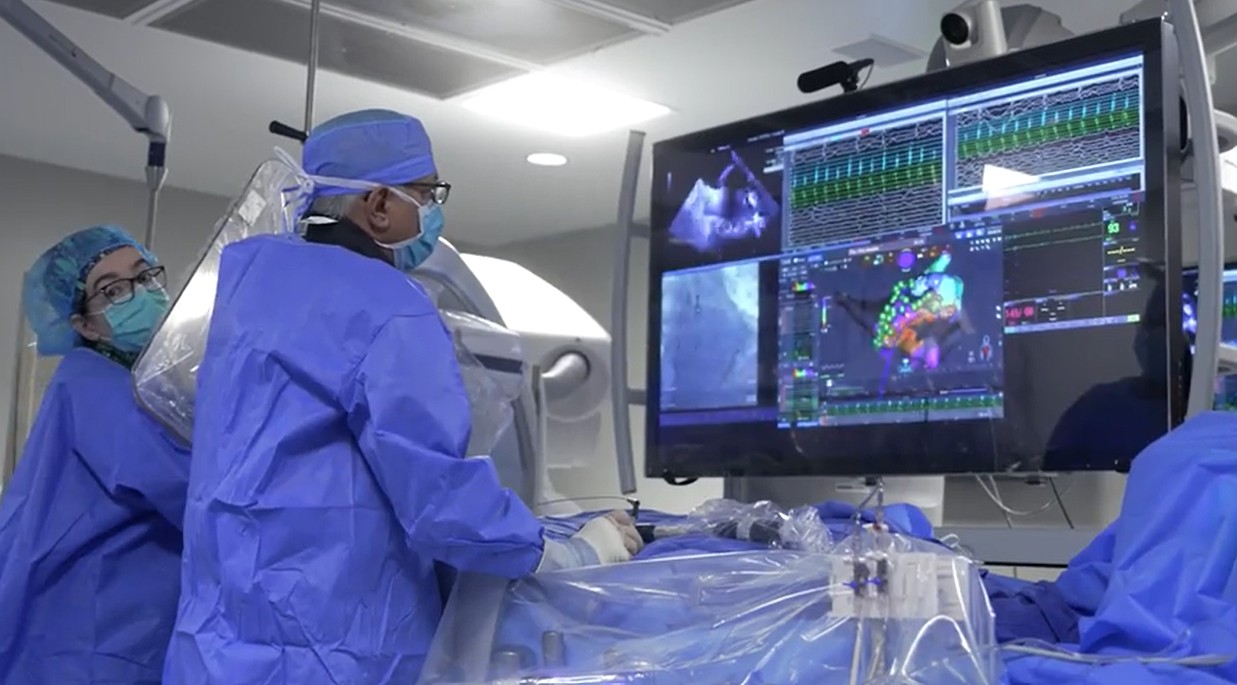
St. David’s Medical Center doctors perform a live procedure during EPLive medical conference.
Provided by EPLive
Every other year, about 1,600 cardiac electrophysiologists from around the world tune into an operating room at St. David’s Medical Center in Austin to watch the latest treatments for heart rhythm problems live.

This year, 200 of them came to Austin in person. The event reached doctors from Belgium, Brazil, Canada, Colombia and Italy. In alternating years, the EPLive conference moves to locations around the world, with doctors from the Texas Cardiac Arrhythmia Institute at St. David’s Medical Center continuing to coordinate the sessions. EPLive has been held in India, Italy and Colombia. The conference is headed to China and Saudi Arabia next, said Dr. Andrea Natale, the executive medical director of the institute and the course director for EPLive.
Article continues below this ad
The conference, which started in 2012 in Austin, is different from other training sessions or medical conferences because of the live cases, Natale said.
Doctors demonstrate new techniques and devices for patients with irregular heart rates. Many demonstrations have shown techniques that have been part of clinical trials that became the standard of care.
This year, Natale and his colleagues in Austin demonstrated performing a cardiac ablation to destroy the part of the heart causing the heart to misfire into an arrhythmia while installing a Watchman device during the same procedure. The Watchman is a left atrial appendage closure device that prevents a blood clot from traveling from the heart to the brain, causing a stroke. People who have atrial fibrillation have an increased risk of stroke because the abnormal heart rhythm can cause blood clots to travel to the brain. The Watchman, which is delivered through a catheter, unfolds in the left atrial appendage of the heart to stop blood clots from traveling to the brain.
Doing the two procedures together saves time, saves on the number of times a patient undergoes anesthesia and is generally more efficient.
Article continues below this ad
EPLive allows doctors to watch live procedure at St. David’s Medical Center. They can see the same screens the doctor in the catheter lab can seen.
Provided by EPLive
Combining two procedures
Often, people who have atrial fibrillation are on blood thinners for the rest of their lives to prevent a stroke. Blood thinners can cause bleeding that is difficult to stop, which can be dangerous during an accident or surgery. The Watchman can help patients get off blood thinners while lessening the risk of stroke.
Austinite Paula Vaughan, 77, had the dual procedure in mid-June, a few weeks after it was demonstrated during EPLive. Vaughan had been experiencing a rapid heart rate two years ago. Her Samsung watch detected it and sent her alerts.
Article continues below this ad
Her first ablation to control atrial fibrillation was done that year. “The ablation seemed to be successful,” Vaughan said, but she hated blood thinners.
This spring, though, Vaughan again started getting notices on her Samsung watch that her heart rate was elevated. At one point, she got 27 messages in one day.
“I wasn’t feeling anything per se,” Vaughan said.
Around this time, Vaughan’s cat, Buddy, scratched her, and Vaughan had difficulty stopping the bleeding. That was worrisome.
Article continues below this ad
When her cardiac electrophysiologist, Dr. John Allison, who is part of the Texas Cardiac Arrhythmia Institute, met with Vaughan, it was clear that the arrhythmia was back, and Vaughan wanted to be off blood thinners while still reducing her risk of stroke.
On June 15, Vaughan had both the Watchman inserted and a new ablation. Both were done through a catheter inserted through the groin to reach the heart.
She stayed one night in the hospital and already has seen a significant reduction in the number of high heart rate alerts her watch is sending her. Most of the time, her heart rate is in the 70s and 80s beats per minute, compared with the 100s to 130s she was experiencing. She expects to begin weaning off blood thinners at her next checkup at the end of July.
Article continues below this ad
EPLive allows doctors to watch live procedure at St. David’s Medical Center.
Provided by EPLive
Sharing techniques worldwide
EPLive allowed doctors to see the preparation and process of doing both procedures during the same anesthesia session. “It’s becoming more popular in the patient that requires more ablation,” Natale said.