
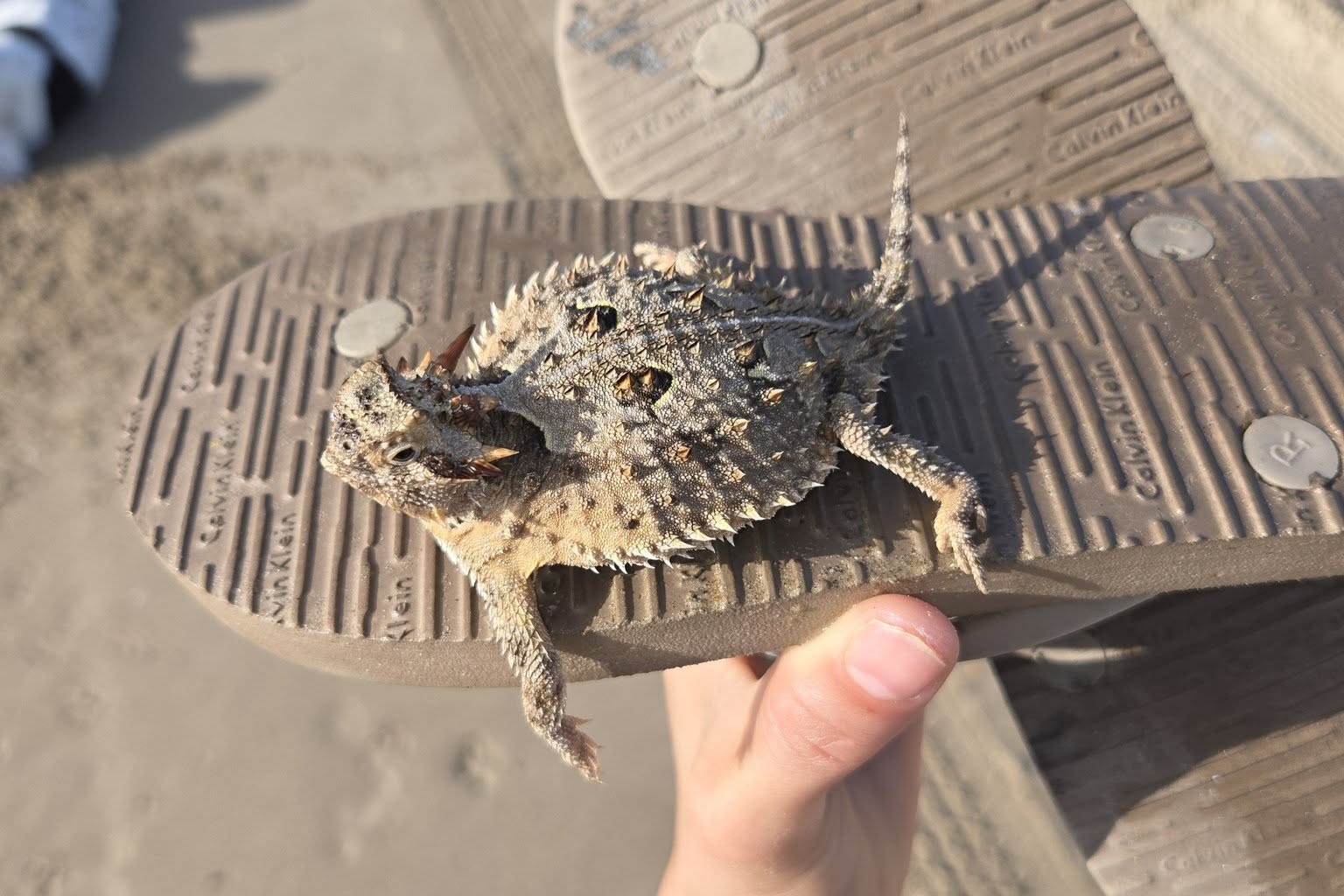
Imagine spotting what looks like a toad being tossed around in the surf on a South Padre Island beach, only to discover you’ve rescued one of Texas’ most iconic reptiles.

That’s exactly what happened to Port Isabel resident Jennifer Gomes during a recent morning walk with her dog and mother-in-law.
While walking along the far end of South Padre Island, an area she hadn’t explored before, Gomes spotted what looked like a toad in the surf.
Article continues below this ad
“I noticed it, but we kept walking,” Gomes told Chron. “Then a wave came and brought it right to our feet. My mother-in-law saw it, got scared and ran away yelling, ‘It’s a toad! It’s a toad!'”
At first, Gomes thought the animal was dead because it seemed so out of place. Then another wave rolled in.
“I said, ‘No, it’s alive!’ I was holding my flip-flops in my hands, so I used them to scoop it up and lift it out of the water.”
Jennifer Gomes used her flip-flop to lift a Texas horned lizard out of the surf on South Padre Island.
Jennifer Gomes
Once it was safely out of the surf, Gomes noticed its spiky back.
Article continues below this ad
“I wondered, ‘What kind of animal is this?’ I knew it was a lizard, but I didn’t know what kind,” she said.
After Google came up empty, she posted a photo in a local South Padre Island Facebook group. Within seconds, commenters identified it as a Texas horned lizard, affectionately nicknamed the “horny toad” despite actually being a reptile.
“People kept saying, ‘What is it doing in the water? It’s not an aquatic animal,'” Gomes said. “Others warned me, ‘Be careful, it can squirt blood from its eyes.’ But it was very calm. It looked very, very tired. I think it must have been in the water for a long time.”
What was it doing in the water?
The state-listed threatened reptiles have become increasingly uncommon across much of Texas, but experts say South Padre Island is part of their natural range.
Article continues below this ad
“They do occur naturally on some of the barrier islands such as Matagorda and South Padre,” Dean Williams, who leads Texas Christian University’s horned lizard research program, told Chron. “Nice to see they are still there.”
Texas A&M herpetologist Lee A. Fitzgerald said horned lizards typically live in the dunes and grassy areas behind them, where they feed on ants.
Gomes said many people online were surprised to see the lizard on the island, while others questioned how she didn’t recognize it.
“I told them this is a tourist destination,” said Gomes, who moved to Texas from Brazil about seven years ago. “People come here from all over the world.”
Article continues below this ad
Instead of taking the reptile to a wildlife rehabilitator, Gomes released it in an area with native brush away from the shoreline, because it appeared healthy.
Smart, funny and sometimes unhinged look at the week that was.
By signing up, you agree to our Terms Of Use and acknowledge that your information will be used as described in our Privacy Policy.
“It just happened to be trapped in the water,” she said. “I honestly thought it was someone’s pet that had escaped or been abandoned because I couldn’t imagine it belonging there.”
Jennifer Gomes released the Texas horned lizard into native brush away from the shoreline after rescuing it from the surf.
Jennifer Gomes
Neither Williams nor Fitzgerald knows exactly how the horned lizard ended up in the surf. Fitzgerald said it may have been swept into the water or released on the beach before running toward the waves. “This was a lucky lizard?” he said.
Article continues below this ad
Williams said anyone who finds a horned lizard in the surf should move it farther inland into the dunes. Fitzgerald added that if one appears distressed, it should be kept cool and in the shade before being released into suitable habitat later in the day during extreme heat.