
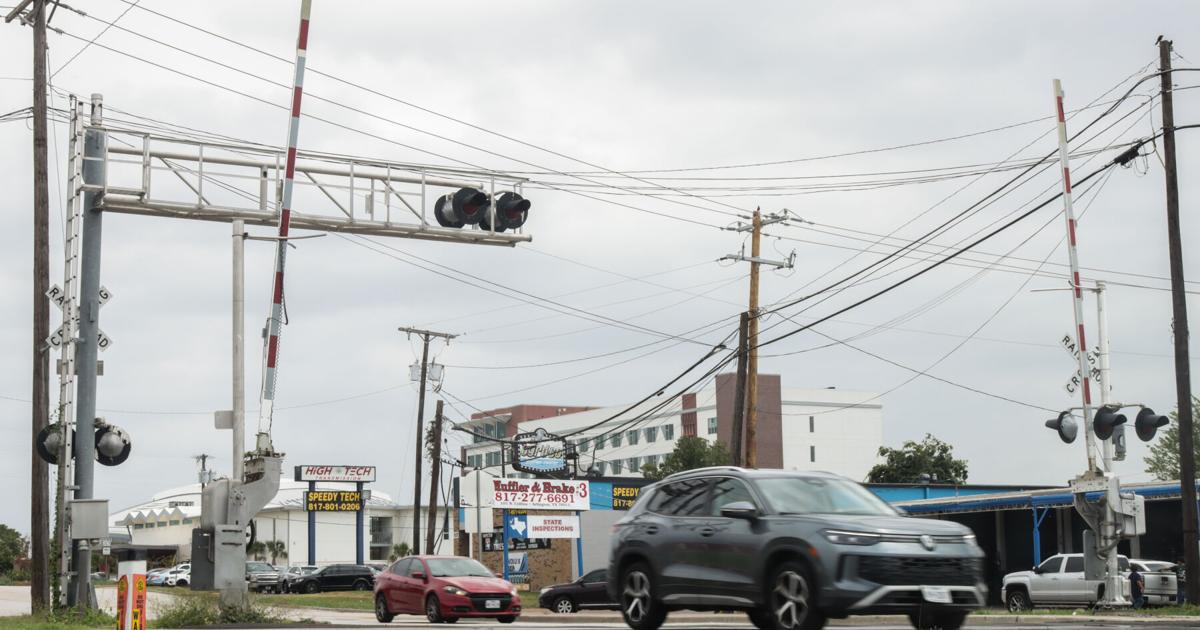

Cars drive across the Collins Street railroad crossing on July 24 in Arlington. Construction on the project addressing traffic concerns is likely to start in the next 10 years.
The U.S. Department of Transportation awarded Arlington a $6.4 million grant for planning and preliminary testing for a bridge or tunnel for Collins street and Cooper street.
The potential overpass or underpass aims to address traffic concerns in the area caused by train tracks on Cooper and Collins street via bypassing the train, cutting down resident’s commute times.
The Better Utilizing Investments to Leverage Development grant program is a competitive grant that funds transportation infrastructure such as highways and bridges, according to the U.S. Department of Transportation website.
Mauricio Galante, District 1 city council member, said the grant will fund the planning and testing needed to pursue the project, including whether the project is feasible to build, environmental testing and engineering plans.
Addressing the traffic and economic challenges created by the train tracks splitting the city has been one of Galante’s priorities since his joining of council and the grant is one of the first steps in that direction.
The grant is reimbursement-based, in which the city will file for reimbursement after each expense until they reach the $6.4 million limit.
Galante said Arlington’s Grants Management Department applied for the program while he and several other city officials advocated for the project.
The pitch for the grant was given in a way that highlighted the tourism of the city and how much it has grown over the years. Galante said it is a must to find a solution to the increasing traffic congestion as Arlington grows in population and as a tourism destination.
“[The train track] blocks the traffic during several hours during the day, during business hours, during traffic hours,” he said. “It’s disrupting the lives and the businesses in the city, and the backlog of cars during traffic hours is understated.”
To begin addressing these traffic issues, the city will submit a request for proposals, a formal document used to announce a project; picking an engineering company for the project; holding a public process request; and a request for proposal and to select an engineering firm for preliminary tests.
During the testing phase, nearby businesses will be able to voice their concerns and be a part of the planning process in a public hearing, Galante said. Traffic would be minimally affected during the planning process.
“Every construction process [is] like that, which impacts the area; there will be a public hearing for it,” he said.
Galante said the project will be included in the city’s comprehensive plan, which could help it move on to the first phase.
The preliminary studies for the project are expected to take a couple of years. After that, the city will seek additional federal and state funds to pursue construction. Galante said construction could start in the next 10 years if everything goes smoothly.
“We’re gonna hit the ground running. That’s all I can say,” he said.
@kh.kennedyharvey