
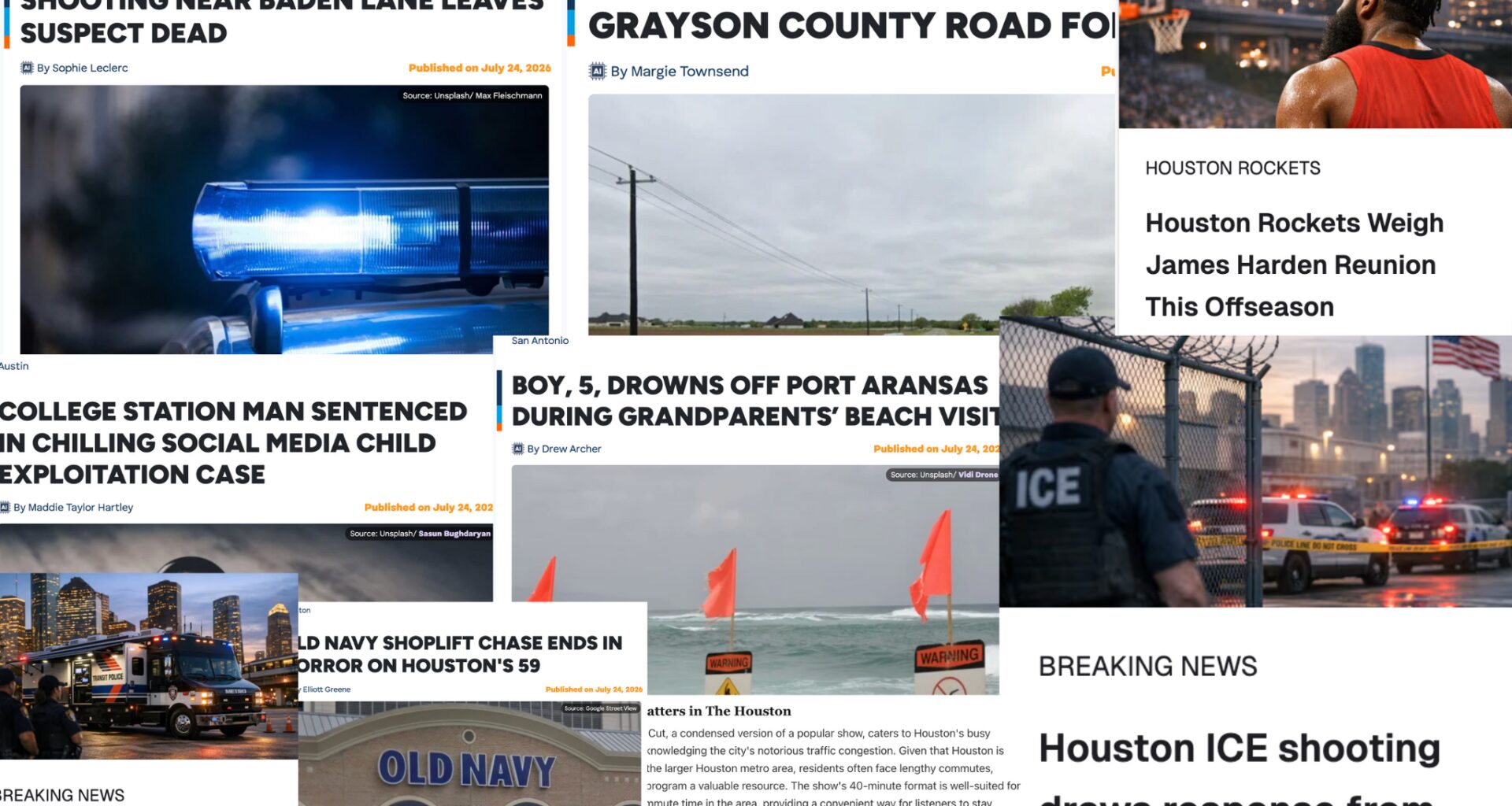
Hoodline Houston reporter Alyssa Ford is a busy woman. On Thursday, she reported on community drama in Montgomery over a Texas Roadhouse (reporting eerily similar to my colleague’s reporting that same day). An hour later, Ford wrote about malfunctioning train signals in Houston’s East End. And as I was wrapping up my day on Thursday, Ford was still cranking out news on a Houston game room bust, an update in a decades-old rape case, and controversy over Flock cameras in Conroe.

Ford wrote six stories on Thursday. The day before that, she wrote six, too. But Alyssa Ford does not have a superhuman work ethic. “She,” as far as I can tell, is not a person at all. Next to Alyssa Ford’s byline, and the other bylines on Hoodline’s website, is a tiny “AI” badge.
Hoodline is an AI-powered newsroom first launched in 2014 to boost local news coverage in San Francisco using a blend of data scraping and reader tips. Eventually, it became an AI-assisted website, and now it appears to simply churn out wholly AI-generated news stories. While still California-focused, the company now includes cities across the country; besides Houston, Hoodline’s Texas footprint includes Austin, Dallas, El Paso and San Antonio.
Article continues below this ad
As far as actual reporting, the output is largely anodyne. Most of Hoodline’s stories aggregate from a mix of local news outlets, social media posts, and government websites and spit it out in a poor man’s version of the Axios “Smart Brevity” format. I first became aware of Hoodline in 2024 when I wrote about the people who tried to resurrect Enron, an effort I jokingly called “Zombie Enron.” Hoodline’s Houston site aggregated the story and reported on the serious return of a company called “Zombie Enron.” The Nieman Lab at Harvard University categorized Hoodline as part of a larger network of “Pink Slime” journalism websites. In 2019, Nextdoor bought Hoodline.
It’s not clear if any humans are involved in Hoodline’s publishing process; stories seem to be full of hallucinations and other errors. In a story about the Houston Dynamo and Dash teaming up with the City of Houston to give away free tickets, Hoodline’s AI reporter attributes a quote from Mayor John Whitmire to a City of Houston statement. But that Whitmire quote came from my colleague Michael Shapiro’s story on Whitmire’s press conference, and doesn’t appear in the statement released by the city. It’s a low-level error, sure, but the point of journalism is to truthfully tell things as they happened. If Hoodline, and the other glut of AI local news websites, can’t attribute basic quotes to where they came from, what happens when it comes to reporting life-and-death news?
On Hoodline’s website, the company says that while “AI may assist in the background,” the company’s journalism is “driven by real human insight and discretion.” Hoodline has said in the past that it uses bylines like “Alyssa Ford” because it envisions their AI reporters as eventually evolving into “AI news anchors.” (Impress3, the company behind Hoodline did not respond to a request for comment.)
Article continues below this ad
Paul S. Howell/Getty Images
Ghosts in the machine
Besides Hoodline, at least two other networks have launched AI slop “news” sites in Texas. The first, Nexcom Media, appears to be based out of Conroe and runs dozens of news sites covering cities across the nation and in Texas. Besides Houston, Nexcom has AI websites covering 39 different Texas towns. (Nexcom Media didn’t respond to an interview request.)
Nexcom’s sites operate in a “briefing” format. Each story on one of Nexcom’s sites has a summary of the story and tells readers where the information came from, whether it’s been corrected, and crucially, if a human reviewed the article. A story on Nexcom’s “The Houston” website about a measles outbreak, for instance, says that its article is an “automated summary drawn from the source’s own published text.” While still AI slop, this seems less egregious to me. They are short summaries and link back to the source, operating with at least some transparency.
Article continues below this ad
The same can’t be said for “Houston.com,” which appears to be a mishmash of an events calendar and news website generated almost entirely by AI. Houston.com appears to have been set up in November 2024 (the first-ever article on the site congratulates Donald Trump on winning the presidential election) and aggregates from press releases and summaries created for specific news items. (One early story on Houston.com about Alex Bregman winning a Gold Glove award in 2024 says that Bregman’s “sights are set on helping the Astros continue to compete for championships.” Bregman signed with the Boston Red Sox after that season.)
Then, garish, hilarious AI-generated images are on every Houston.com article. A recent story about the Astros shows Yordan Alvarez horrifically contorting a bat behind his back. Strangely, many of Houston.com‘s stories seem to be aggregated from video. One of the site’s stories on protests at Houston City Hall demanding accountability after an ICE agent killed Lorenzo Salgado Araujo is a summary of a Washington Post video posted to Facebook.
A company called Dotlife Network, which says that it “builds and operates city directory websites that connect residents with local businesses, events, and neighborhood resources,” seems to run Houston.com. Dotlife Network did not respond to an interview request. Houston.com‘s website also says that it is operated by a Kansas-based LLC called Houston.com LLC. A LinkedIn page for Jason Barrett, a Kansas-based entrepreneur who runs marketing agency Go Local Interactive, said on Linkedin that he runs the site.
Houston.com seems to be the only fully-fleshed out site; AI community websites for Dallas, Fort Worth, Austin and major cities like Boston are bare-bones, with no news or events listed. The play here seems confusing, though considering that I found the site organically through a Google search related to Houston news, it seems the goal is to bring in web traffic through AI-optimized SEO around events and lifestyle.
Article continues below this ad
Smart, funny and sometimes unhinged look at the week that was.
By signing up, you agree to our Terms Of Use and acknowledge that your information will be used as described in our Privacy Policy.
All of this reflects the strangeness of this AI-junkified era we live in now. At a time when news readership is at an all-time low and local newspapers have been decimated (especially in Texas), that void has been filled by these websites run with little to no human oversight.
It’s extremely disheartening not just to imagine that people *might* get their news this way, but to see the stuff my coworkers and I write carelessly consumed and regurgitated like this. Every Texas journalist I know cares deeply about putting out work that’s thoughtful, incisive, well-written and crucially, made by a human being.
That’s why it’s nice to see other publications like Texas Monthly take a stand and state that while AI tools may have use cases in journalism, “they are not a replacement for human creativity, ingenuity, and artistry.” As AI encroaches into everything, including local news, we need that spirit now more than ever.
Article continues below this ad