
Todd Sanders still remembers the stoplight that changed everything.
In 1990, driving through Austin in a yellow Volkswagen, he found himself idling at a corner near Lamar Boulevard and Enfield Road. Across the intersection stood the towering Terminix bug and pest control sign, its neon glowing bright above the city that would soon become home.
Sanders was studying graphic design at the time, searching for work that would let him make art with his hands instead of sitting behind a desk.
Article continues below this ad
“If that light was green, I don’t know what I would’ve done,” Sanders recalled. “Sitting at that red light, I looked over and said, ‘That sign embodies this town.’”
More than three decades later, Sanders is the proud caretaker of that Terminix sign, and his own neon pop art has become as synonymous with Austin as the landmarks that first inspired him.
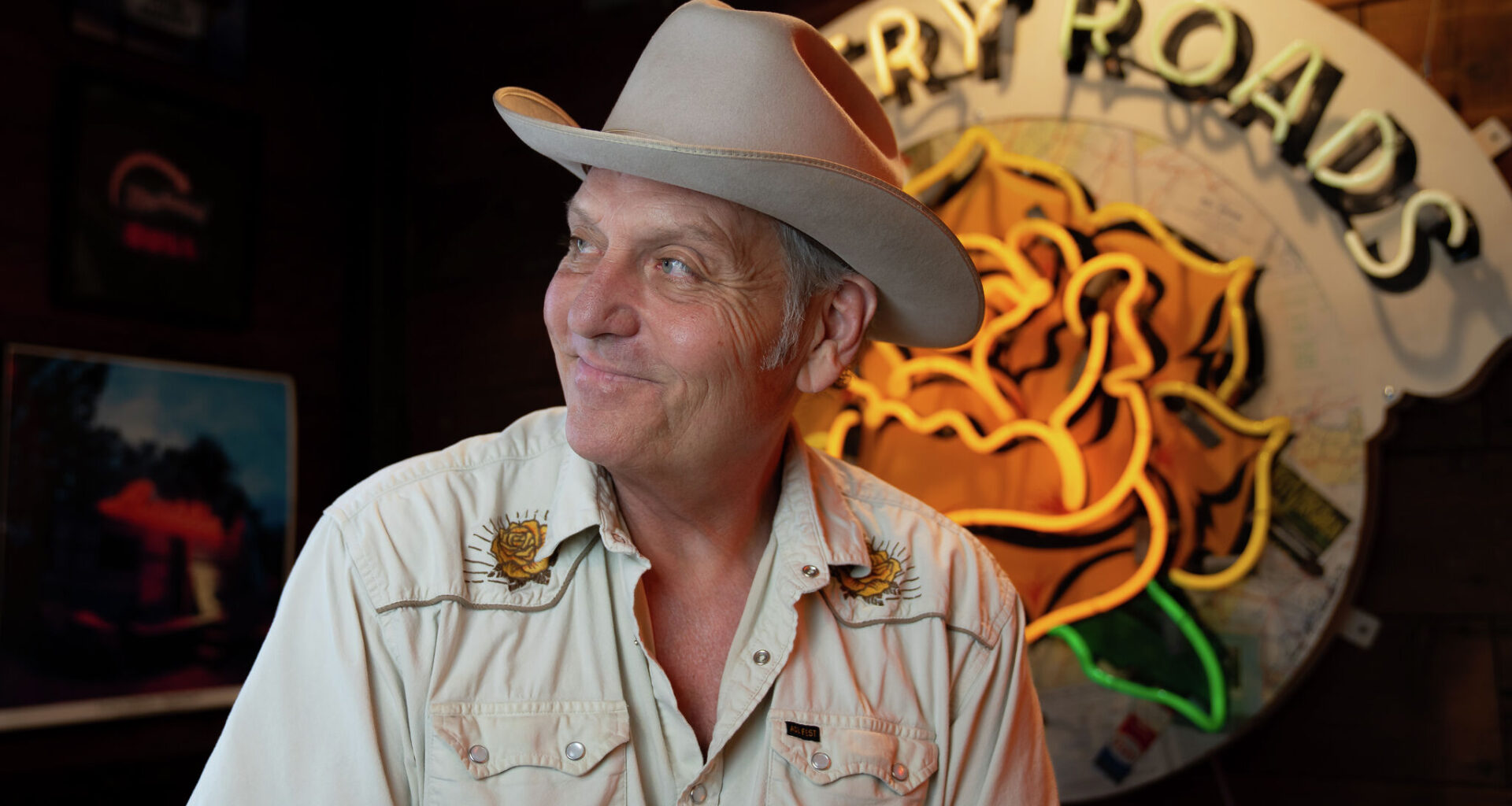
Neon artist Todd Sanders in front of one of his creations at his workshop and gallery, Roadhouse Relics, on South First Street in Austin, July 15, 2026. Sanders, with two other artists, painted the iconic “Greetings from Austin” mural on the side of the building in 1997. Now, Sanders is selling the building and moving to Round Top.
Sara Diggins/Austin American-Statesman
But after spending nearly 30 years at his South First Street studio, the artist behind Roadhouse Relics is preparing to leave the city that shaped his career and artistic identity.
Article continues below this ad
The site of his studio, 1720 South First St., has been purchased by Austin-based real estate development group River Sharpe, which plans to repurpose the property while honoring its history — and preserving the iconic mural it’s best known for, the vintage postcard-style “Greetings from Austin” painted on its exterior wall.
Sanders will move his studio and gallery about 80 miles east to Round Top — a small town also known for its art — by the end of the year, marking the end of an era for that stretch of South First.
“I made a decision to celebrate what I loved about Austin,” Sanders said. “To know that, in celebrating Austin, I’ve shaped Austin’s identity forever — that’s my proudest moment.”
Sanders in plain sight
For many Austinites, Sanders’ work is hidden in plain sight.
Article continues below this ad
His weathered neon signs helped establish the visual language of many local businesses long before vintage aesthetics became fashionable. He restored marquee signs at historic theaters across Texas, including Austin’s own Ritz and State theaters. He also consulted on the Paramount Theatre’s neon and porcelain paint restoration, choosing the color that would be most historically accurate.
As many as 50 original signs created by Sanders once graced popular thoroughfares around the city, but today, only a handful of those original commercial commissions remain — including the iconic Bouldin Creek Café and Lambert’s Downtown Barbecue signs, as well as many signs inside the Continental Club on South Congress.
Sketches for some of Todd Sanders’ work decorate a front desk in his workshop and gallery, Roadhouse Relics, on South First Street in Austin, July 15, 2026. Sanders’ began his career with commercial signage, creating signs for several iconic Austin businesses, but made the switch to fine art.
Sara Diggins/Austin American-Statesman
The others either changed hands or disappeared as businesses closed and buildings were demolished.
Article continues below this ad
“I once heard a place was closing, and I rushed out to save the sign,” Sanders said. “The owner told me it had already gone to the dump with the sheetrock. I thought, this is no way to leave a legacy.”
He shifted away from commercial sign-making in 2005 to focus exclusively on fine art, creating handcrafted neon works that now hang proudly in galleries and private collections across the country.
But one of his most notable influences is visible right outside his front door.
Todd Sanders’ works, “Cowboy Boot” and “Mason Jar” glow on the wall of his studio, July 15, 2026.
Sara Diggins / Austin American-Statesman
In 1997 — shortly after purchasing a long-neglected former grocery that would become his studio — Sanders joined muralists Rory Skagen and Bill Brakhage to paint the “Greetings From Austin” mural on the side of the building facing Annie Street.
Article continues below this ad
The trio expected little more than neighborhood attention, but the mural quickly became one of Austin’s defining images. Tour buses regularly stop outside the building, and Sanders estimated roughly 75,000 visitors pose for photos there each year.
The mural will remain after the property’s sale. Sanders said River Sharpe has committed to preserving both the mural and several historic roadside artifacts displayed on the property — including the iconic Terminix bug, Willie N. Festus, who started it all and now resides in Sanders’ backyard.
Affordability stretches artists thin
Sanders’ instinct toward preservation has been a north star in his career. But preserving Austin’s creative spirit, he acknowledges, has become increasingly difficult.
Article continues below this ad
When he purchased the Roadhouse Relics property in 1997, South First Street looked dramatically different. There was no neon from Barton Springs Road to Oltorf Street, he said, as the corridor consisted primarily of modest homes occupied by longtime residents rather than the boutiques, bars and restaurants seen today. Parking was plentiful. Traffic was manageable. Artists could afford to live nearby.
Now, visitors struggle to find parking. Large trucks delivering artwork to Sanders’ studio navigate increasingly congested streets. Tourists stop by constantly, interrupting Sanders’ creative flow. Inside the studio, finished works crowd every available inch because expansion is no longer financially feasible, even for a widely accomplished and active artist like Sanders.
Todd Sanders’ workshop, July 15, 2026.
Sara Diggins / Austin American-Statesman
Todd Sanders’ workshop, July 15, 2026.
Sara Diggins / Austin American-Statesman
Those logistical challenges helped drive his decision to move to Round Top, where he expects more room, fewer distractions and an environment better suited to producing large-scale work.
Article continues below this ad
For younger artists in Austin, however, Sanders sees a broader issue. Affordability, he said, is making it much harder for emerging artists to establish themselves in the city than it was when he did.
“When I was on South Lamar, I was living in a travel trailer,” Sanders said. “I think I was paying $165 a month for the spot, so an artist could still make art and live in Austin, but it’s becoming harder to do that.”
Now, neighborhoods that once served as creative incubators have become expensive commercial districts. Even nearby communities once considered affordable alternatives have seen rapid appreciation.
“I don’t know where you would go anymore,” he said. “You’d have to leave Austin to really make it affordable, and a lot of artists are.”
Article continues below this ad
On South First Street, Sanders’ departure is one more in a string of closures along the strip. Longtime businesses have been forced to reckon with redevelopment pressures, adaptive reuse projects and new investment. River Sharpe did not respond to a request for comment about plans for Sanders’ building, but Sanders said the development group plans to restore the building and honor its history through its undisclosed new venture.
Austin’s soul ‘will never go away’
Even on his way out, Sanders rejects the common narrative that Austin has “lost its soul.” He said he’s heard versions of that complaint since arriving in 1992.
People in the ’90s told him they wished they had experienced the Armadillo World Headquarters era of the 1970s. Those residents in the 1970s, he said, longed for Austin of the 1950s. Every generation of new Austinites are told the best days happened just before they arrived.
Article continues below this ad
“The cars are zipping around quicker, and some of them don’t even have drivers in them anymore,” Sanders laughed. “But I think people see something in Austin like I saw it when I first drove through town, and in their own way they celebrate it as well.”
“I don’t think Austin soul is ever going to go away,” he added. “It’ll constantly reinvent, but it will never go away.’
Neon artist Todd Sanders’ collection of vintage signs and decor adorn the yard of his workshop and gallery, Roadhouse Relics, on South First Street in Austin, July 21, 2026.
Sara Diggins/Austin American-Statesman
Beginning next year, Roadhouse Relics will operate from Round Top, while artwork viewings in Austin will continue by appointment through the end of 2026. Sanders’ work will also remain available at West Chelsea Contemporary in Austin and art galleries on both coasts.
Article continues below this ad
Austin, Sanders said, will never disappear from his work.
“I followed my dreams here,” he said. “I let Austin change me. But in doing so, I changed Austin in a way, and I’m super proud of that. There will always be a little part of Austin that says, ‘Todd was here.’”