
The City of Austin launched the Displacement StoryMap on July 7, which documents historic changes in Austin’s neighborhoods. The map identifies communities at risk of displacement due to rising costs.
The StoryMap found that Black and Hispanic communities have moved further from the city center, as median rent in Austin has increased 120% since 2000.
The map used data from the American Community Surveys and the U.S. Census to compare demographics in Austin’s neighborhoods between 2000 and 2024. Austin Housing began the program to document how rising housing costs have changed where community groups live. Their goal was to promote the city’s anti-displacement efforts in an easily understood format.
The StoryMap highlights Austin Housing’s resources for both renters and homeowners. Programs include home repair support, legal advice for tenants and a search tool for available affordable housing.
Will Swinton-Ginsberg, a senior planner in Austin Housing’s Displacement Prevention Division, said the StoryMap confirmed with data the narrative about Austin’s tech boom, with data showing that professional and technical work are the most common form of employment for most of the city. Austin’s rising housing costs have also limited the types of workers who can live in Central Austin to high-paying industries like tech, he said.
“When housing costs were lower, that allowed for a wider diversity of types of jobs to be able to exist and for different levels of affordability to be met,” Swinton-Ginsberg said. “Then today, you obviously see that change taking place, where a lot of those kinds of lower-earning industries are being pushed further out.”
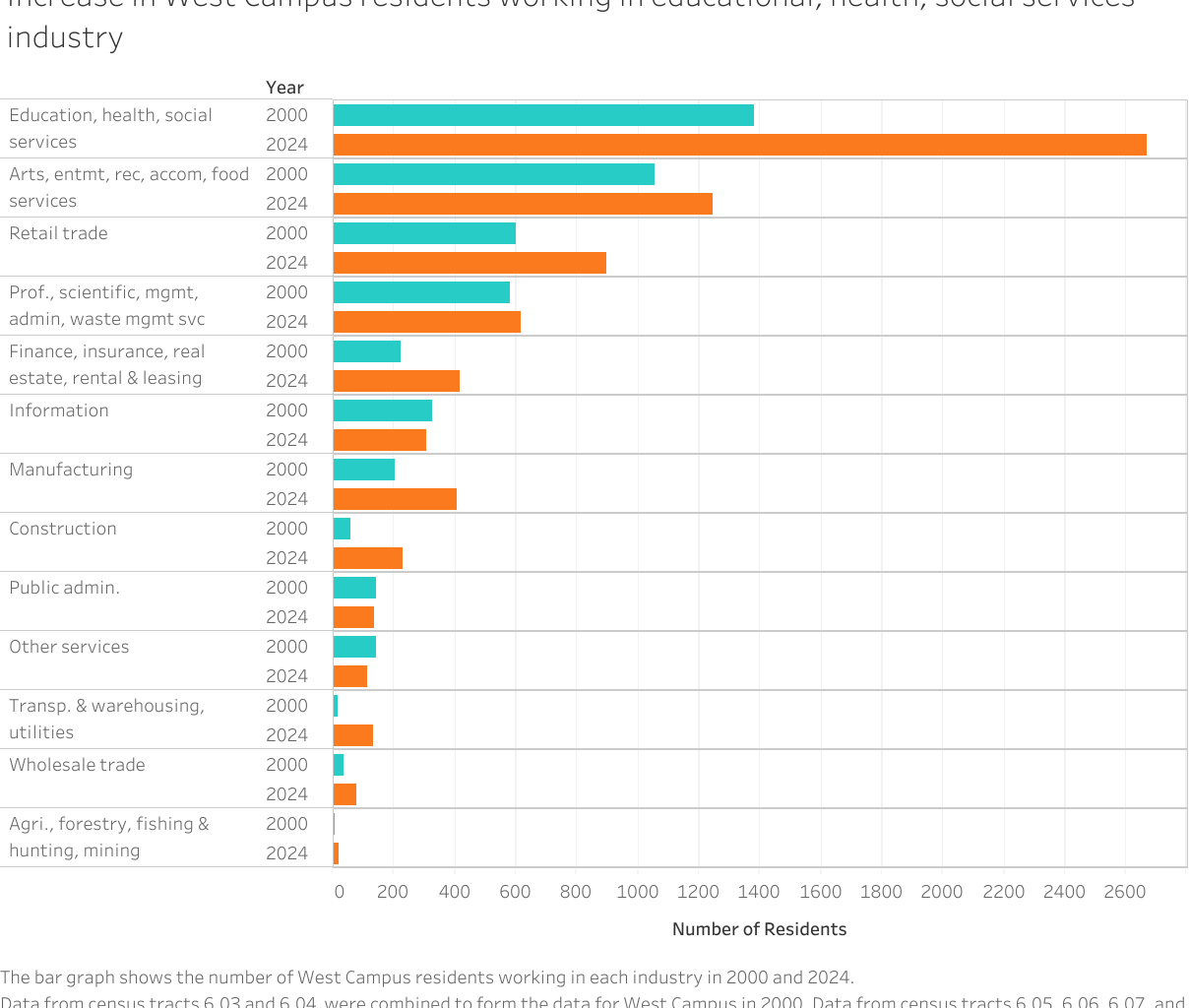
Swinton-Ginsberg said students have been the predominant group in West Campus since 2000, but the area has grown more racially diverse.
“West Campus — that census tract is no longer predominantly white, and is one of the few census tracts in Austin that’s actually predominantly Asian,” Swinton-Ginsberg said. “It’s a very different dynamic in West Campus than it is in the rest of the city, because students are obviously a slightly different population.”
The city plans to update the StoryMap as new anti-displacement programs and new data become available to continue reflecting and helping Austin residents, Swinton-Ginsberg said.
Marla Torrado, division manager for Austin Housing’s Displacement Prevention Division, said the StoryMap just confirms what most already know about Austin’s unaffordable housing market.
“It’s not until you see it reflected in an analysis or a map that it really hits you,” Torrado said.