
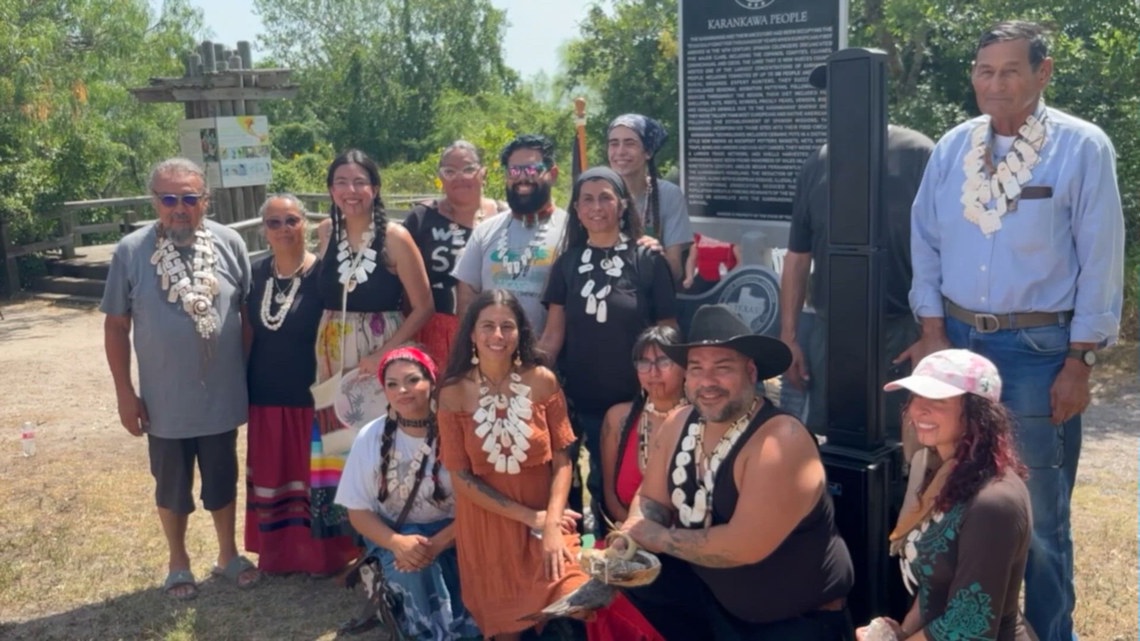
The Karankawa Tribe of Texas unveiled a new state historical marker Saturday, replacing a 1976 marker they say misrepresented their history.
CORPUS CHRISTI, Texas — The Karankawa Tribe of Texas celebrated a historic milestone Saturday as a new state historical marker was unveiled in Corpus Christi, replacing one tribal members and historians said misrepresented their history for nearly 50 years.
The original marker, installed by the state in 1976, described the Karankawa people using terms including “primitive,” “savage” and “cannibal.” Tribal members said those descriptions perpetuated harmful stereotypes and ignored decades of historical research.

This story continues below.
“It uses the word primitive and savagery, cannibals, a lot of very harmful stereotypes,” said Dr. Peter Moore, a history professor at Texas A&M University-Corpus Christi. “We’ve come a long way. Historians have done a lot of work to correct the record. Those things are filtering down into the popular culture, but there’s still a lot of work to do.”
Enrique Gonzalez of the Karankawa Tribe said claims that the tribe practiced cannibalism have long been used to justify violence against Native people.
“The Karankawas were very healthy, they had an array of all kinds of food. This is the land of plenty, you will not starve,” Gonzalez said. “You didn’t have to kill a white guy and eat him, there’s no need for that.”
Moore said historical accounts show those narratives also helped justify the tribe’s extermination.
“Stephen F. Austin said the solution to the problem of the Karankawas … is to exterminate them,” Moore said.
RELATED: Apache leaders reunite in Corpus Christi to honor history and strengthen unity
For Gonzalez, who said he experienced discrimination growing up during the 1960s and 1970s, the language on the original marker reflected attitudes he had encountered throughout his life.
“They would come up and tell you, ‘Go back to Mexico,'” Gonzalez said. “I said, ‘I’m Native American. How can I go to Mexico?'”
The new marker was developed with input from the Karankawa Tribe and presents a more accurate account of the tribe’s history and enduring presence along the Texas Gulf Coast.
“We should be a part of writing our own story,” said Sandra Love Sanchez, the tribe’s environmental liaison. “We’re not just a footnote in the history books. We are still here, guys.”
For tribal members, replacing the marker represents more than correcting historical language. They say it is a public acknowledgment that the Karankawa people survived attempts to erase both their history and their identity.