
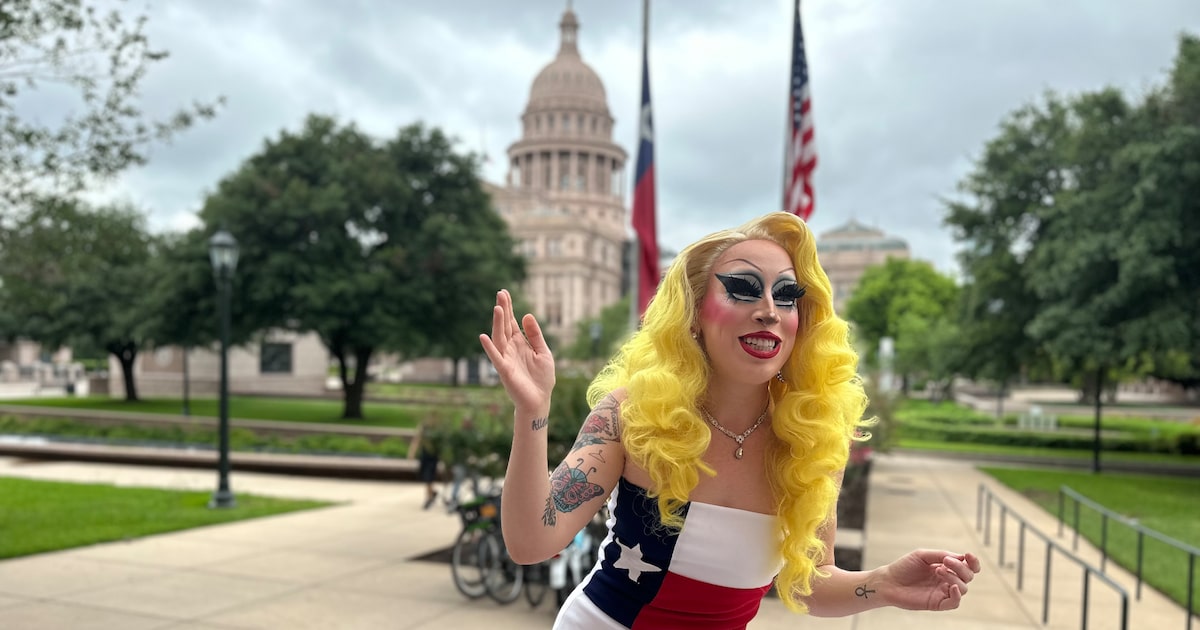
AUSTIN — A federal appeals court ruled Thursday that a previously blocked law designed to ban public drag performances can now go into effect.
A panel of judges on the 5th U.S. Circuit Court of Appeals reversed a 2023 ruling from a Houston federal judge that had blocked enforcement of the law indefinitely.
In a divided ruling, the court found that the plaintiffs – LGBTQ pride organizations and drag performers – largely failed to prove that the law would adversely affect them.
The law at the center of the suit – 2023’s Senate Bill 12 – prohibits public sexual performances in front of minors. The bill’s author and supporters have said that the bill would effectively ban all drag performances in public or in the presence of minors.
Political Points
The court was divided, with Judge Kurt Engelhardt, an appointee of President Donald Trump, and Judge Leslie Southwick, who was appointed by former President George W. Bush, signing on to the opinion that ordered a Houston federal court to reconsider the case under a free speech framework established by a 2024 U.S. Supreme Court decision on a social media regulation law.
“The district court did not conduct this analysis, nor did the parties brief the proper standard or adequately develop the record,” Engelhardt wrote. “Consequently, we are unequipped to undertake this task in the first instance, and remand for the district court to do so.”
Attorney General Ken Paxton cheered the ruling.
“I will always work to shield our children from exposure to erotic and inappropriate sexually oriented performances,” Paxton said in a news release. “It is an honor to have defended this law, ensuring that our state remains safe for families and children, and I look forward to continuing to vigorously defend it on remand before the district court.”
It was unclear if the plaintiffs would appeal the decision to the Supreme Court. They did not immediately respond to messages seeking comment.
Although the lawsuit challenging the law is not yet dead, the appeals court dismissed any challenges to the criminal penalties that SB 12 created. Violations are a class A misdemeanor, carrying a possible penalty of up to one year in jail and a $4,000 fine for performers.
The ruling stopped short of saying whether drag performances are protected under the First Amendment, which was central to the 2023 ruling that halted the law from taking effect. However, Engelhardt, writing for the majority, said an argument could be made that drag performances, especially those featuring nudity, are not a protected form of expression.
“We have genuine doubt, however, that pulsing prosthetic breasts in front of people, putting prosthetic breasts in people’s faces, and being spanked by audience members are actually constitutionally protected – especially in the presence of minors,” he said.
Judge James L. Dennis, an appointee of former President Bill Clinton, dissented in part, stating that the ruling “turns a blind eye to the Texas Legislature’s avowed purpose: a statewide ‘drag ban.’”
Dennis said the majority’s doubt over free speech protections to drag performances was a “gratuitous dictum” that “runs headlong into settled First Amendment jurisprudence.”
“Drag – a costumed, choreographed, and frequently parodic performance that speaks in the idiom of gender – plainly participates in that protected tradition,” he stated.