
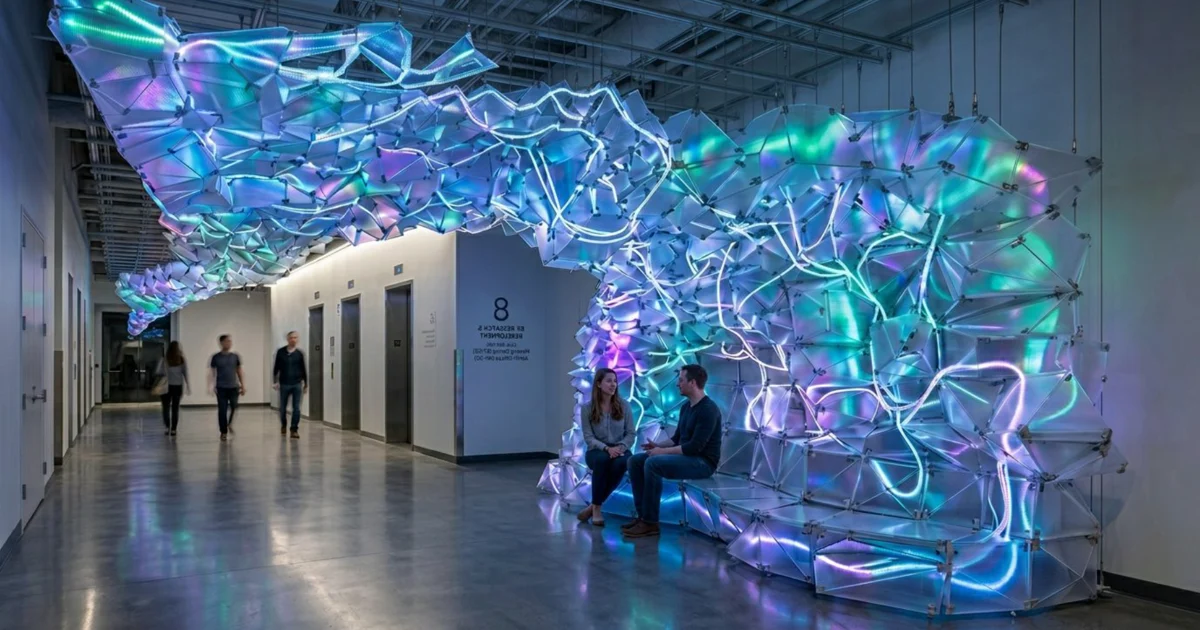


An artificial intelligence rendering designed by Shermeen Yousif’s student is depicted.
Photo courtesy of Shermeen Yousif
Correction
In a previous version of this article, artificial was spelled incorrectly.
Generative Artificial Intelligence, also known as GenAI, has been an area of research for decades, dating back to the 1960s with Joseph Weizenbaum’s creation of ELIZA, one of the first computer programs designed to understand natural language.
GenAI then gained public traction in 2022 with ChatGPT, according to the World Intellectual Property Organization.
Now, four years after ChatGPT was made available to the public, Shermeen Yousif, director of the Performative AI Lab at UTA, is pushing the boundaries of the uses of GenAI in the field of architecture.
Through her research, Yousif looks to integrate GenAI and robotics to pursue decarbonization and ecological design in the hopes of advancing both creative exploration and high environmental performance in architecture, according to a UTA press release.
Yousif’s research is one of six currently being highlighted by the Research Enhancement Program at UTA.
The program offers grants to act as seed funding for launching new research and serve as a foundation for future research and funding from external sources. The program dispersed more than $150,000 in 2025, according to UTA’s research website.

Photo courtesy of Shermeen Yousif
Yousif’s research looks to give students and designers a way to better explore and showcase their concepts through the variety of AI models available. Yousif said, AI is used more as a tool to help students break out of limited thinking when it comes to conceptualizing designs.
“They connect multiple AI models, and each model is used specifically for a specific design task,” Yousif said. “They become like a maestro, like a composer of notes.”
Recognizing the ethical issues some may have around AI usage, Yousif said she requires her students to input their own data, sketches and information into the models or acknowledge if a precedent is used in the conception of designs as a way to ensure there is no plagiarism of other artists’ works.
Yousif said the concept for her research began during her PhD program at Texas A&M, where she studied machine learning for cluster analysis for generative systems.
The project developed further during the COVID-19 pandemic as professors and designers became homebound.
“They were looking at that [AI] as a path because they don’t have access to their labs, fabrication or whatever,” she said. “They became excited about AI.”
Now, 12 years of work and data collection have culminated in Yousif’s newest addition to UTA.
On Aug. 17, UTA will be home to a new Performative AI Lab. The lab will house an LED screen, spanning roughly 29 ½ feet and standing at roughly 6 ½ feet, that students can use for the graphic representation and multimodality of the AI models that they will use for architectural design.
The LED screen will also be used as a way for students to showcase their designs and projects. Rather than having the limited viewing of a poster, Yousif looks to use the screen in a more immersive way.

An artificial intelligence rendering designed by Shermeen Yousif’s student is depicted.
Photo courtesy of Shermeen Yousif
“You can see the 3D of the building. You can enter the building,” she said. “You can have this immersive environment, and that’s hard to communicate in a still image, in a poster.”
Along with the LED screen, the lab will also house a robotic arm with an interchangeable tip, allowing the arm to grab, scan or print items on six different axes.
The next phases Yousif looks to go through are system integration and calibration, robotic fabrication trials and performance analysis, according to the press release.
“Interaction with AI is important because if you are slow, and if you don’t attempt to follow this or be part of this paradigm shift, you will have a huge disadvantage,” she said.
Though only prototypes are being created and tested, through tests and peer-reviewed publication, the project aims to garner further grants, allowing the findings to scale up the project from prototypes to full-scale building systems.
“The question is no longer who designs, but how human and machine intelligence orchestrate a design together,” Yousif said in the release. “And whether that process can expand creative exploration while driving architecture toward decarbonization and genuinely ecological design.”
@noahloganlittle