
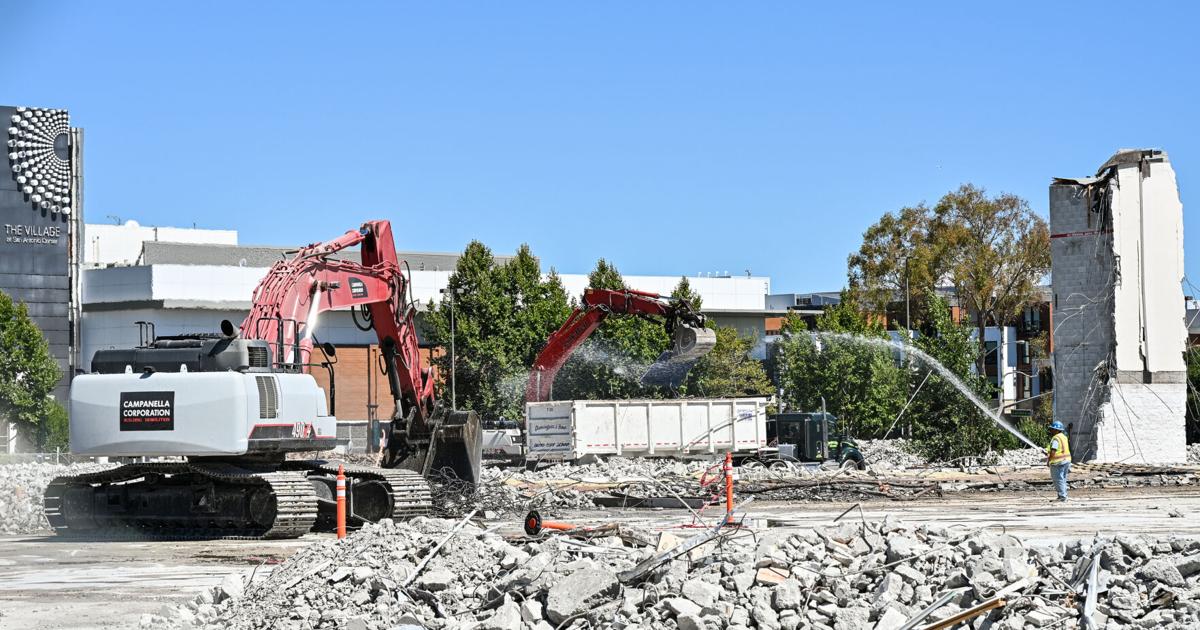
Construction is underway at Los Altos School District’s (LASD) future San Antonio campus, but district officials and Bullis Charter School (BCS) remain divided over whether the long-awaited “10th site” will provide a long-term solution to their longstanding facilities dispute.
Demolition began in June at the 11.7-acre Mountain View site, which once housed the San Antonio Shopping Center. The planned 607-student TK-8 campus is scheduled to open in fall 2028 and remains on schedule and on budget, according to district officials. Underground utility work is expected to begin in the coming months, with vertical construction anticipated around January.
Plans call for 29 classrooms, administrative offices, a library, outdoor play areas, a gym and a multipurpose room.
While construction has begun, the question of who will use the campus has not been finalized.
LASD officials have said BCS remains their preferred occupant. The district’s vision is for the new campus to become BCS’ primary site, with remaining BCS students continuing to use space at Egan Junior High School.
District officials say that arrangement would address multiple needs: providing BCS students with newer facilities while allowing LASD to transition Blach Intermediate School and Egan into middle schools for district students.
BCS Executive Director Maureen Israel said the new campus could be part of a broader solution. She said a two-site arrangement could be workable if it provides reasonably equivalent facilities — including instructional, specialized and outdoor spaces — for all BCS students.
BCS served 1,095 students during the 2025-2026 school year, including 910 students within LASD boundaries and 185 from outside the district, Israel said. According to LASD data, out-of-district students represented about 6% of BCS’ in-district enrollment from 2014-2015 through 2020-2021; that share has since increased to about 17% of total enrollment as in-district enrollment declined.
Because the new campus is designed for 607 students, Israel said it would not accommodate BCS’ entire enrollment.
“Anything that ignores hundreds of families and students is not a solution,” Israel said in an emailed response.
The disagreement centers largely on how Proposition 39, a state law governing charter school space, applies to BCS. The charter school argues LASD has not provided equivalent access to classrooms and other campus resources and estimates it should receive significantly more space.
District officials dispute that analysis, saying Prop. 39 requires facilities only for in-district charter students and that LASD and BCS have operated under mutually agreed-upon facilities agreements since 2014 rather than using the Prop. 39 process.
Finances are another point of disagreement. BCS officials argue the district’s financial picture changes when accounting for state funding formulas and LASD’s status as a basic aid district. Israel said BCS enrollment affects the district’s per-student funding calculations because local property tax revenue is spread across fewer district-enrolled students.
LASD officials, however, say BCS creates significant costs, including about $12 million in annual per-pupil transfers, shared parcel tax revenue and other expenses. They estimate the total annual cost associated with BCS at nearly $14 million.
Both sides say they remain in discussions about a broader facilities agreement. LASD said the discussions are taking place under a confidentiality agreement requested by BCS. Israel said BCS remains focused on reaching a negotiated agreement but may still need to begin the Prop. 39 process to meet state deadlines if an agreement is not reached in time.